
Online Divorce
Divorce smartly without a lawyer. Save yourself $10,000+.
- 100% Legit Divorce Program
Can you Truly Divorce in California without Going to Court?
Yes you can avoid a court in California for divorce or legal separation. By avoiding the court the people mean whether they go before a judge at any point to get a divorce.
Even you can complete your entire divorce from start to finish without a lawyer. Avoiding the court and getting a divorce without a lawyer requires agreeing with your spouse on all issues. Such a divorce is known as uncontested divorce.
Avoiding the court and having to appear as a family court judge keeps your case relatively easier.
Whichever type of divorce, even if you avoid going to court for a hearing or trial, you still will need to file your paperwork. You can do this either by going to the courthouse or choosing another filing service, like online filing or mailing.
For those with low-conflict, simple assets, or shorter marriages, having a simple divorce process is ideal. And, fortunately, can be achieved with online services and online filing methods that are now available, like The Complete Divorce.
At The Complete Divorce we assist parties of all socio-economic backgrounds to get divorce using our Fully-Guided Divorce program that does not require hiring a lawyer or going before a judge at any point. The program is completely expert-led and helps parties finish divorce from start to finish in just $49.99/mo. Subscribe to start your divorce.
Start your FL-100 Petition. Our software is easy to use – led by California divorce attorney, Dina Haddad.
These two answers rebuild the rest of the interview. Whole sections appear or disappear — you'll never be asked something that doesn't apply to you.
Every answer saves the moment you type it. Close the tab, come back next week, land on the same question.
These two answers tick the case type and the residency box on page 1 of FL-100. Next come your dates.
The date of separation is when you decided to no longer be married (both by words and actions).
The date of separation must be after the date of marriage.
These five answers fill page 1 of FL-100 — the case type, the residency box, both dates and the children box. Print the form from the panel on the right and they are already on it.
Building your FL-100…
Warning
To file for divorce in California, at least one spouse must have lived in the state for six months and in the county where filing for at least three months to file for divorce. This doesn't apply to legal separation. Consider changing your response.
How California Law and Systems Supports Completing Divorce Outside The Court? And is this Practice So Common?
| Aspects | Divorce Mediation | Collaborative Divorce | Joint Petition | Summary Dissolution | Uncontested Divorce |
|---|---|---|---|---|---|
| Court Appearance | No | No | No | No | Rarely, if ever |
| Cost | $3,000–$8,000 shared | $15,000+ per spouse | One Court Filing | Court Filing Fee | $435–$450 per filing + Others |
| Category | ADR (alternate dispute resolution) | ADR (alternate dispute resolution) | Court Filing Pathway | Court Filing Pathway | Court Filing Pathway |
| Requirements Level | No Requirements. Commitment to negotiation | No Requirements - Just Commitment | No Stricter Requirement – Regardless of Mar Length, Children | Very Strict Requirements | No Strict Requirements |
| Serving the Spouse | Depends on Filing Pathway Used | Depends on Filing Pathway Used | No (joint filing) | No | Yes — Service Required |
| Attorney Requirement | Optional – But Mediator is preferred | Required — each side has their own | No – Typically DIY | No — Optional | No — Optional |
California’s Family Code is deliberately built in a way that amicable and mutual divorce never needs a courtroom. California’s no-fault dissolution, which just requires the marriage to have the “irreconcilable differences” is sufficient ground. You don’t need to prove faults and wrongdoings to court and even no testimony is required.
Secondly, as per California Family Code §2336 and California Rules of Court, Rule 5.405 a judge is expressly authorized to review, sign, and enter a divorce judgment based on written declarations alone. This clarifies that parties don’t need to have the hearing, appearances and meeting the judge.
You would be amazed to know that 90–95% — family law cases resolve without trial as the majority of the people want to reach agreement and avoid conflicts. And it can happen easily if couples decide to divorce or legally separate and negotiate the terms through a mediator, through collaborative counsel, or through an online divorce program like The Complete Divorce.
Couples can sign an MSA and submit the full judgment package to the clerk and once the judicial officer reviews it, the divorce can be finalized after six months and one day. Let’s see each of the methods that have the potential to resolve amicable cases outside the court.
1. Divorce mediation
Divorce mediation has a 90% probability of helping pirates avoid the court. But when it stalls, parties have to either retry it or have to rely on the court for a final decision.
What happens in divorce mediation: The mediator — a single neutral professional — helps both spouses work through the terms of divorce or legal separation, such as dividing property and debt, spousal and child support, and a parenting plan. Once you agree, the mediator drafts a Marital Settlement Agreement (MSA) and it gets filed into the court. A judge reviews it to finalize a divorce.
How parties avoid court using mediation: The mediator performs the communication, fact-development, and drafting functions that a courtroom otherwise absorbs. By the time the paperwork reaches the clerk, every contested issue is already resolved. There is nothing left for a judge to decide.
Example: In re Marriage of Assemi (1994) 7 Cal.4th 896 held that mediated family law settlements can be enforced summarily under Code of Civil Procedure §664.6.
Why you might still end up in court: Mediation stalls on a single issue (often custody or business valuation), one party walks out, or the MOU is signed but one spouse refuses to sign the formal MSA. In those cases, the case pivots into litigation — but the mediation work is rarely wasted; issues already resolved usually stay resolved.
2. Collaborative divorce
Collaborative divorce has 85–90% probability that parties may avoid the court.But the overall process can be expensive itself and if it fails the divorce becomes very expensive.
What is collaborative divorce? It is a team-based process that helps parties out of court. In this form of ADR (alternative dispute resolution), each party hires their own collaboratively trained attorney and brings in independent or shared a financial specialist, a divorce coach, and a child specialist.
How the procedure eliminates court: The disqualification clause is the mechanism. It aligns every professional’s economic incentive with settlement — the entire team loses the engagement if litigation begins. This creates unusually strong pressure toward resolution.
Why you might still end up in court: When collaboration fails, both parties must start over with new attorneys, which is expensive and demoralizing. Failure is uncommon but the downside is significant — it’s the reason collaborative divorce is chosen carefully rather than as a default.
Cost and Timeline: Collaborative divorce costs around $15,000+ per spouse and is expensive than mediation but cheaper than litigation. It costs come up because of more professionals that get involved into the process. While the timelines depend on how complicated things are, they generally run several months, right alongside the six-month waiting period.
3. Joint petition for dissolution
This is the big thing for amicable couples seeking mutual divorce as the Senate Bill 1427 introduced on Jan 1, 2026, created a new joint petition for dissolution, which has many benefits and amongst two are that; (1) it lets cooperative spouses file together as co-petitioners, (2) Couples pay a single filing fee.
While traditionally, in California, one spouse has to be petitioner while one has to be respondent, no matter how cooperative and friendliest couples were — This approach has been costlier and makes split look like a fight.
The joint petition has no tight eligibility restrictions unlike summary dissolution as it allows any couple that agrees on everything, no matter how long you were married, whether you have kids, or how complicated your finances are.
The trade-off is that it still requires full financial disclosures (the Declaration of Disclosure, FL-140, and its supporting schedules), and you still wait out the mandatory six months.
4. Summary dissolution (for the simplest cases)
Summary Dissolution has the highest probability (95%) that you would finish the case without setting foot in the courtroom. But it is typically reserved for couples with short marriages, no children, no real property, limited debt and property under statutory caps, and mutual waiver of spousal support. Indeed, it has stricter criteria.
How the procedure eliminates court: The joint filing removes the adversarial structure entirely. There is no petitioner and respondent — only two co-filers submitting one packet. Because eligibility is narrowly defined and both spouses sign a written property agreement upfront, the judge has no adjudicative role. The case is administrative from start to finish.
But be careful: If the clerk discovers that you have not fulfilled the eligibility, you may require the hearings in the court.
How long it takes: Like other California divorces, summary dissolution also has a six-month cooling-off period, which cannot be waived. The clerk handles the paperwork and mails you the judgment.
5. The standard uncontested divorce
This is the most used pathway and the parties have 90-95% probability of avoiding the courtroom. This type of divorce is typically the cheapest of all types of divorce.
What is uncontested divorce?In a standard uncontested divorce, one spouse files the Petition (FL-100) and the other responds, or the couple works out a Marital Settlement Agreement and hands it to the judge for a signature.
How the procedure eliminates court: Family Code §2336 and Rule 5.405 give the judge authority to decide the case on declarations alone. The MSA does the substantive work — property division, support, custody — that a trial would otherwise do. The judge’s role compresses to reviewing the package for legal compliance.
When might you end up in court? In the judgment packet or divorce forms have mistakes or you did not follow the California courts procedures such as having the defective disclosures, ambiguous property division, or spousal support terms may require you to enter the courtroom.
The Complete Process of Getting a Divorce Outside the Court
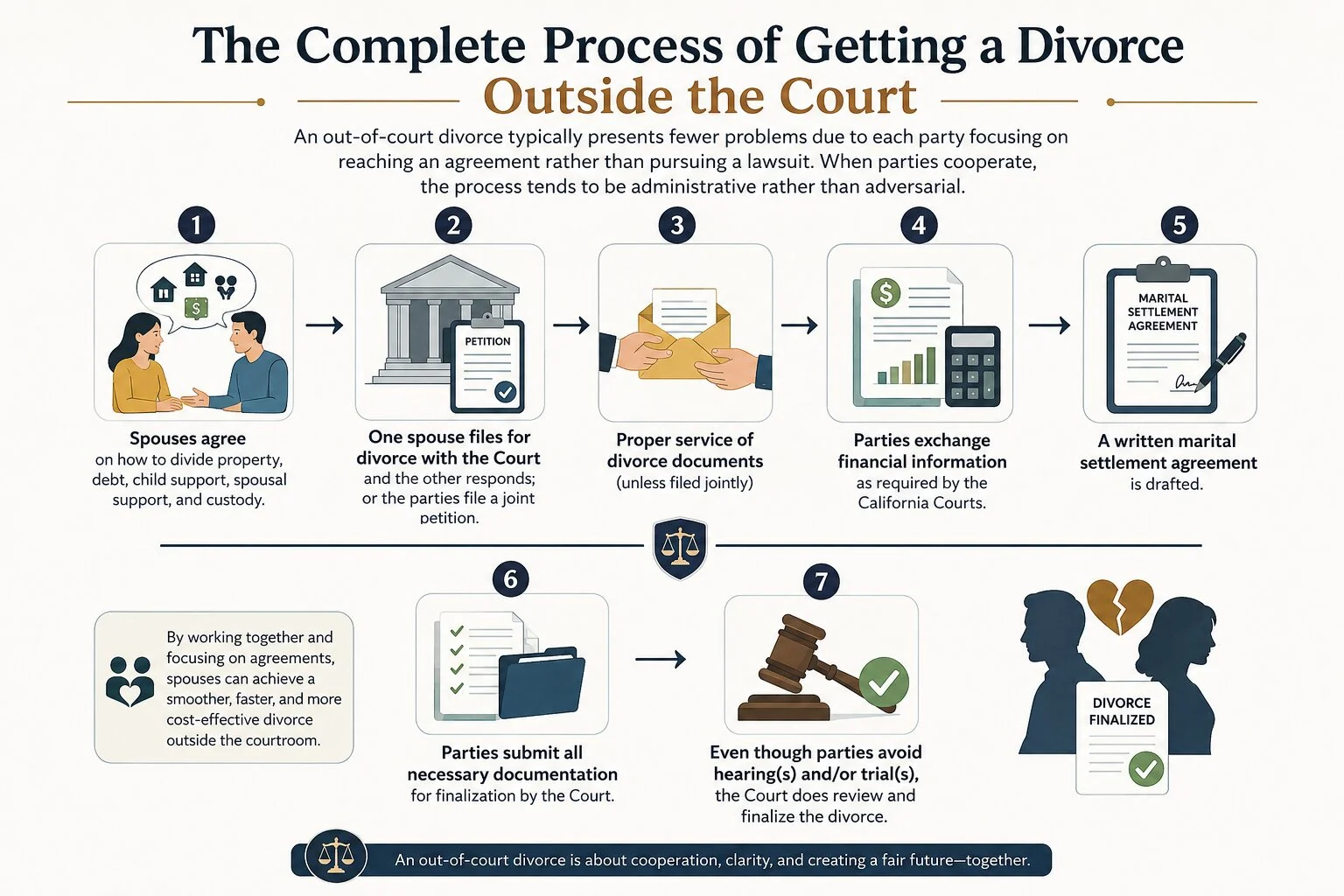
An out-of-court divorce typically presents fewer problems due to each party focusing on reaching an agreement rather than pursuing a lawsuit. When parties cooperate, the process tends to be administrative rather than adversarial. The typical process for most uncontested divorces features:
- Spouses agree on how to divide property, debt, child support, spousal support, and custody.
- One spouse files for divorce with the Court and the other responds; or the parties file a joint petition.
- Proper service of divorce documents (unless filed jointly)
- Parties exchange financial information as required by the California Courts.
- A written marital settlement agreement is drafted.
- Parties submit all necessary documentation for finalization by the Court.
Even though parties avoid hearing(s) and/or trial(s), the Court does review and finalize the divorce.
When Divorce Might Require Court Proceedings?
Divorce litigation usually occurs when couples do not agree on primary divorce issues or need legal protection. Litigation increases the stress and expense of divorce; delays it, and exposes private aspects of a couple’s life to public scrutiny.
The lengthy litigation process can also negatively impact a parent-child relationship and increase the financial burden through attorney fees, hearings, and discovery.
Court involvement becomes more likely when there is:
- Dispute about child custody.
- The potential for hidden or deceitful behavior with respect to assets and/or finances.
- Concerns regarding domestic violence.
- Dissatisfaction with how alimony/support or asset/property distribution has been addressed.
However, not all disagreements go to trial. Instead, many couples use alternative dispute resolution methods, such as mediation, negotiated settlement agreements, or collaborative law, before letting the case escalate to trial.
Read More: Cheapest way to get divorced in California.
Take Control of Your Divorce Without Setting Foot in Courtroom
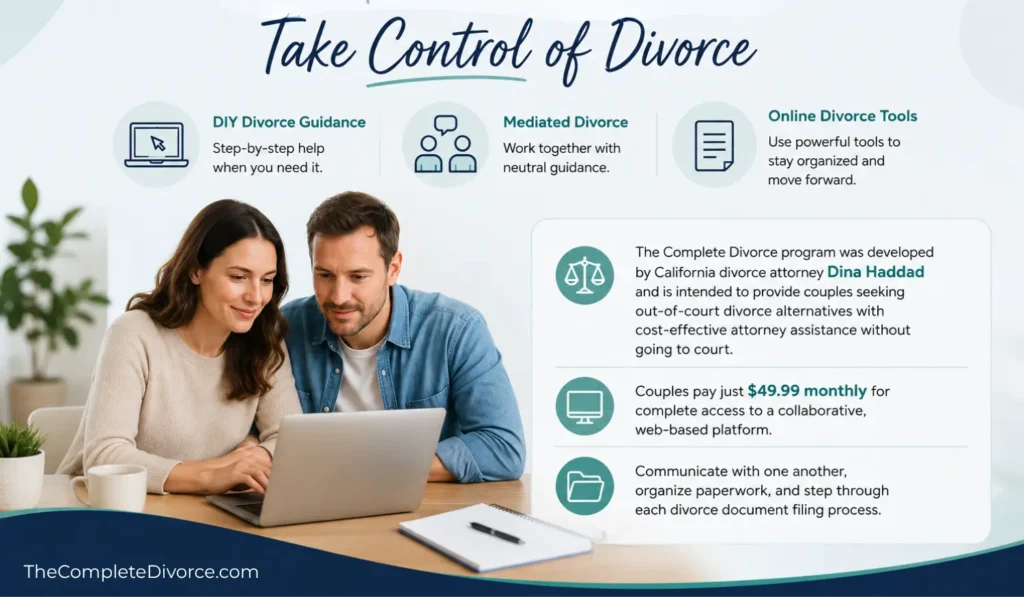
The actual part of most DIY divorces in California is not finishing the forms; rather, it’s about completing the divorce without setting foot in court, without hiring a lawyer, and without facing court rejections.
Before you file, know which type of divorce suits you best and which can help you divorce outside of court. The Complete Divorce fills the gap for couples who wish to start on their own and complete it without courts and lawyers.
From divorce filing (where couples start) to getting a divorce decree, we guide couples through our fully guided divorce program. We assist parties with divorce forms, paperwork review, filing, MSAs, and parenting plans. We help parties correct errors on their forms. This is how we fill the gap and let parties move forward confidently.
Trust the program, as it was developed by California family law attorney Dina Haddad to give couples attorney-built guidance they can trust at a fraction of the usual cost. Start your divorce for just $49.99/mo today.

Written By:
Dina Haddad
Divorce Attorney — Mediator & Founder of The Complete Divorce
“Hi. I’m Dina Haddad, a divorce attorney-mediator here in California. I’m so tired of couples not having a process that’s easy to complete their divorce. They are getting lost, wasting time and money, and beyond frustrated with their results.
That’s why I created The Complete Divorce, California’s premier online divorce program. I took my successful mediation practice and condensed it into an affordable and winning program.”
FAQ — Divorce Without Going to Court
Q. Can you file for divorce without court?
No. Although divorces may be finalized without a hearing or a trial, the divorce documents as well as the final Judgment will be processed by California Courts.
Q. What is a silent divorce?
There is no such legal term called a “Silent Divorce”. However, the term is used informally to refer to a couple that has not filed or is not pursuing the legal divorce process. The couple are emotionally detached from each other and continue to be married and do not file for divorce.
Q. What are the alternatives to court divorce?
The most common alternatives to court divorces include divorce mediation, collaborative divorce, negotiated settlements, and online services that allow amicable couples to complete the process without litigation.
California premier divorce program.
Making California divorce simple and lawyer-free.
- Filing & Review Support
- 1-on-1 Divorce Meeting
- Child support calculations
- MSA Filing Support
 ⭐⭐⭐⭐⭐
⭐⭐⭐⭐⭐
2000+ divorced without a lawyer.

Contents Understanding Narcissism Choose Right Mediator & Rely on Professional
Divorce is unchartered territory. It’s a complicated and unfamiliar legal

Divorce is unchartered territory. It’s a complicated and unfamiliar legal