
Read our blogs to get tips on California uncontested, online, and DIY divorce.
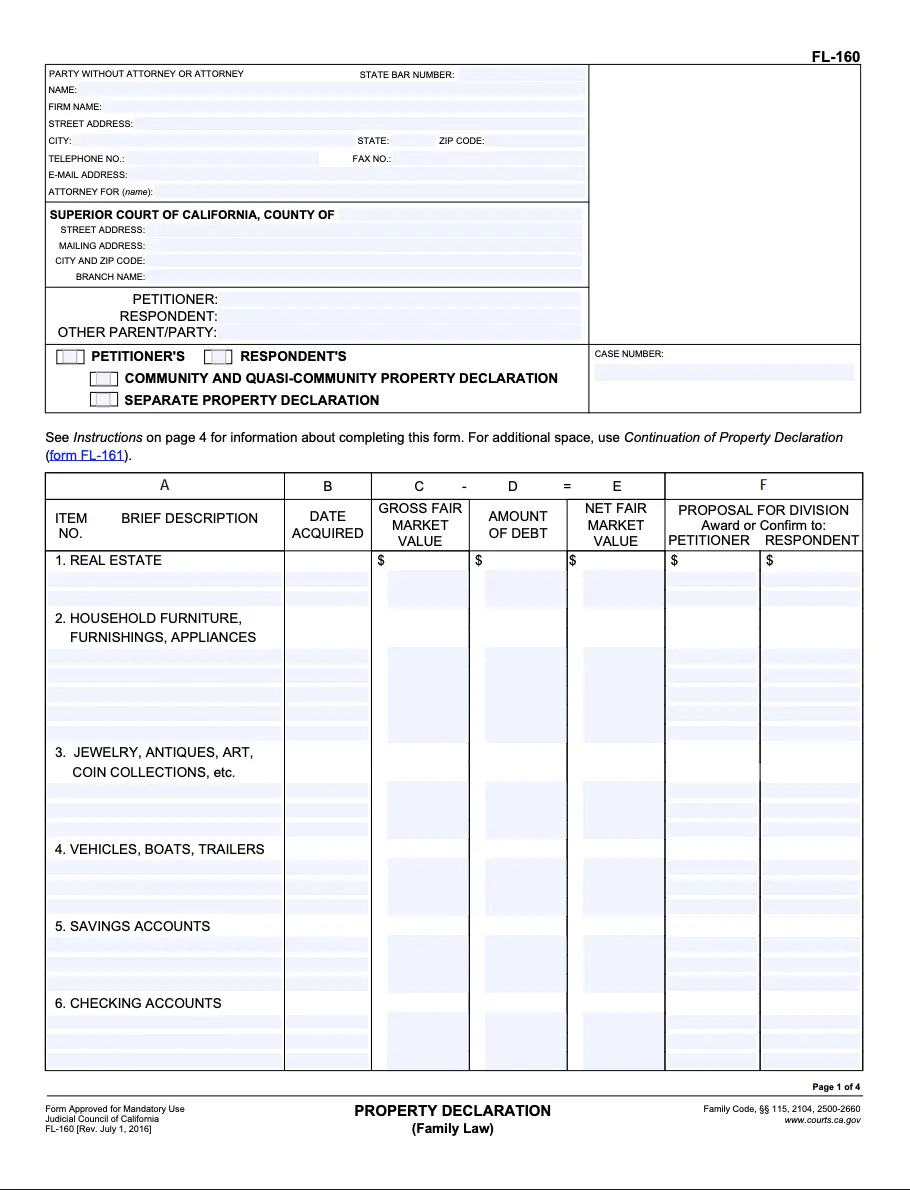
California’s FL-160 can look confusing, thanks to the four-page grid of assets, debts, and dollar columns. To make things even more confusing, there’s often uncertainty around whether to use this form or FL-142.
This form also follows a clear structure; it lists what is owned and owed and then proposes who receives it. There is a penalty of perjury, so answering accurately is very important.
This guide can help with that. It will also help you decide when to use each form, and prevent you from making common filing mistakes.
Preparing your divorce forms? Skip the guesswork and let The Complete Divorce prepare your property forms. Get more help with our divorce expert’s Pre-divorce checklist and DIY divorce checklist before you start your divorce.
Form FL-160 is the Judicial Council of California’s Property Declaration. It provides descriptions of assets and debts relating to the marital estate, their respective values, and each spouse’s proposed division of such.
The court uses the information provided to determine whether a specific division of the community property is equitable.
In addition, FL-160 is a financial disclosure schedule. You may serve it in lieu of the Schedule of Assets and Debts (FL-142), attach it to a Petition or Response, or include it in a default or judgment package.
The form consists of two separate declarations; Community and Quasi-Community Property Declaration and Separate Property Declaration.
Each declaration must be completed separately. The first two pages list examples of personal and real property in items 1-18. Debts are listed on page three in items 19-26. Page four contains instructions. Learn more about other California divorce forms.
Making Your California Divorce Paperwork Easier Than Ever
Want Help with FL-160? Let us be on your side.
Get your paperwork error free with The Complete Divorce expert-led sessions, divorce workshops, and divorce forms video tutorials.
 ⭐⭐⭐⭐⭐
more than 2,000 California couples helped
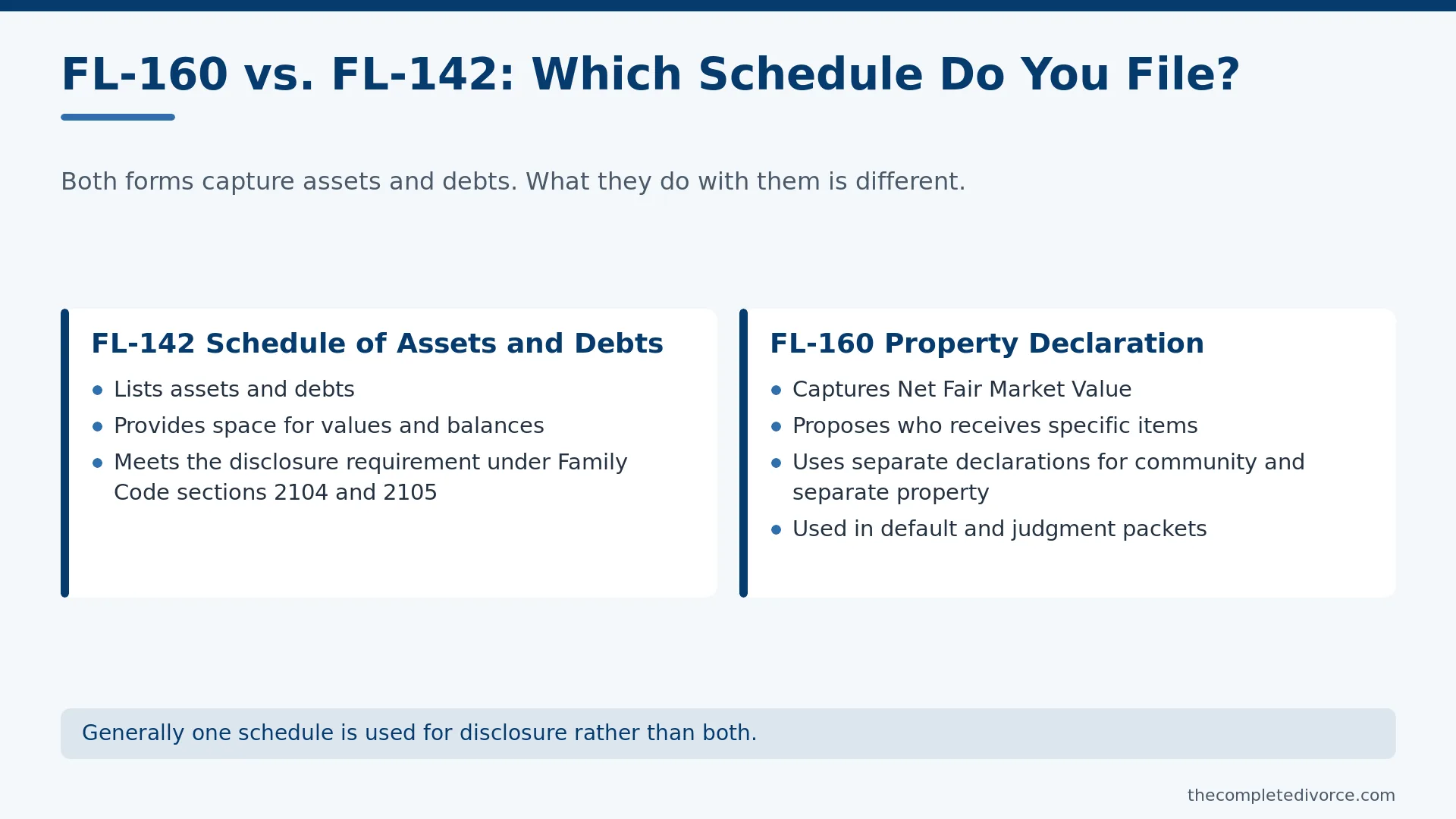
Both forms capture assets and debts. FL-142 provides a space to capture their values and balances. FL-160 captures Net Fair Market Value and proposals to divide community property. It also uses separate declarations for community and separate property.
Generally, one schedule is used for disclosure as opposed to both. FL-160 is used to propose who receives specific items. It is also used in default and judgment packets to help the court order who receives the items.
Requirements vary depending on the purpose for which the form is used. For disclosure purposes under the Family Code Sections 2104 and 2105, a schedule is required, and FL-142 or FL-160 would meet that requirement.
Attaching FL-160 to a Petition or Response is not required. Courts would require the form for use with FL-165 or FL-180 in a default or judgment situation.
If a category of an asset or debt is not applicable, place “None” in the category rather than leaving the category blank.
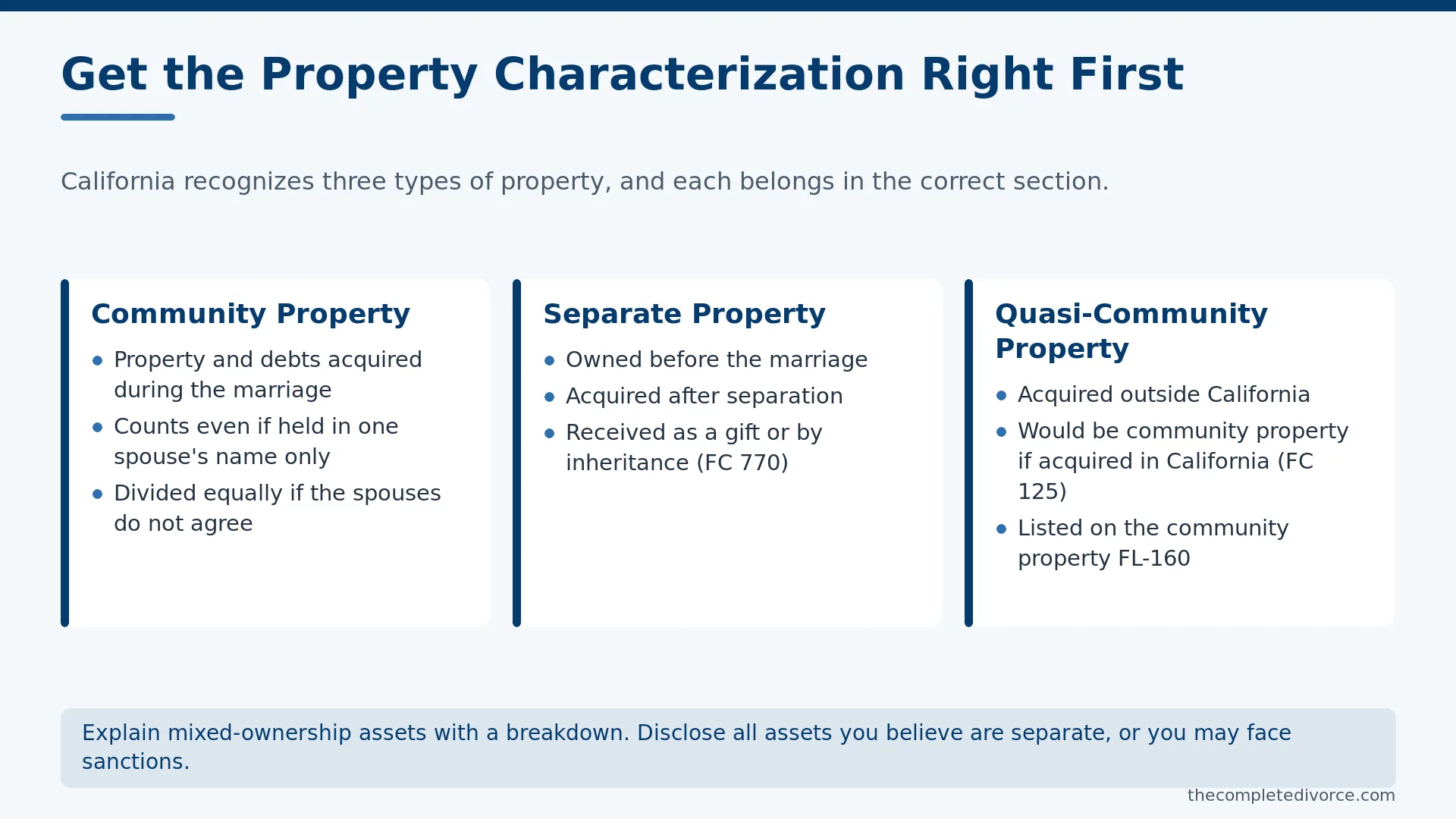
Once you have completed FL-160, make sure each asset and debt is classified in the correct location. California recognizes three different types of property. Each should be classified in the appropriate section.
Community property in California generally consists of all property and debts acquired during the marriage, even if it is only in one spouse’s name. If the court divides the community property and the spouses do not agree on how it should be divided, it will be divided equally.
Separate property generally consists of all property owned prior to the marriage, all property acquired after separation, and all property received by a spouse as a gift or by inheritance (FC §770).
Quasi-community property is property acquired outside of California that would be community property if acquired in California (FC §125).
Some assets can have mixed ownership. An asset that is tracing property should be explained and the breakdown of ownership should be described. Disclose all assets you believe are separate, or you may face sanctions.
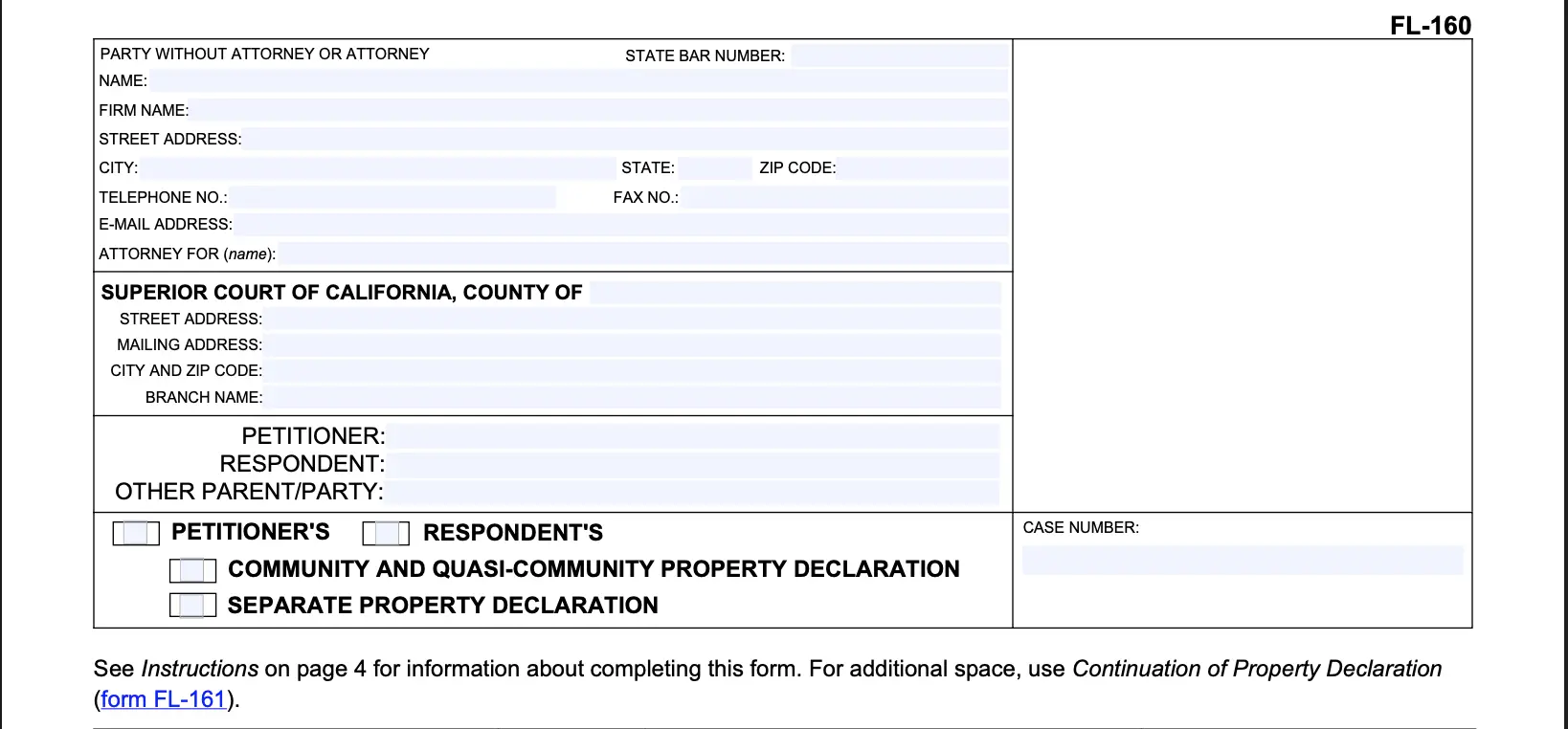
Find your identification details at the top of FL-160 and copy the caption from your FL-100 (Petition) or FL-120 (Response) to include both parties’ names, court branch and case number.
Provide your attorney’s information in the top-left box. If you are pro per, provide your information in the top-left box under “Party Without Attorney.”
Check either box for Petitioner or Respondent to indicate whose declaration you will be submitting. Only one box should be checked.
There are two types of declarations. For property that is classified as community or quasi-community, a declaration should be made as a “Community and Quasi-Community Property Declaration.”
For property that is classified as the separate property of a spouse, a declaration should be made as a “Separate Property Declaration.”
If you have a combination of both in your property, you should complete two FL-160 forms. Do not combine them in one declaration.
Finally, enter the case number in the top right corner. The case number should match the case number on the other divorce documents that you complete. A discrepancy will cause a delay in processing.
Page 1 and 2 of FL-160 have a six-column table with 17 asset categories and totals lines. Each asset gets a row with info entered across columns A-F. If you run out of space you can use FL-161, the Continuation of Property Declaration, to list additional assets. In item 17, you enter the totals for assets listed on the continuation. Item 18 shows the totals for the asset columns.
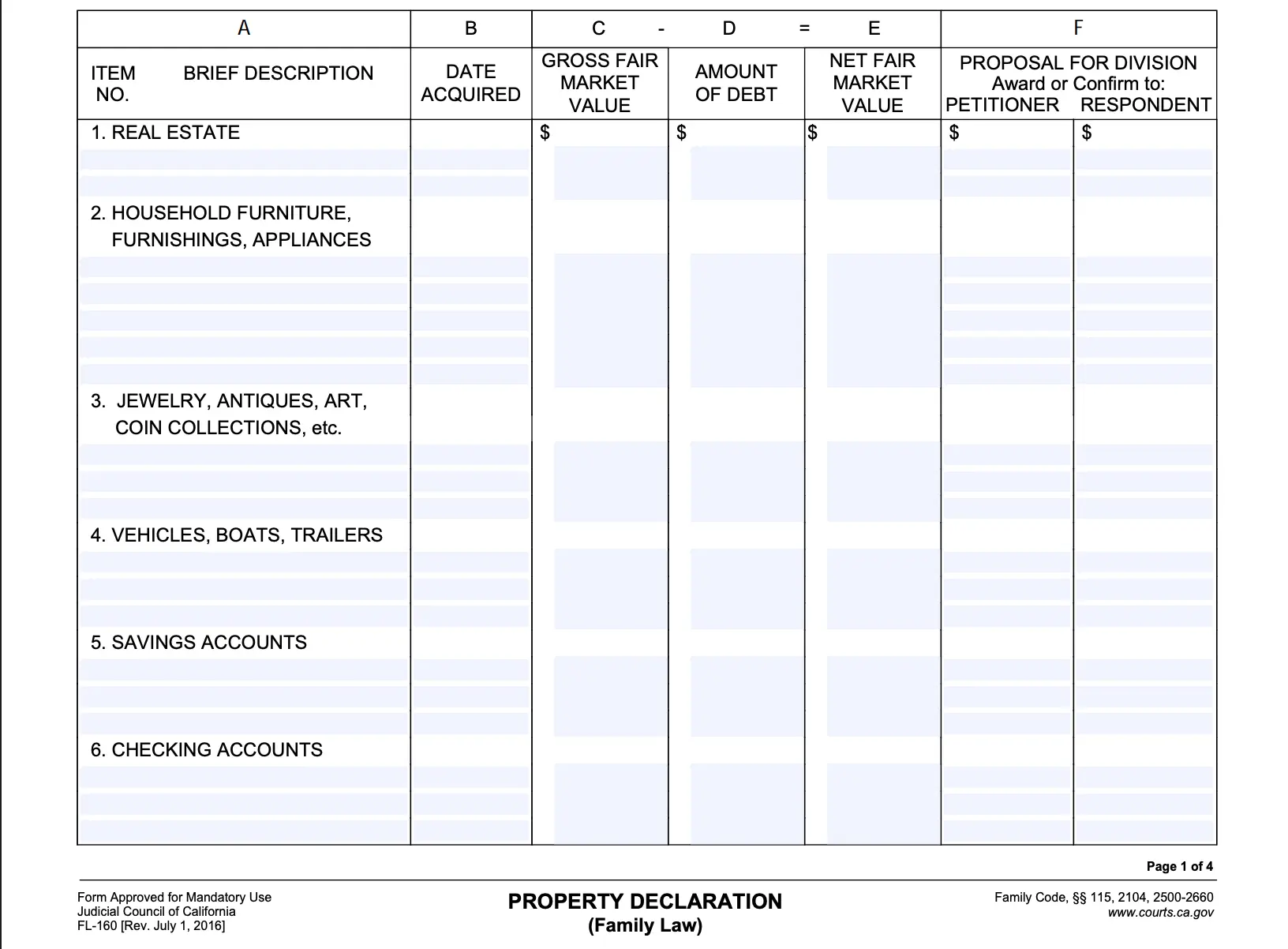
There are six identical columns for both asset pages. Column A describes the item. Column B is the acquisition date. Column C is the gross fair market value.
Column D is any debt. If there is debt, column E will show the net fair market value by subtracting column D from C. Column F is the proposed division and identifies whether the item will be awarded or confirmed to the Petitioner or Respondent and its value.
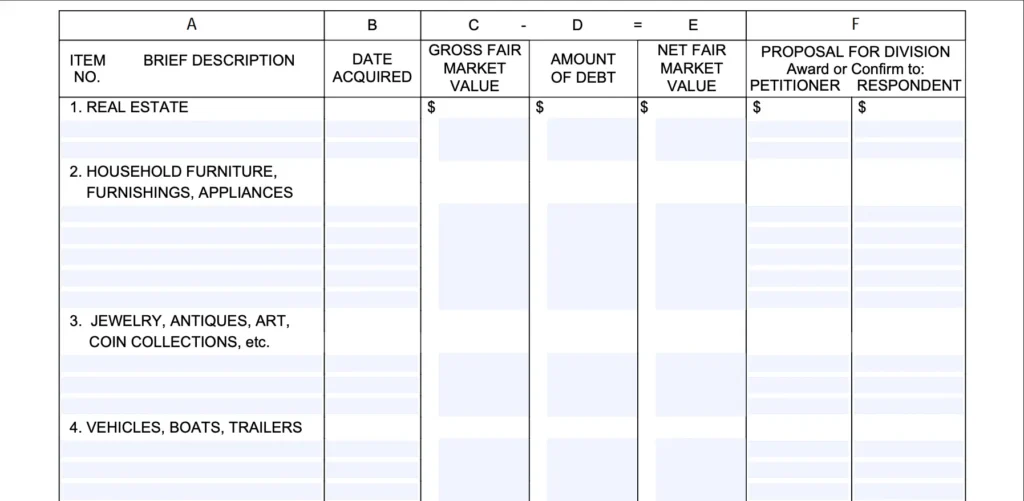
Item 1 is for Real Estate. For each property, list the address and outline the amount of the mortgage, if any. Item 2 is for Furniture, Furnishings and Appliances.
You will group by estimated resale value. Item 3 is for Jewelry, Artwork, Antiques and Coin Collections. You will group by estimated value.
For valuable items, an appraisal may be needed. Part 4 is for Automobiles, Trailers and Boats. For each item, state make, model and year. Include the loan amount, if any.
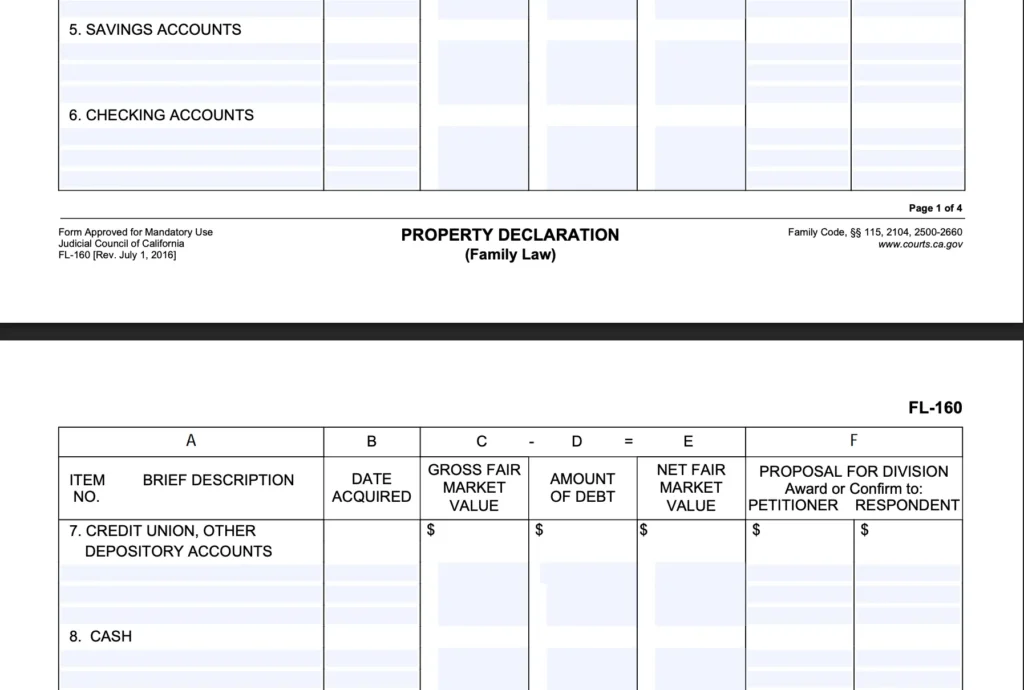
Use recent statements to determine the value of these accounts. Items 5-8 cover various checking and savings accounts.
Give the name of each institution, include the account number and state the balance.
The Item 9 covers expected tax refunds. Item 10 covers life insurance policies with cash value or loaned value. Item 11 covers stock, bonds and other securities. State the value of each based on current market value.
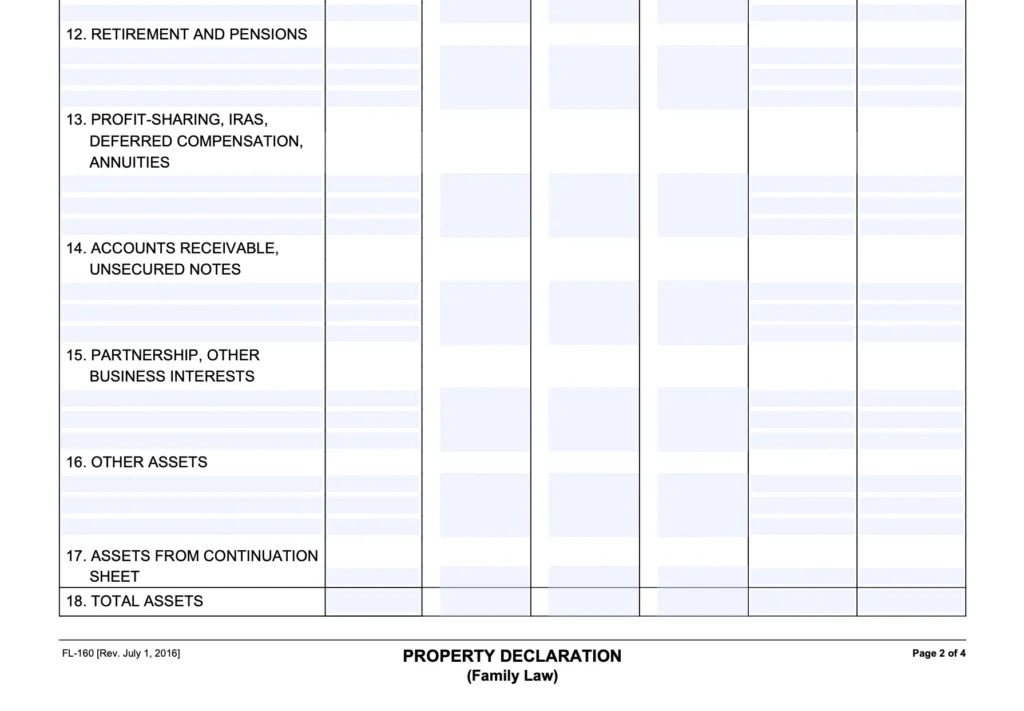
Items 12 – 13 covers information regarding retirement accounts, pensions, profit-sharing, IRA, deferred compensation and annuities.
Indicate contributions made before and during the marriage. Item 14 covers amounts owed to either spouse. Item 15 is for interests in partnerships and other business interests.
Item 16 for assets that do not fit in any other category. Item 17 focuses on assets listed on FL-161, and finally, see item 18 for totals of all the asset columns.
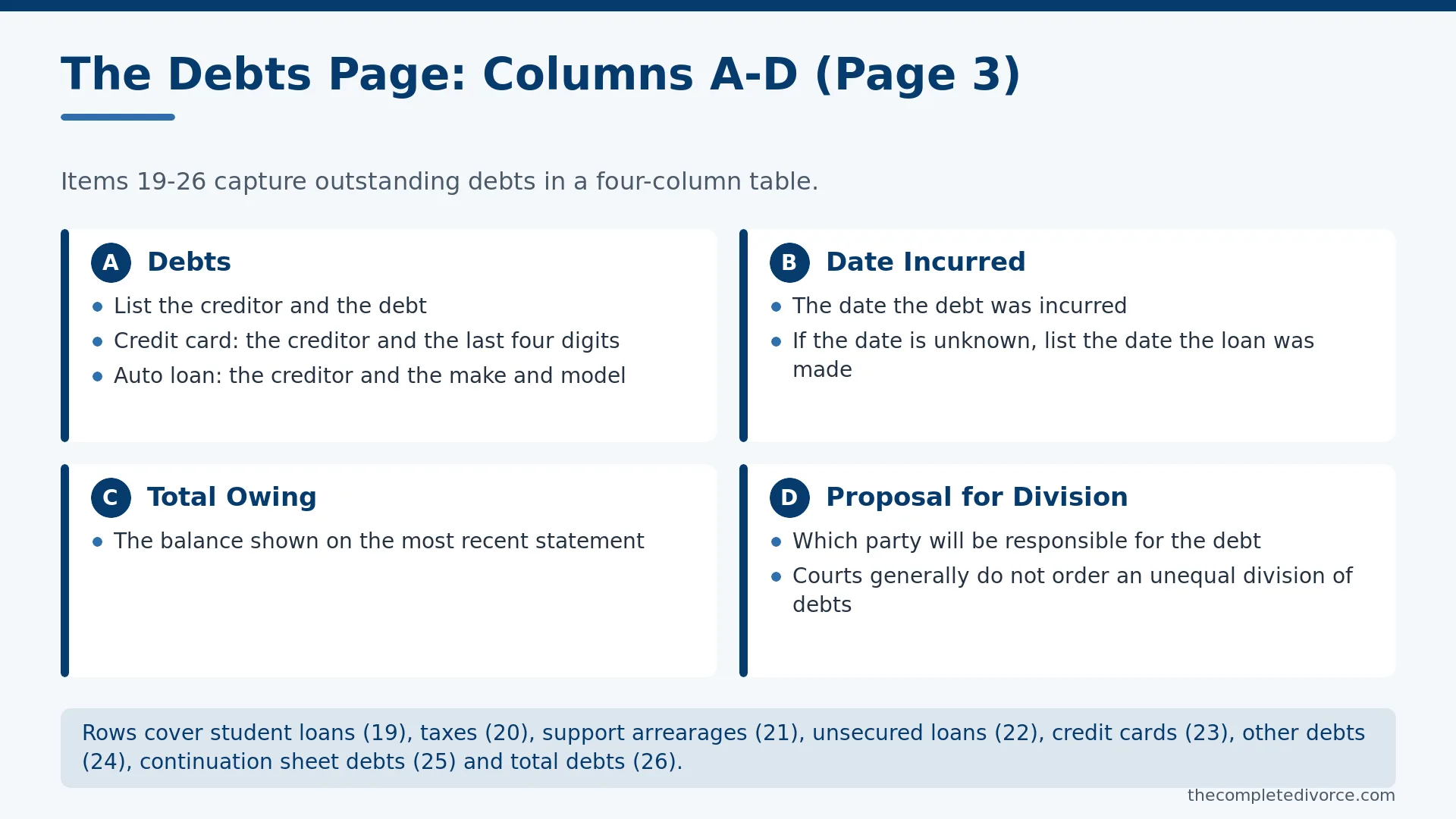
Page 3 captures outstanding debts in a four-column table. Each entry must include sufficient information to identify the creditor, the balance and the proposed allocation.
These rows describe student loans (19), taxes (20), support arrearages (21), unsecured loans (22), credit cards (23), other debts (24), debts listed on a continuation sheet (25) and total debts (26).
In general, the court will not order unequal division of debts. Dividing debts in a California divorce can be done unequally if the total division of the marital property is equal, or if both parties agree to divide the debts unequally.
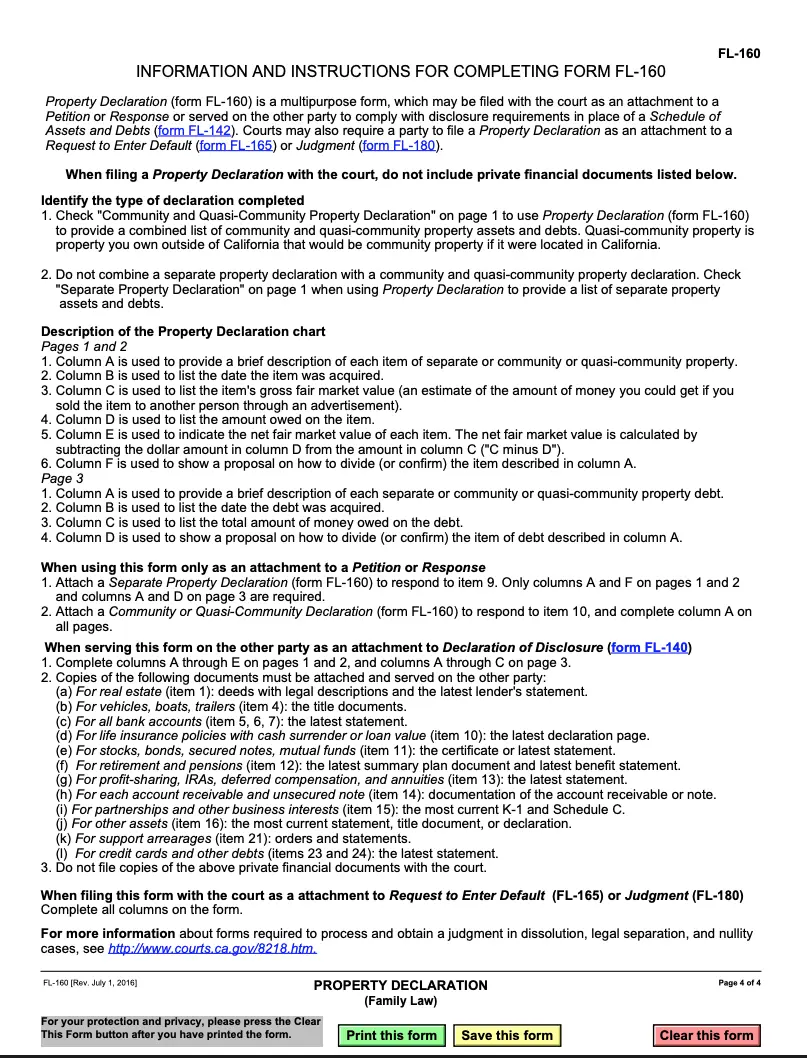
If you’ve used up all the spaces on FL-160, list additional assets or debts on FL-161 (Continuation of Property Declaration). Attach a FL-160 and transfer the totals from the continuation sheet to items 17 and 25.
You must date and sign FL-160 under penalty of perjury. An unsigned or undated form is considered incomplete.
Requirements depend on the purpose of the form:
Note that when filing and serving divorce papers in California, private financial statements must not be filed with FL-160. Exchange supporting documents with the other spouse instead.
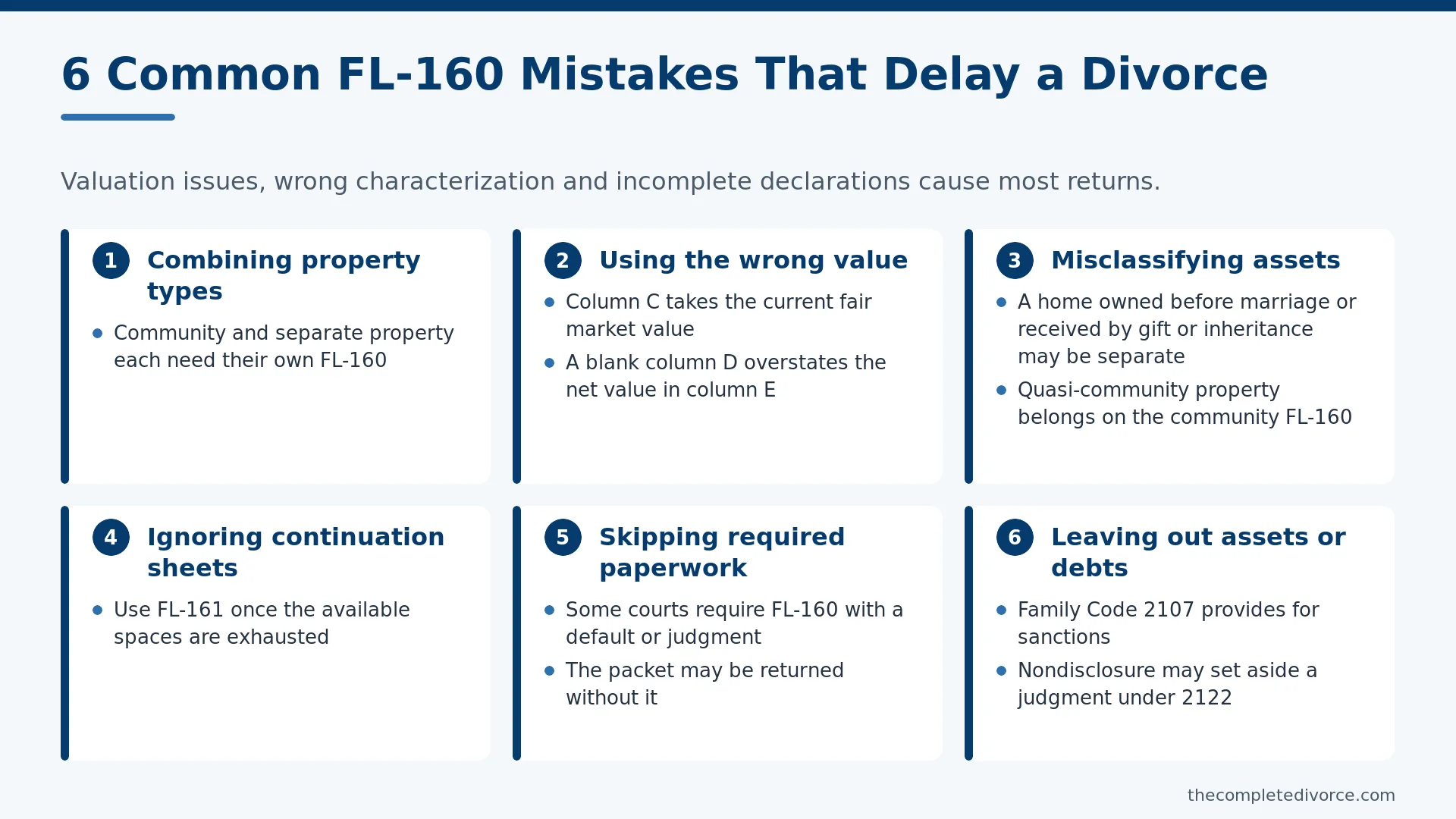
There are a few frequent errors made on FL-160. These include valuation issues, failure to classify property correctly, and incomplete declarations. Ensure your FL-160 has no mistakes mentioned below prior to submission.
Once both spouses reach an agreement on a proposed property division, it should be documented in a Marital Settlement Agreement in California.
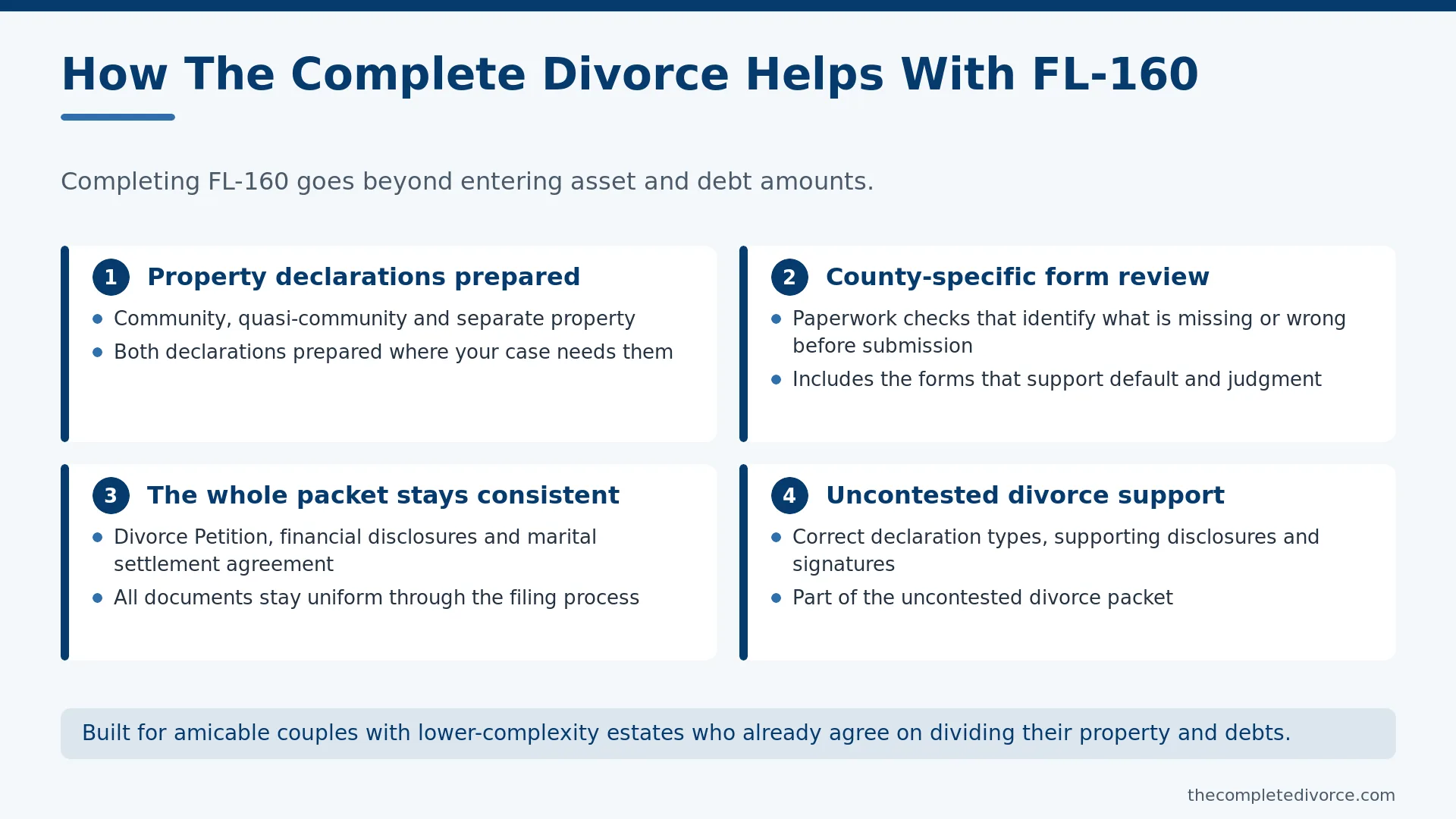
Completing FL-160 goes beyond entering asset and debt amounts. You must also select the correct declaration types, and provide supporting disclosures and signatures.
Complete Divorce assists parties in completing these forms as part of their uncontested divorce packet.
It prepares property declarations for community, quasi-community, and separate property. It also prepares the requirements for FL-160 for both property types.
There are forms and paperwork reviews specific to the county to help identify what is missing and what errors exist before submission, including forms to support default and judgment.
The support is also given to the divorce Petition, financial disclosures, and marital settlement agreement, to keep all documents uniform during the process of filing.
The Complete Divorce is for amicable couples that have lower-complexity estates, and have agreed on how to divide their property and debts.
Begin your cheap Uncontested Divorce in California with support in completing FL-160 and other required forms.
FL-160 records your assets and debts and proposes how to divide them. Identify each item correctly, use current market values, and subtract outstanding debts.
Your signature is under penalty of perjury, especially when filing default or judgment paperwork. Don’t make filing errors with Complete Online Divorce in California, which helps prepare your property declaration and related forms.

Divorce Attorney — Mediator & Founder of The Complete Divorce
“Hi. I’m Dina Haddad, a divorce attorney-mediator here in California. I’m so tired of couples not having a process that’s easy to complete their divorce. They are getting lost, wasting time and money, and beyond frustrated with their results.
That’s why I created The Complete Divorce, California’s premier online divorce program. I took my successful mediation practice and condensed it into an affordable and winning program.”
FL-160 is a financial disclosure form that lists all assets and debts of a marriage, states the values of each, and states what each spouse believes is an equitable division of the property.
FL-142 just lists assets and debts with their values. FL-160 includes a calculation of net fair market value and proposes a division between spouses.
No. You can use FL-142 to satisfy your financial disclosure requirements. You do not have to file FL-160, but you may be required to file it for a judgment.
Often yes. Many courts require FL-160 with default or judgment paperwork to state what the court is being asked to divide.
Subtract the debt shown in Column D from the fair market value shown in Column C and enter the result in Column E.
It may result in a Family Code §2107 sanction for nondisclosure. §2122 may allow a court to set aside a divorce judgment.
FL-160 may be required to be filed or served, depending on the purpose. It may be served as a financial disclosure schedule or filed with a Petition, Response, Default, or Judgment.