You’ve been served with divorce papers in California and have 30 days to respond. Defaulting on the paperwork can result in a judgment being made against you.
Rushing through this process can result in mistakes that could cost you in the long run.
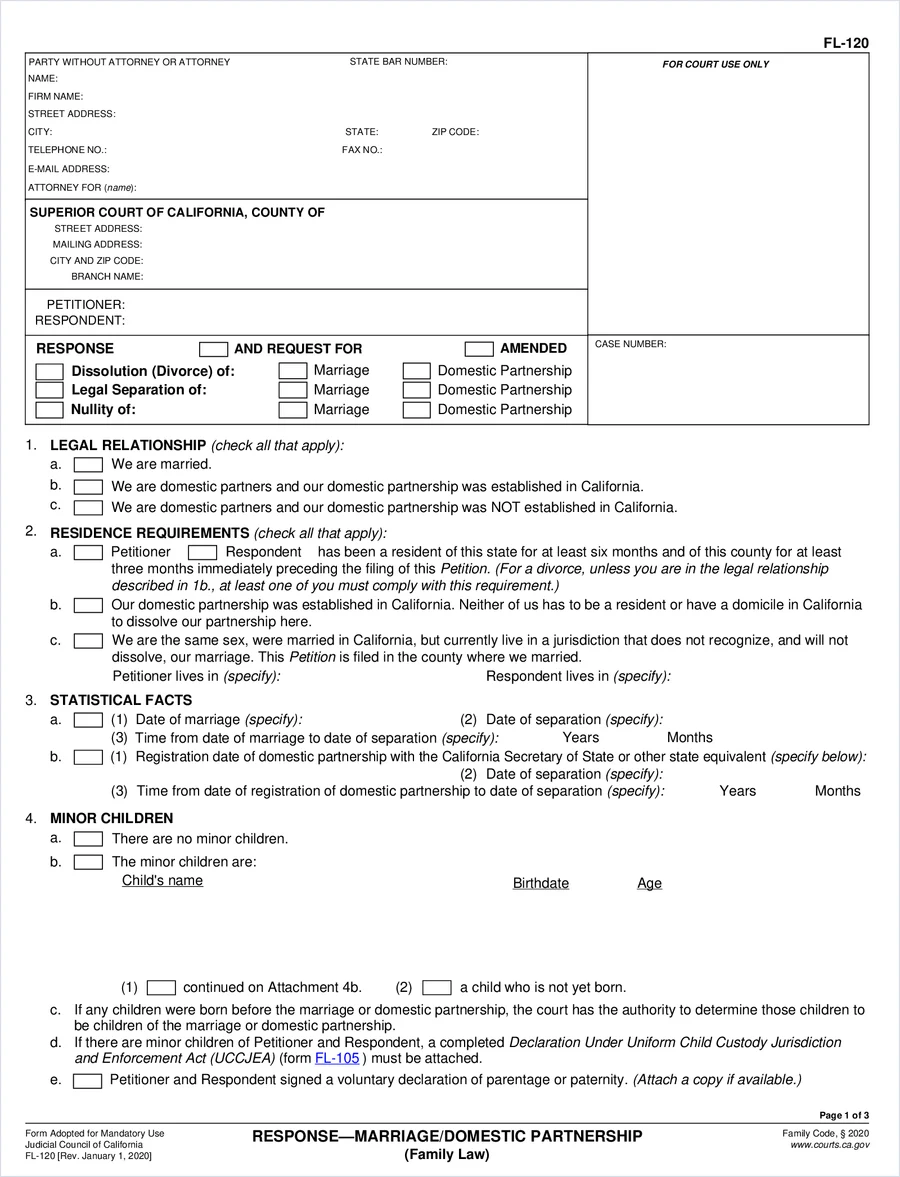
Use FL-120 to respond to the divorce petition to protect your interests regarding property, support, and custody.
This guide provides information regarding the different sections and associated forms, how to file, serve, and common mistakes.
Complete your FL-120 and get it reviewed with a California attorney mediator, Dina Haddad, before filing it with the court.
The Complete Divorce can help you with and even divorce. Start your divorce for $24.99/mo and move forward with confidence.
Form FL-120, Response-Marriage/Domestic Partnership, is a Judicial Council form used to respond to a Petition for Dissolution of Marriage, Legal Separation or Nullity in the state of California.
Making Your California Divorce Paperwork Easier Than Ever
Want Help with FL-120? Let us be on your side.
Get your paperwork error free with The Complete Divorce expert-led sessions, divorce workshops, and divorce forms video tutorials.
 ⭐⭐⭐⭐⭐
more than 2,000 California couples helped
The respondent fills this out. In this case, that would be the spouse or partner who did not initiate the divorce case. The spouse who filed the Petition is the petitioner.
By completing FL-120, the respondent enters the case, and notifies the court of their position regarding requests for property and financial support, as well as child custody and visitation.
FL-120 is for marriages, and California domestic partnerships. It is for Divorce, Legal Separation and annulment proceedings.
Filing a response does not mean that you agree to end the relationship. In fact, you can agree to end the relationship but disagree to the support, property or custody and visitation requests.
FL-100 is the Petition to initiate a California dissolution (divorce) or legal separation or nullity action. FL-120 is the Response to a Petition filed by the other party to the action.
The layouts and numbering of the two forms are the same. This allows the responding party to refute and respond to each allegation and request in the petition.
There is a filing fee charged by the court to file the case. There is also a separate first appearance fee to respond to the petition. The first appearance fee is charged when FL-120 is filed with the court.
After service of the divorce papers, the Respondent has 30 days to complete and sign FL-120 and have it filed with the court.
If FL-120 is not filed by the 30th day, the Petitioner can get a court order allowing them to proceed with the divorce without the Respondent.
This is called a default. To determine if a default has been entered, contact the clerk of the court. Responses are usually accepted after the 30-day period if no default has been granted.
Consider where you stand on ending the marriage, disputing the grounds for divorce, or seeking an annulment, before filing FL-120.
Take into consideration your position on custody, support, and property issues. Afterwards, gather the Petition for Dissolution of Marriage, FL-110, Summons, and the case number.
Also include an asset and debt list. The Summons automatically issues temporary restraining orders pertaining to assets, insurance, and children.
You have three options when replying to the Petition. First, if you agree to all requests, your divorce can proceed amicably, allowing you have a cheap uncontested divorce in California
Second, you can disagree with certain requests. To do this, you will need to complete a FL-120 and make your requests known regarding those issues. If this leads to a full dispute then this can proceed to a contested case and court hearings.
Third, you can agree with the request for divorce but can disagree with issues of custody and property division. Answer all questions separately and resolve remaining issues by agreement.
Some respondents may choose not to file FL-120. If both spouses sign a marital settlement agreement, the petitioning spouse may request a default judgment.
Respondents in this situation do not participate in the process and forfeit the opportunity to file a Response, but they also avoid paying the first appearance fee.
This option assumes the trust of both spouses to abide by the written terms of the agreement. If there are one or more terms of the agreement that are still to be decided, there’s too much risk, and it may be prudent to complete FL-120 instead.
FL-120 is structured the same way as the Petition (FL-100). Complete each question corresponding with the section on the Petition, so the court can compare both documents.
FL-120 requires the same level of detail as the Petition, so type or write legibly with black ink.
If there is not enough space to complete a question on FL-120, attach a separate sheet and identify the question with the number corresponding to that on the attached form.
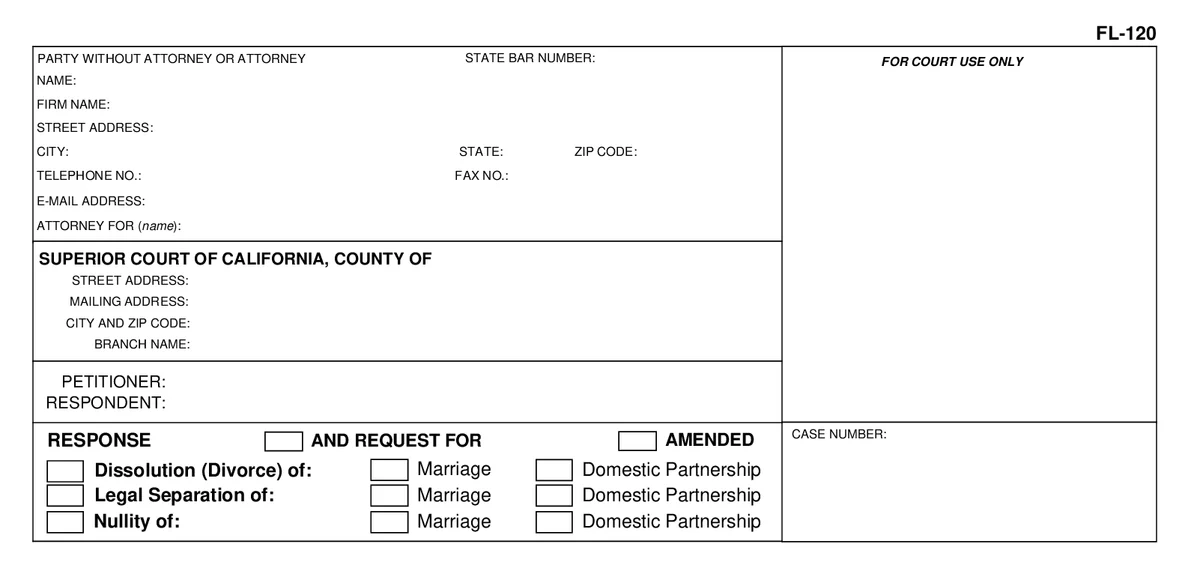
Fill out the information at the top of the first page. Enter your full name, address, phone number, and email in the first box on the left.
If you do not have an attorney, do not enter a State Bar number and put "In Pro Per" or "Self-Represented".
Next, enter the exact case name of the Superior Court, the County and the names of both parties as they are listed on the Petition.
Enter the Case Number and check "Response". Select "Amended" only if replacing a previous filed Response.
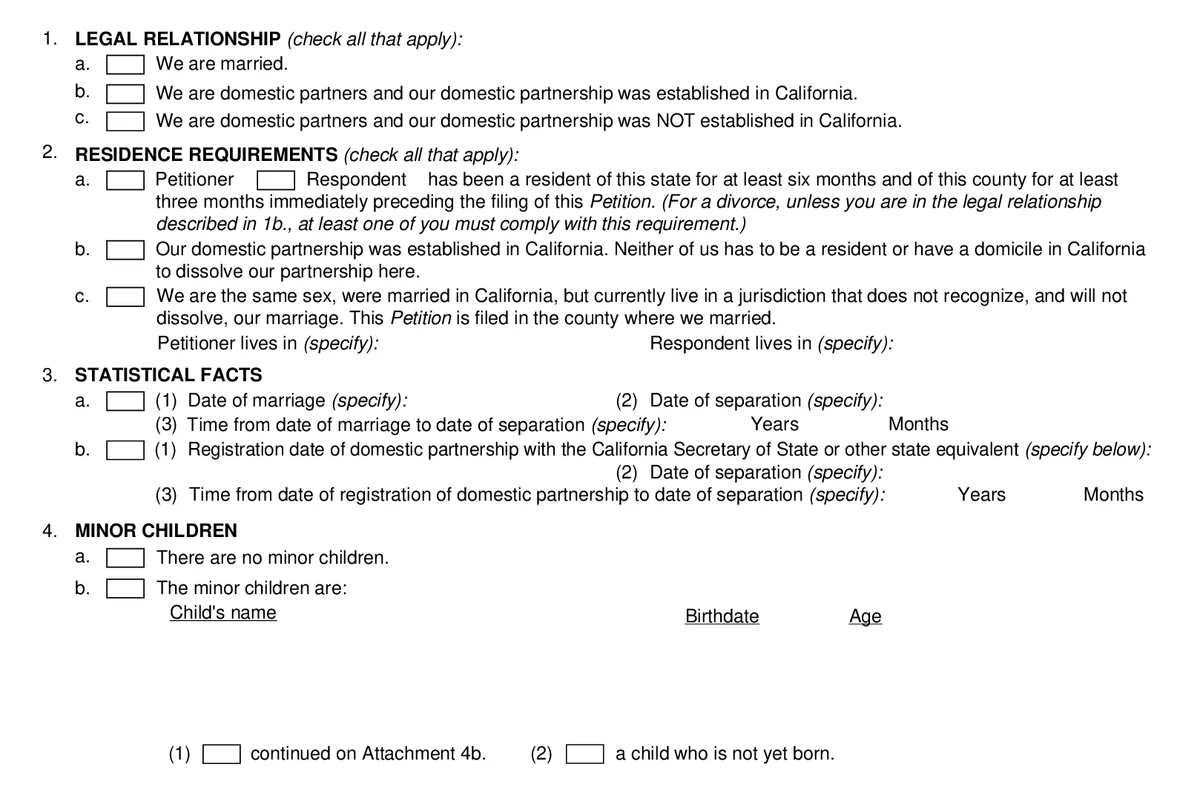
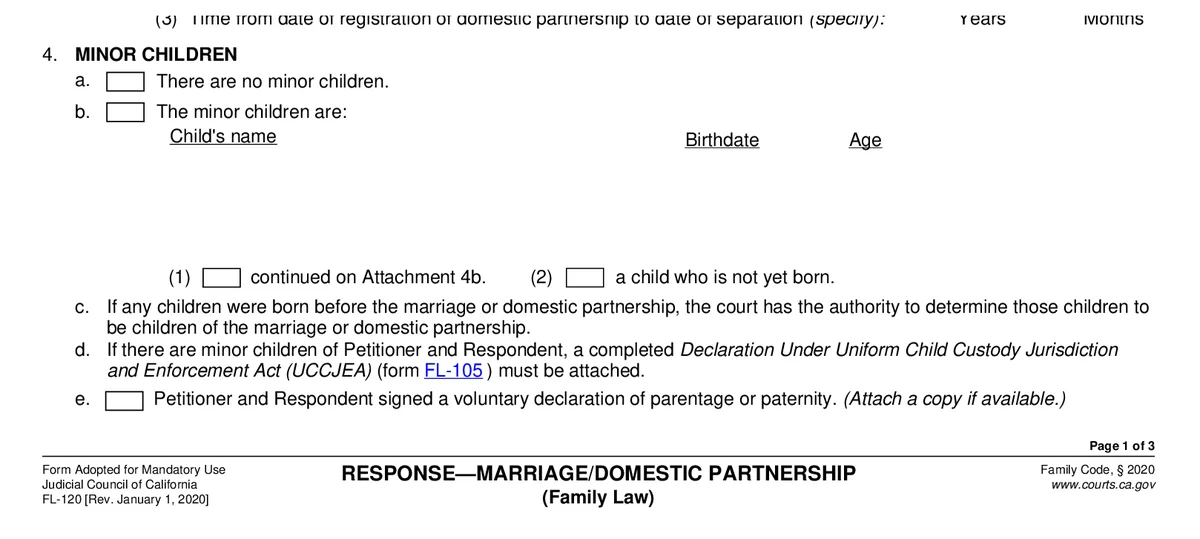
Items 1- 4 provide basic information for your case. Item 1 asks if you are married or domestic partners. Item 2 asks about your residency.
For dissolution in California it usually takes six months of California residency and three months of county residency, but for legal separation there is no residency requirement.
Item 3 has information about your date of marriage and separation. Item 4 has information about minor children, UCCJEA declaration (FL-105) and parentage.
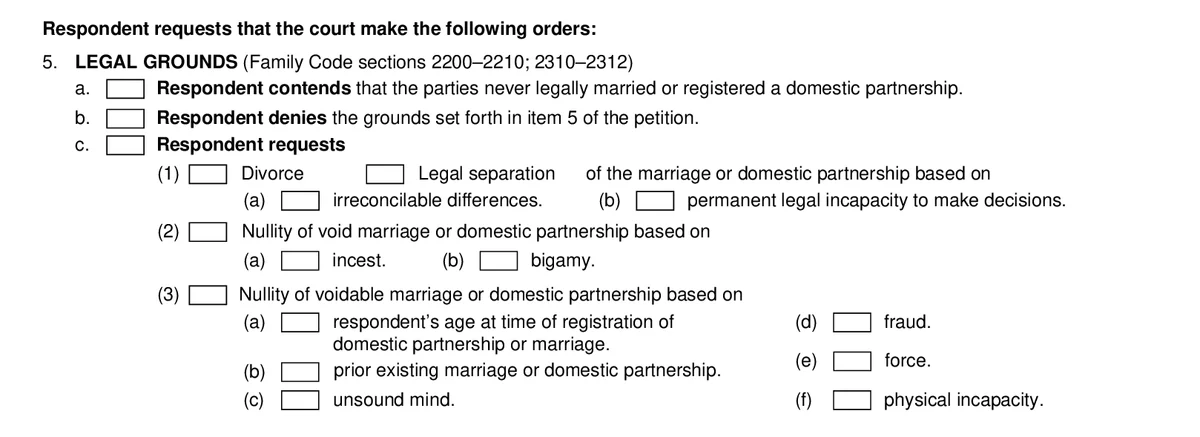
Item 5 provides a place for you to document your position regarding legal grounds for terminating the relationship.
You have the opportunity to dispute the existence of a valid marriage or domestic partnership, or deny the grounds asserted in the Petition.
In California, irreconcilable differences and permanent legal incapacity to make decisions are recognized grounds for dissolution. A party may also petition for a dissolution when the other party has requested for a legal separation.
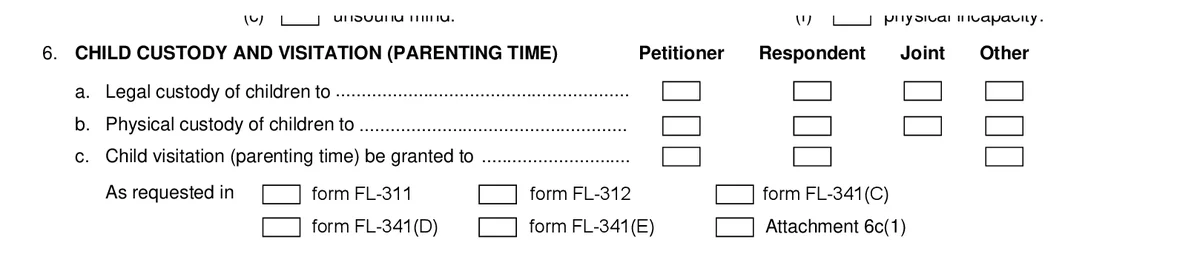
If you have minor children, in this Item you have an opportunity to indicate your requests for legal and physical custody and your requests for visitation (parenting time).
You may indicate whether you believe custody should be awarded to the petitioner, the respondent, or joint custody.
You should include in this request any concerns regarding the children's best interest. You may also want to complete FL-311 to provide a detailed parenting plan.
Other attachments, including FL-312 and the FL-341 series, are applicable where it is relevant. In some instances, parents are able to reach agreements outside the Court regarding custody of the children and visitation.
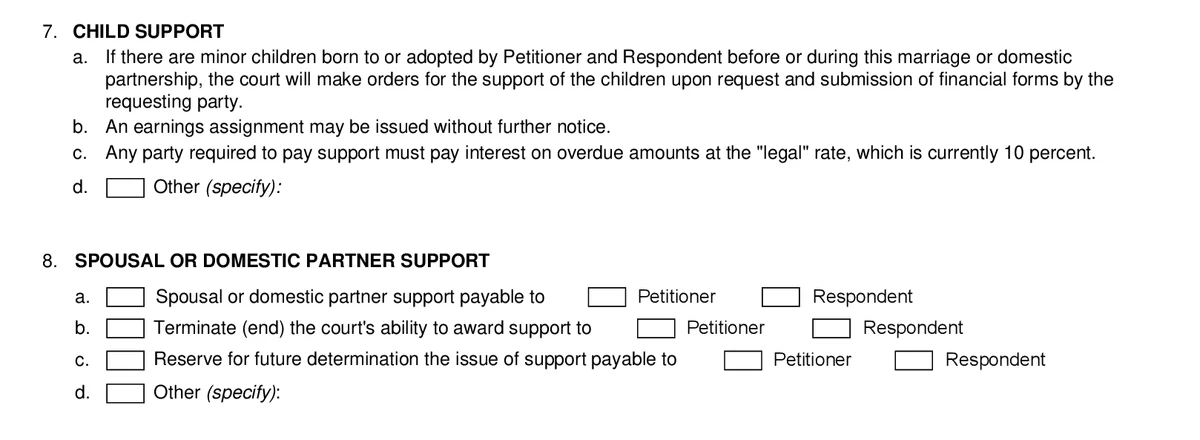
Items 7 and 8 deal with child and spousal support. Item 7 says child support follows the statewide guideline using the income indicated in the financial forms filed.
The court can order an earnings assignment and support accrue 10% interest. Item 8 says you can ask the court to end its authority to make spousal support orders or reserve the matter for later.
Use Financial Forms and FL-150 to provide the court with the financial information to set support amounts.
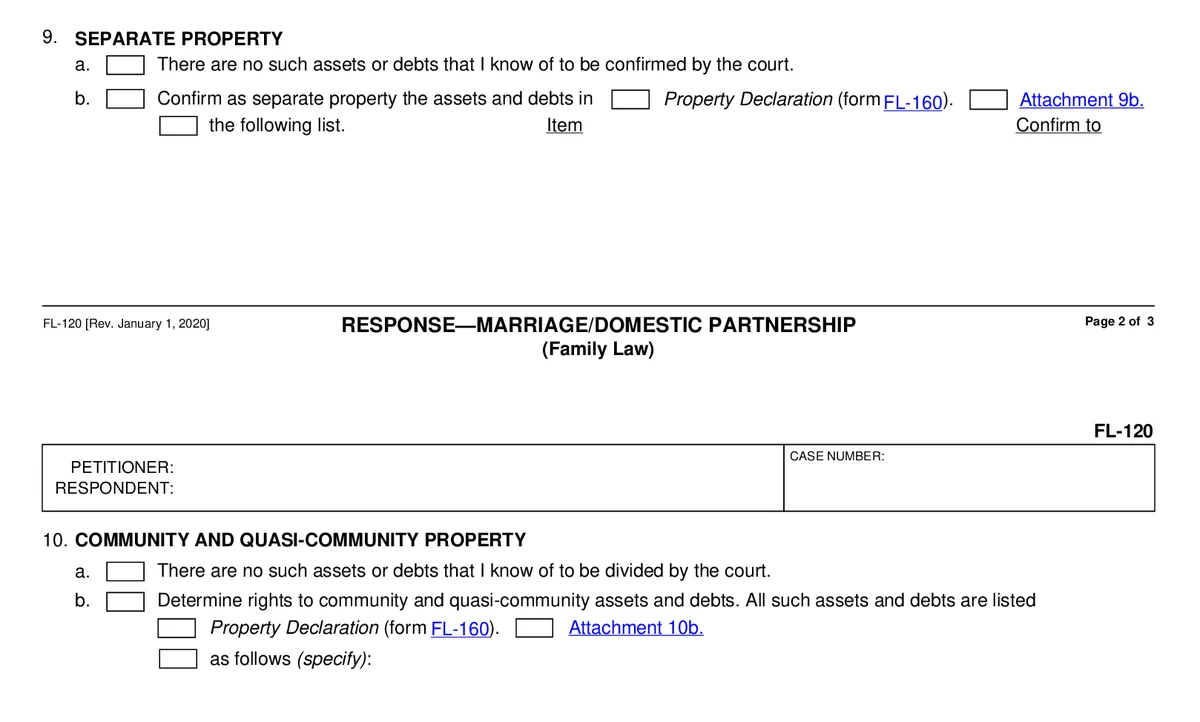
Items 9 and 10 ask you to identify property and debts for the court to decide. Item 9 requests you identify property that you claim is separate property, including property you owned before marriage, and property you received as a gift or inheritance.
Use either FL-160 or an attachment form. Item 10 requests the court to divide community and quasi-community property and debts.
In most cases, the court will order an equal division of community property when Dividing Debts in a California Divorce.
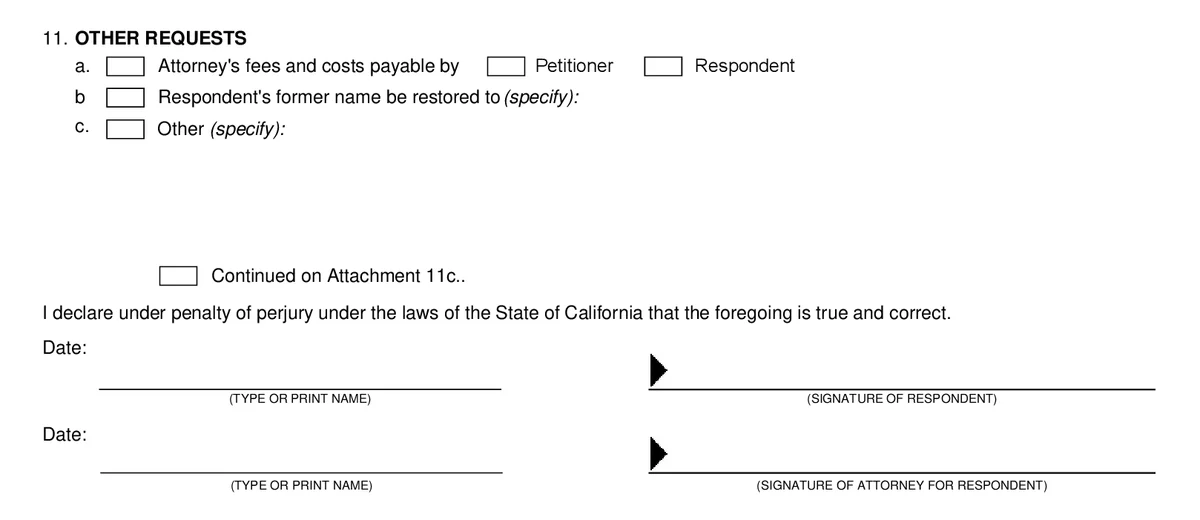
Item 11 covers requests for attorney’s fees, order restoring a former name, and other orders. To restore a former name, state the exact former name and use additional space on Attachment 11c if needed.
Sign and date the declaration under penalty of perjury. If an attorney is representing you, the attorney will also sign the declaration.
Fill out every attachment you refer to in this response (FL-105, FL-160, and FL-311) and include it with this response.
Court staff or the clerk may not process or accept the response if there are missing pages, the declaration is not signed, or other required documents or attachments are not included.
Submitting FL-120 is only part of your process because you still need to file and serve additional divorce papers in California.
You must also exchange financial disclosures, file your Response with the court, and serve a copy on the petitioner.
All divorce terms are agreed upon, both spouses must exchange financial disclosures. You can request a fee waiver if you cannot afford the filing fee.
After filing FL-120, you must serve your preliminary declaration of disclosure on the petitioner. This includes a Schedule of Assets and Debts (FL-142) or Property Declaration (FL-160), alongside an Income and Expense Declaration (FL-150).
You serve these documents on the other party rather than file them with the court.
File a Declaration Regarding Service (FL-141) as proof. Both parties must exchange disclosures, even in uncontested divorces.
When completing FL-120, a respondent is required to pay a first appearance fee. This cost varies by county, typically ranging from $435 to $450.
If you have a low income or are receiving public benefits, you can also request to have the fee waived by submitting a Request to Waive Court Fees (FW-001).
Both of these are filed with the same Superior Court that is handling your divorce case.
The manner in which they are filed varies by county, but usually one of the following apply: filed in person, filed by mail, or filed electronically. You should keep file stamped copies.
After FL-120 is completed, a respondent must have a copy served to the petitioner. One of the more common options is having a copy served by mail.
The person serving the divorce papers must be at least 18 years old and can not be a party to the case. You also cannot serve the documents.
The server is required to fill out a Proof of Service by Mail (FL-335) and you are required to file this with the court.
Making simple mistakes on FL-120 can result in delays when filing, affecting your legal rights and creating issues later on during the divorce process.
Bonus Tip: Before filing, make certain you have attached all required documents to FL-120.
Since January 1, 2026, California Senate Bill 1427, introduced Form FL-700, a joint petition for divorce for eligible couples. As co-petitioners, spouses no longer need to submit a separate FL-120 Response.
Couples that agree on joint petition may find this process more favorable than the standard petition and response process. However, there are eligibility requirements.
Updated terminology on FL-120 includes “permanent legal incapacity to make decisions.” Respondents filing the form generally pay an initial appearance fee of $435-$450, depending on the county, unless they qualify for a fee waiver.
Couples with a short marriage and no children that have limited assets may also qualify for Summary Dissolution in a California Divorce. This process is also quite simplified.
The Complete Divorce provides a low-cost alternative to respondents preparing their own divorce paperwork without the high cost of full-scope legal representation. The service identifies the required county-specific forms, including FL-120, FL-105, FL-142 or FL-160, and FL-150.
Our paperwork review checks case numbers and determines whether any other disclosures have been missed or whether there are service requirements. We will also provide the respondent with information on how to complete the required responses to the Petition. The process is entirely online with our help.
Start your process with The Complete Divorce and have your FL-120 and other divorce documents prepared and reviewed before submission.
Complete the FL-120 and file it within 30 days, exchange financial disclosures, and arrange for proper service.
Responding allows you to be part of the decision-making process concerning your children, finances, and property. Silence can lead to a default judgment. An amicable response can still lead to an uncontested divorce. Don’t make filing errors or miss deadlines.
If you are responding to a divorce in California, use The Complete Divorce to have your legal documents completed and reviewed before filing.

Divorce Attorney — Mediator & Founder of The Complete Divorce
“Hi. I’m Dina Haddad, a divorce attorney-mediator here in California. I’m so tired of couples not having a process that’s easy to complete their divorce. They are getting lost, wasting time and money, and beyond frustrated with their results.
That’s why I created The Complete Divorce, California’s premier online divorce program. I took my successful mediation practice and condensed it into an affordable and winning program.”
FL-120 is the Response to a Petition for Dissolution of Marriage, Legal Separation or Nullity. The respondent uses this form to respond to the requests made by the petitioner concerning minor children, child or spousal support, division of property and debts.
No. Responding to a divorce petition is optional. However, if a response is not filed in 30 days, the petitioner may request a default judgment, thereby excluding you from participation in the process and possibly resulting in an order that you do not want.
You generally have 30 days from the date you were personally served to file FL-120. Signing the form does not satisfy this time requirement.
The first appearance fee (cost of filing) for the respondent is approximately $435 to $450, depending on the county. You can request a fee waiver if you qualify by completing Form FW-001.
Yes, you are allowed to file FL-120 without an attorney. However, you must abide by the court’s rules including the completion and inclusion of required exhibits, service, exchanging financial disclosures, and other such things.
The petitioner is allowed to request a default judgment, which allows them to proceed without your participation. Contact the court to see if a default judgment has already been entered.