Online Divorce
Divorce smartly without a lawyer. Save yourself $10,000+.
- 100% Legit Divorce Program
California Divorce vs Legal Separation? Know which Path Protects You (2026)
In California, divorce legally ends your marriage. Legal separation does not. With legal separation, you remain married. Because of this, you cannot remarry.
Divorce allows remarriage. However, if you did obtain a legal separation, you can later divorce. If you do need a divorce later, you would need to file a new family law case in California; although, the agreements in your legal separation can still carry forward to the divorce.
Both legal separation and divorce require court orders or agreements on property and debts. Both processes will also require a full disclosure of all income information.
However, unlike divorce, legal separation may help you keep certain benefits. For example, some health insurance plans do not exclude a legally separated spouse as a dependent.
This can allow the non-employee spouse to stay on their spouse’s health insurance This can be useful if you are nearing retirement but rely on your spouse’s health insurance benefits until you can qualify for MediCare. It is crucial to check your insurance coverage and definitions of dependent in making this decision. The Complete Divorce is designed by California divorce expert Dina Haddad. It helps couples complete the process without a lawyer in just $49.99/mo subscription. Start your divorce or legal separation today. For more, explore our plan and pricing. Let’s help you get an affordable divorce!
Start your FL-100 Petition. Our software is easy to use – led by California divorce attorney, Dina Haddad.
These two answers rebuild the rest of the interview. Whole sections appear or disappear — you'll never be asked something that doesn't apply to you.
Every answer saves the moment you type it. Close the tab, come back next week, land on the same question.
These two answers tick the case type and the residency box on page 1 of FL-100. Next come your dates.
The date of separation is when you decided to no longer be married (both by words and actions).
The date of separation must be after the date of marriage.
These five answers fill page 1 of FL-100 — the case type, the residency box, both dates and the children box. Print the form from the panel on the right and they are already on it.
Building your FL-100…
Warning
To file for divorce in California, at least one spouse must have lived in the state for six months and in the county where filing for at least three months to file for divorce. This doesn't apply to legal separation. Consider changing your response.
Legal Separation vs Divorce in California — What’s the Real Difference?
The key difference is your marital status. Legal separation keeps you legally married. It protects finances. It also establishes court orders. Divorce permanently ends the marriage. This happens after California’s mandatory waiting period.
Legal Separation (California)
Divorce (California)
You remain legally married
Your marriage is legally ended
You cannot remarry
You are free to remarry
No six-month waiting period to change marital status
Six-month waiting period required to dissolve marital status
Court can decide custody, support, property, and debts
Court decides custody, support, property, and debts
Best if you need to keep benefits or are unsure about ending the marriage
Best if you want full legal and financial freedom
The 5 Similarities Between California Divorce and Legal Separation
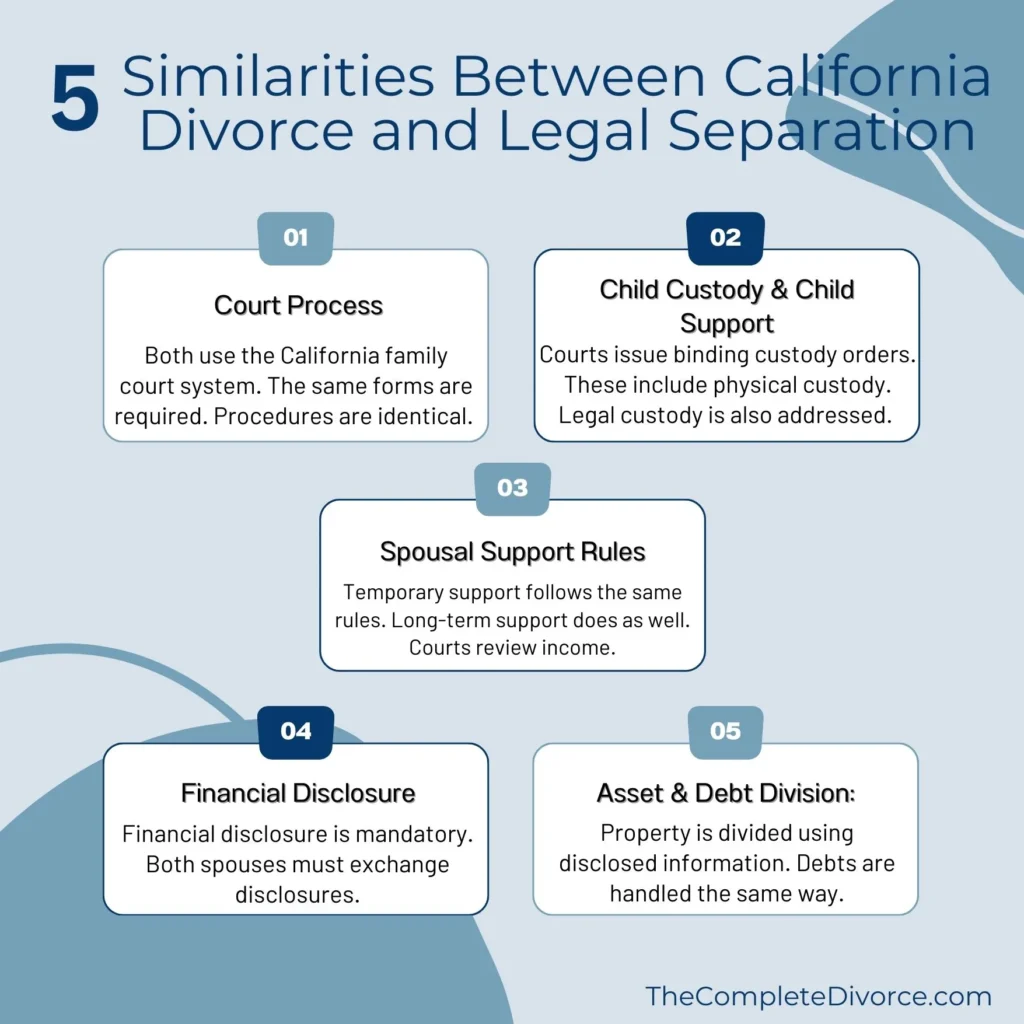
Both processes follow identical court rules. Both require court filings and payment of the same court filing fees. The same standards apply to custody. Support rules are also the same. Financial disclosures are required in both cases.
- Court Process: Both use the California family court system. The same forms are required. Procedures are identical. At filing, you choose divorce or legal separation. After that, the process remains the same.
- Child Custody & Child Support: Courts issue binding custody orders. These include physical custody. Legal custody is also addressed. Visitation schedules are set. Child support is ordered based on the child’s best interests.
- Spousal Support Rules: Temporary support follows the same rules. Long-term support does as well. Courts review income. Length of marriage matters. Earning ability is considered. Financial need is assessed consistently.
- Financial Disclosure: Financial disclosure is mandatory. Both spouses must exchange disclosures. Income must be listed. Expenses are included. Assets must be disclosed. Debts are also reported. Common forms include FL-140. FL-150 is required. FL-142 applies when needed.
- Asset & Debt Division: Property is divided using disclosed information. Debts are handled the same way. Spouses may agree on division. If not, the court assigns responsibility.
In California, legal separation and divorce operate almost the same. The primary difference is how marital status ends.
When is Legal Separation Right for You over Divorce?
Legal separation works best when you need legal protection. It applies when you are not ready to end the marriage. It also fits situations where divorce is not possible.
In California, couples choose legal separation for practical reasons. Personal considerations also play a role. The most common reasons are outlined below.
- Religious or personal reasons: Some religious beliefs oppose divorce. Certain personal values also discourage it. Legal separation becomes the only acceptable legal option.
- Keeping health insurance or benefits: Legal separation may preserve employer-provided health insurance. It can also protect access to other critical benefit plans.
- Possibility of reconciliation: Legal separation establishes enforceable rules. It allows spouses to separate their finances and end community property laws. This allows the financial aspects to be resolved while the couple determines if the relationship can be restored.
- Financial independence: Legal separation helps stabilize income. Expenses can be managed independently. Divorce can be considered later.
How legal separation affects a future divorce
The court orders or agreements reached in a Marital Settlement Agreement for a legal separation will still be binding in a divorce. However, modifiable provisions like child custody, child support, and spousal support can be modified in the divorce proceeds.
Otherwise, non-modifiable orders, like property divisions, in a court’s legal separation judgment are final. This remains true after divorce filings begin. Long-term thinking is also essential. Here’s how legal separation affects a future divorce:
- Property & asset division: Who keeps the home now often matters later. Cars and savings may remain permanently assigned.
- Spousal support: Support provisions in a legal separation judgment may be non-modifiable, such as a termination date. However, provisions like the amount of spousal support that is paid is typically modifiable regardless of whether it is a legal separation or divorce.
- Child custody & parenting plans: Although the longevity of a timeshare schedule in a legal separation will impact the timeshare schedule in a divorce, child custody is modifiable regardless of whether it was in a legal separation or divorce.
- Retirement & pensions: Decisions on retirements and pensions in a legal separation will be binding in a divorce given asset division is permanent.
- Estate & inheritance rights: Beneficiaries must be updated promptly. Failure may allow unintended inheritance by a spouse.
- Legal mistakes become permanent: A legal separation is not a temporary agreement. It has the same finality as a divorce.
Legal separation can provide immediate protection just like a divorce. However, it should not be approached as a faster option given the agreements in a legal separation are just as permanent as in a divorce.
Top Reasons People Choose Divorce Instead of Legal Separation
When you are certain the marriage is over, divorce is often the better option. It permanently ends the legal relationship.
The top three reasons people choose divorce include:
- Freedom to remarry: Divorce gives you the legal freedom to remarry. No court permission is required. There is no delay after judgment. This is unlike legal separation in California. However, note that you have to follow certain rules for how soon you can remarry after a divorce.
- Clean financial break: Divorce creates a clean financial break. Income is separated. Debts are divided. Tax responsibilities are clarified. Financial planning becomes independent. Legal finality is established.
- Estate & inheritance clarity: Divorce clarifies estate planning. Beneficiary rights are reset. Inheritance expectations become clear. Future disputes are reduced. Unintended claims by a former spouse are prevented.
How Divorce and Legal Separation work in California
Both divorce and legal separation in California follow the same court process. Each requires filing forms. Papers must be properly served. Financial disclosures must be exchanged. Property and debts must be resolved.
Child custody issues are also addressed. Child support is determined. Spousal support is decided. The court reviews all agreements. Disputes are resolved if necessary. A final judgment makes orders enforceable.
Divorce and legal separation process
These steps apply equally to both cases.
- Filing the case: At filing, you choose divorce or legal separation. The required forms are largely the same. Your choice determines whether your marital status will dissolve.
- Serving the other spouse: Your spouse must be formally served. This provides legal notice. It also starts mandatory response deadlines under California law.
- Financial disclosures: Both spouses must exchange full financial disclosures. Income must be listed. Expenses are disclosed. Assets and debts are included. Supporting documents are required.
- Agreements on property, support, and children: You may reach agreements on key issues. These include custody. Support is also addressed. Property division must be resolved. If disputes exist, a judge decides. Decisions are made under California law.
- Final court judgment: After all requirements are met, final paperwork is submitted. The judge reviews the documents. The Judgment is signed. Court orders become official. They are enforceable statewide.
The Modern, Simple and Affordable Way to Separate or Divorce in California
Legal separation and divorce in California follow the same court steps. These steps can increase costs quickly. Lawyer-led cases are expensive. Many cost $15,000 to $20,000 or more. Delays and conflict push costs higher.
The Complete Divorce offers a smarter option. The cost is $49.99 per month. The service is designed by California divorce expert Dina Haddad. It helps cooperative couples avoid stress. It reduces legal expenses. Many save $10,000 or more. Peace of mind is protected. Explore The Complete Divorce or start your divorce today.

Written By:
Dina Haddad
Divorce Attorney — Mediator & Founder of The Complete Divorce
“Hi. I’m Dina Haddad, a divorce attorney-mediator here in California. I’m so tired of couples not having a process that’s easy to complete their divorce. They are getting lost, wasting time and money, and beyond frustrated with their results.
That’s why I created The Complete Divorce, California’s premier online divorce program. I took my successful mediation practice and condensed it into an affordable and winning program.”
FAQ — Divorce vs Legal Separation
Q. Is Legal Separation Faster Than Divorce?
Legal separation and divorce take the same amount of time in California. The court process is identical. Divorce includes a mandatory six-month waiting period for the parties’ marital status to terminate.
However, a divorce judgment can be entered before this date, while the parties’ marital status is still intact. Legal separation does not have the same requirement given the parties are still legally married at the end of their case. In both cases, judgment can be reached earlier. All requirements must be met first.
Q. Do I Need a Lawyer for Divorce or Legal Separation?
No. A lawyer is not required in cooperative cases. This applies to amicable divorces and separations. With The Complete Divorce, you receive structured guidance. Divorce forms are clearly explained. Strategy support is included. Filing is handled correctly. This avoids attorney costs and stress.
Q. Can I Switch From Legal Separation to Divorce Without Starting Over?
Yes. California allows parties to amend their court filing from a legal separation to a divorce if it is done prior to the judgment being entered in the case. The process continues seamlessly. With The Complete Divorce, the transition is straightforward. It is handled without added stress. No extra legal fees are required.
California premier divorce program.
Making California divorce simple and lawyer-free.
- Filing & Review Support
- 1-on-1 Divorce Meeting
- Child support calculations
- MSA Filing Support
 ⭐⭐⭐⭐⭐
⭐⭐⭐⭐⭐
2000+ divorced without a lawyer.