
Get California Online Divorce Forms for $49.99/month– Limited Time Offer!
Read our guide to get help with joint petition, uncontested divorce, online and self-guided DIY divorce.
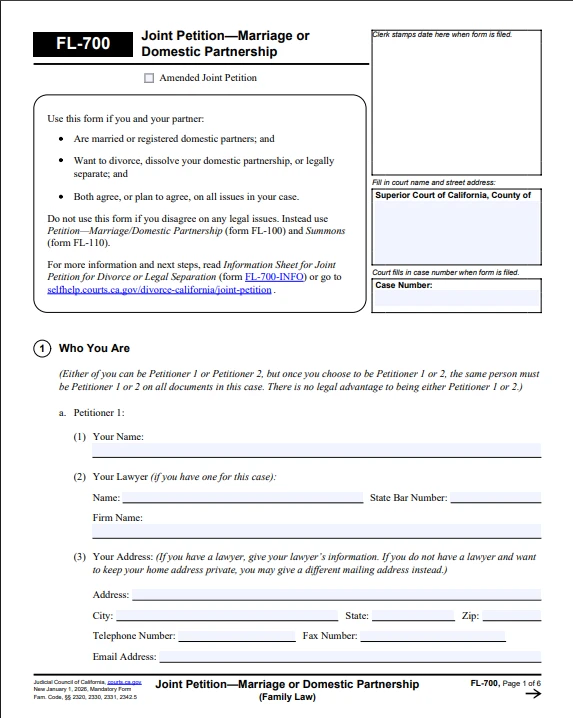
Starting a divorce in California now comes with a new option. As of 2026, parties can now file a joint petition for a divorce or legal separation.
Spouses who agree on all issues can file together using Form FL-700, Joint Petition – Marriage or Domestic Partnership. With this, the Petition does not need to be served to the other and a Proof of Service is not required.
However, DIY filings still carry risks. The eligibility requirements are strict, disclosure mistakes are common, and court rejections can cause delays. Fortunately for uncontested cases without a lawyer, guided support is available with The Complete Divorce.
With The Complete Divorce’s online platform, you can complete the FL-700 or alternatively, the traditional FL-100, Petition for Dissolution of Marriage, and FL-120, Response and Request for Dissolution of Marriage. You can also start with the FL-700 and later revoke the FL-700 using the provided forms in the platform. The program is versatile.
If you feel the FL-700 is ideal for your unique situation, this guide explains what FL-700 is, how to fill it correctly and everything else you need to know.
Making Your California Divorce Paperwork Easier Than Ever
Want Help with Filing a Joint Petition? Let us be on your side.
Complete FL-700 and its relevant forms without an error and reach the settlement fast through The Complete Divorce expert-led sessions, attorney-grade divorce form portal and video tutorials.
 ⭐⭐⭐⭐⭐
⭐⭐⭐⭐⭐
200+ couples successfully completed FL-700
FL-700 is California’s joint petition that allows spouses to start a divorce or legal separation together. However, full agreement on all key issues is required of both parties.
However, that does not have to occur until the end of your case. In other words, when filing a joint petition you are believing you will reach an agreement on all issues and not require a judge to make rulings in your case. This includes areas like:
Instead of having a Petitioner and Respondent, with the Joint Petition, there will be Petitioner 1 and Petitioner 2. Filing fees remain the same, which is typically $435 per person.
As for benefits, you have less initial forms to prepare, , no personal service, and the six-months mandatory wait period starts immediately (compared to when the Petition is served or the Response is filed)..
For the FL-700 route to work, both spouses must be cooperative and at the same time, meet residency, disclosure, and safety requirements.
Deciding between FL-100 and FL-700 depends upon your case and cooperativeness. The following scenarios can help you understand which path to identify and how FL-700 brought the good changes in the system:
Imagine a situation in your divorce when you are cooperative, amicable and agree on the divorce matters or have the confidence to agree by the end but you’ve children, assets, community debt, and/or your marriage length is longer than five years.
Then, you can’t file for summary dissolution and the remaining route will be FL-100 — divorcing traditionally. It could be a little adversarial no matter you’re pursuing uncontested divorce through it. It makes one spouse petitioner and the other respondent. Both have to render the divorce cost and filing fees separately.
The service of documentation makes the process tough too. On the other hand — although both FL-100 and FL-700 share the same DNA, i.e., dissolution, mandatory six month waiting period, grounds for divorce, residency requirement and financial disclosure — FL-700 inception has made the divorce simpler.
It has turned the traditional respondent/petitioner roles into co-petitioner (petitioner 1 and petitioner 2) and allowed mutual divorce.
It does not have a service process and both spouses have to pay one filing fee. And the couples who’re cooperative but not can’t file a summary dissolution can easily file jointly using FL-700.
You can see benefits of joint petition in detail here. Introduced recently in California in 2026, The Complete Divorce has also adapted quickly to this modern filing and assisting parties through their Fully-guided mutual divorce.
From paperwork review to complex support calculations, Dina has been helping couples through strategy meetings and bi-weekly divorce webinars. Start your joint petition confidently with The Complete Divorce.
|
Features
|
FL-100 (Traditional )
|
FL-700 (Joint Petition)
|
|---|---|---|
|
Filing Strategy
|
One Spouse files, the other responds
|
Both spouses file together as equals
|
|
Who is Listed
|
Petitioner & Respondent
|
Petitioner 1 & Petitioner 2
|
|
Tone
|
Adversarial
|
Cooperative
|
|
Service of Process
|
Required (Proof of service needed)
|
Not Required
|
|
Best For
|
All cases — contested, uncontested
|
Uncontested, amicable cases.
|
|
Agreement Needed
|
Not required
|
Yes
|
|
6-Month Waiting Period
|
Starts when Respondent is served
|
Starts immediately upon filing
|
|
Default Allowed
|
Yes
|
No (Both must participate)
|
Divorce costs in California vary widely because the method you choose makes the difference. Litigated divorces often exceed $30,000. On the other hand, lower-cost alternatives are available for self-represented and uncontested divorces. Choosing the right approach matters as total cost is affected, timelines can change, and risk levels vary.
To start a joint divorce, you must file:
For couples with children under 18 and have not graduated high school, you must complete:
Despite being a joint filing, it does not eliminate standard requirements. You still need to complete your disclosures like:
Filing FL-700 does not finalize your divorce, nor does it eliminate required disclosures. It also does not eliminate the six-month waiting period, resolve disputes, or protect you against unfair agreements.
Also, Automatic Temporary Restraining Orders (ATROs) start automatically when FL-700 is filed. This means, during the divorce period, you cannot:
Knowing what you can and cannot do ensures you are legally compliant, speed up your divorce, and avoid trouble for breaking ATROs accidentally.
If cooperation ends, either spouse may revoke the joint petition at any time before judgment. This is done by filing FL-720, while FL-100 or FL-120 must also be filed on the same day.
Once the joint petition is revoked, the joint process ends immediately and the case converts to a traditional divorce.
At that time, the party that revokes the process must serve the other party with their Amended Petition or Amended Response, depending on whether they were Petitioner 1 or Petitioner 2 in the matter. Petitioner 1 will be Petitioner and Petitioner 2 will be Respondent, even if Petitioner 2 decides to revoke the Joint Petition.
You do not need to spend thousands on legal fees to complete FL-700 correctly. Many couples handle the joint petition themselves, especially when guided support makes the process manageable.
Services like The Complete Divorce provide step-by-step instructions, form review, and filing assistance. The goal is to help couples avoid mistakes that slow down the divorce process. Below is a practical overview of how to complete FL-700 accurately.
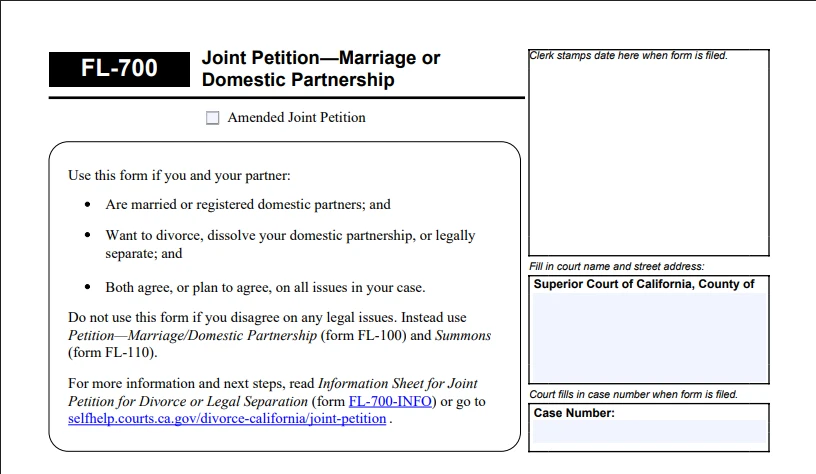
Enter the Superior Court name, county, and address. Leave the case number blank; the clerk assigns it after filing.
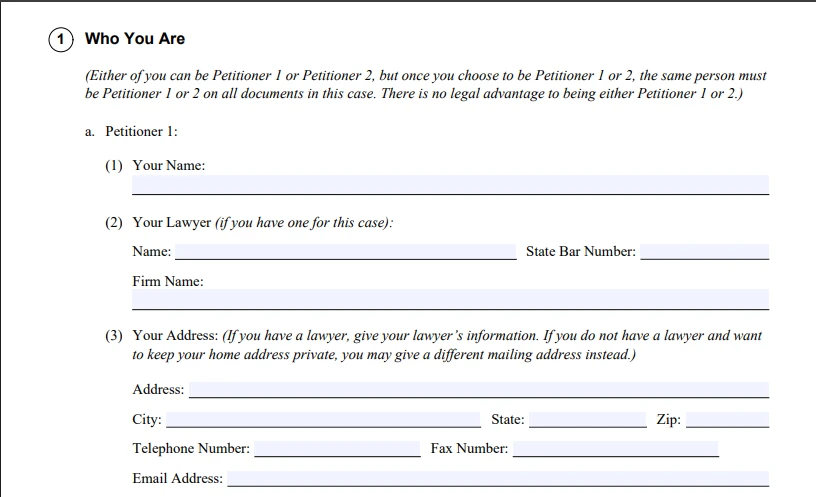
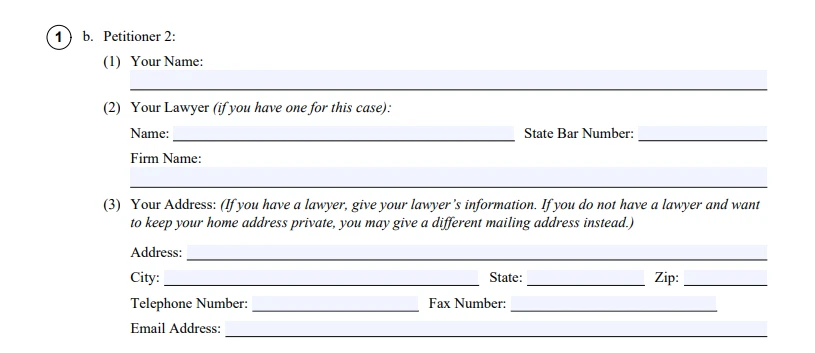
List both spouses as equal joint filers. Choose Petitioner 1 and 2 once and use the same roles on all future forms. There is no legal importance as to who is Petitioner 1 or Petitioner 2.
However, if you revoke the Joint Petition later, Petitioner 2 will be Respondent. Again, there is no legal impact here. If the case proceeded to trial, the Petitioner would present in court first.
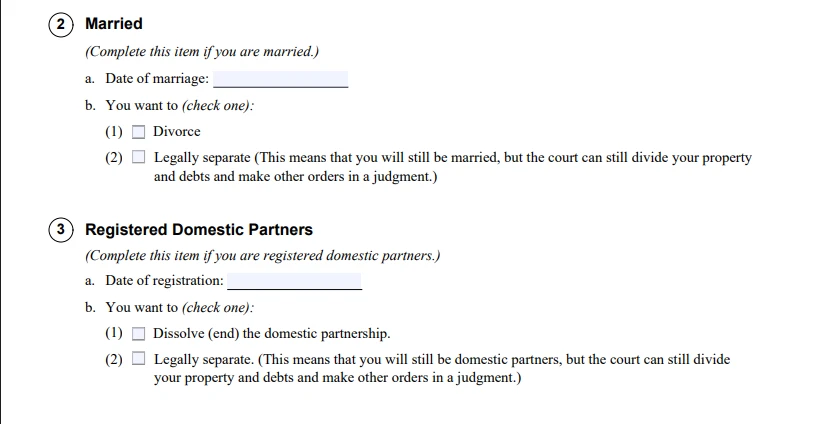
Enter dates and select divorce or legal separation as applicable. Also note that ending a marriage doesn’t end a domestic partnership; you must request both if applicable.
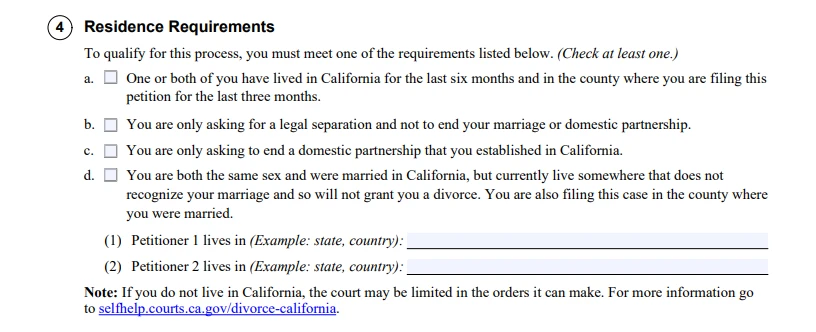
This section clarifies if the court has authority over your divorce. So, tick a box to confirm jurisdiction and fill in your location in California. Note that incorrect selection or details can result in your filing being rejected.

There’s nothing to do here. It merely explains that California is a no-fault state, and you don’t need proof or explanations to end the marriage.
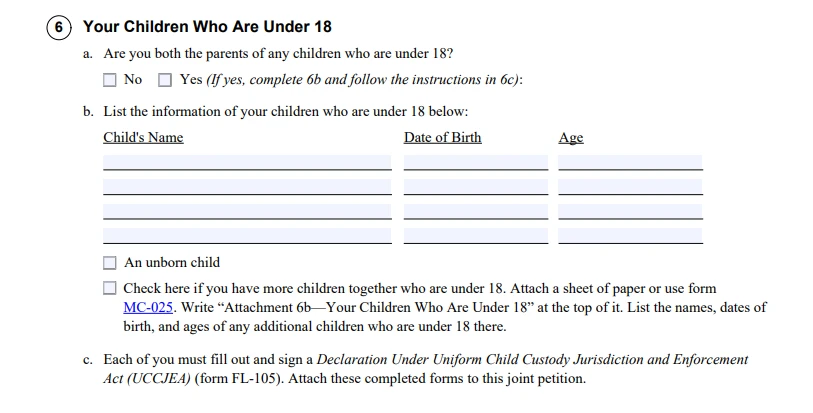

Answer YES or NO clearly. If yes, list each child and attach FL-105 for each parent.
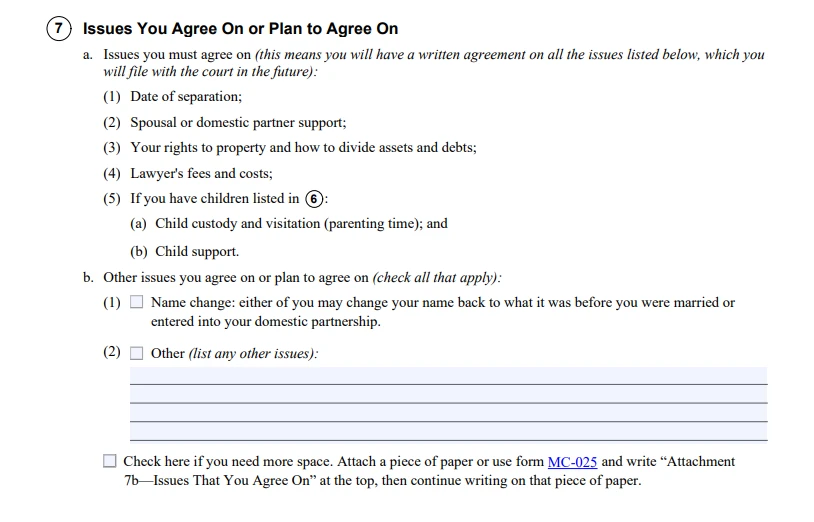
Confirm which issues you agree on or plan to agree on. If you cannot agree on key issues, the joint petition will be revoked. In the Other box, consider adding “Reimbursements and credits,” as an item to work on with your spouse.
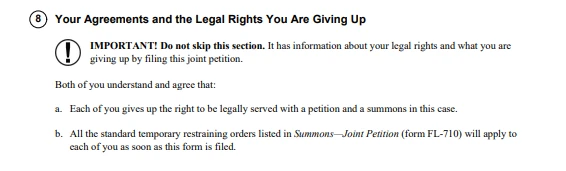
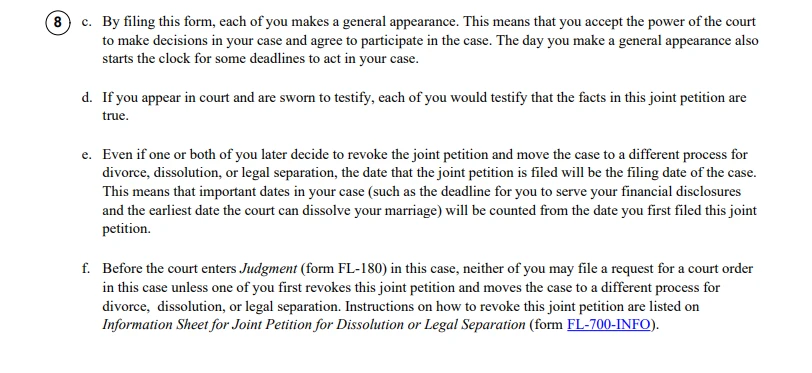
Filing FL-700 means you acknowledge the immediate effect of ATROs, disclosure deadlines, and limits on court motions unless revoked. You also cannot file motions or court requests unless the joint petition is revoked.

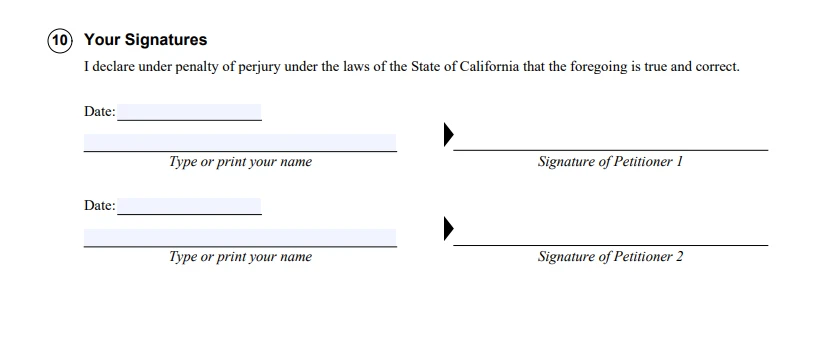
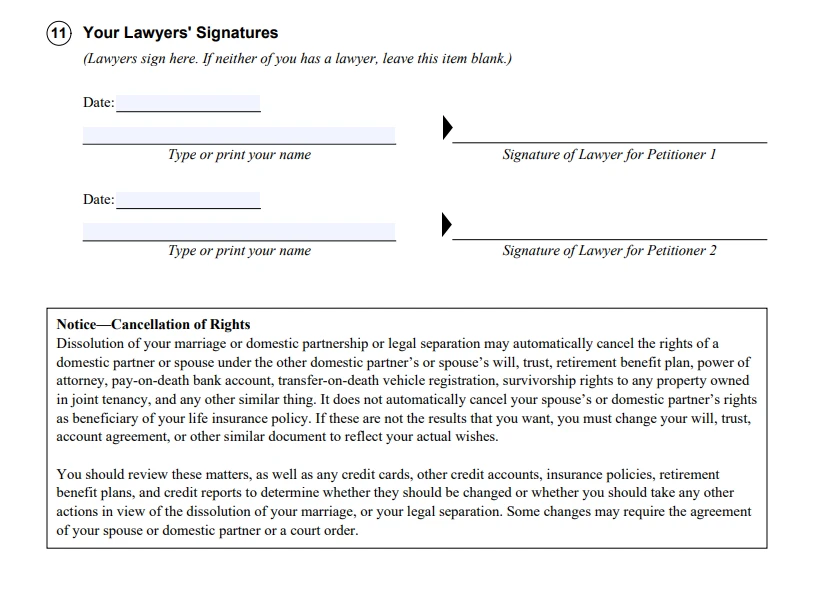
For item 9, only use it if you need to explain something unusual or attach additional information like the MC-025 if needed. In Item 10, both parties must date and scan the form before filing. Electronic or scanned signatures are acceptable. Lastly, leave Item 11 blank if neither spouse has a lawyer or a formal representation.
In a joint divorce, the court filing fee is typically $435 per person. It is paid once per case. Since the filing fees are the same, the benefit of a joint filing is more limited. The benefit boils down to not having to complete a Response or serve the Petition.
If you need assistance with FL-700 but can’t afford an attorney, The Complete Divorce offers its services as a solution. For a starting price of $49.99, you can avoid attorney costs while having expert guidance to complete the forms and other aspects of your divorce process.
The Complete Divorce simplifies the joint divorce process for eligible couples in California.
Here’s how it works:
Anyone can qualify for joint petition in California simply if they’ve been the residents of the state as per residency rules and agree on divorce matters (through a divorce mediator). And literally the joint petition is for everyone who wants to settle marriage peacefully.
Unlike summary dissolution, which sets the high bar for short-term marriages, the joint petition allows couples to pursue divorce amicably regardless of how long they’ve been married and how many children they’ve from the marriage.
This applies to other limitations related to community property debt that summary dissolution sets.
In short, you can leverage a joint petition, if you can’t meet the eligibility requirements for summary dissolution as both are cooperative and need full agreement but the former sets the strict eligibility for short-term marriages.
If you disagree on final terms such as debts, support and/or custody or parenting arrangements, it’s fine unless you’re confident that you and your spouse would agree by the end.
You can rely on a mediator to settle issues as the petition requires both spouses to agree and sign FL-700. The FL-700 will be unfit for uncooperative couples or the cases involving domestic violence, power imbalances, manipulation, hidden assets or high conflicts. In that case you can rely on FL-100 to start a contested or uncontested divorce. The following is the summary of the eligibility required for joint petition:
California’s Premier Joint Petition Program
Complete Joint Petition Smartly through Our Fully-Assisted Divorce Program
⭐⭐⭐⭐⭐
2000+ Couples Successfully Divorced
The Complete Divorce makes filing the joint petition simpler and more reliable. Our AI-powered system streamlines every step, guaranteeing that delays are reduced and confusion is minimized. Your information also remains private as secure systems protect confidentiality throughout.
At $49.99 per month, the guided DIY approach is affordable and access is possible from any device. Most importantly, filings are done correctly the first time; so, common legal mistakes are avoided and your waiting period begins without unnecessary setbacks.

Divorce Attorney — Mediator & Founder of The Complete Divorce
“Hi. I’m Dina Haddad, a divorce attorney-mediator here in California. I’m so tired of couples not having a process that’s easy to complete their divorce. They are getting lost, wasting time and money, and beyond frustrated with their results.
That’s why I created The Complete Divorce, California’s premier online divorce program. I took my successful mediation practice and condensed it into an affordable and winning program.”
No, filing a joint petition does not make the divorce final alone. But it just starts the case process and the rest of the process that involves completing forms and disclosures, and submitting a judgment follows from there.
The timeline would actually depend upon how you divorce (using the self-representation or fully-assisted DIY divorce), completing forms, disclosures, and court backlogs. One important thing is that the 6 months waiting period will always be the part of your divorce, which starts from the joint filing date.
Say if you stop agreeing with your spouse after filing a joint petition (using FL-700), you pursue the standard dissolution with FL-100, which will make one the petitioner and the other spouse the respondent. The Complete Divorce can help you with both options.
Yes it is a must even if you agree on matters. There are two types of disclosures; preliminary and final disclosures. The former is mandatory and must be done within 60 days of filing while the latter is waivable.
No. A lawyer is not required. California allows DIY filing, but mistakes can cause delays or rejection. Guided services like The Complete Divorce help ensure accurate filing and review.
Yes. Registered domestic partners may use FL-700 if both agree on all issues. If applicable, the domestic partnership must be ended correctly. Selecting the wrong option can delay the case.
No. Default is not possible with FL-700 because both spouses appear together. Default applies only to traditional cases using FL-100 and FL-120.