Since 2019 | Trusted By California Couples.

Get California Online Divorce Forms for $49.99/month– Limited Time Offer!
Since 2019 | Trusted By California Couples.
With The Complete Divorce, you get the expert assistance you need to start and finish an online divorce or legal separation in California — confidently and smartly, without a lawyer.
Our fully guided divorce service was founded and is led by California divorce expert Dina Haddad, who is committed to making divorce smarter, easier, and more affordable — empowering families to take control of their divorce without hiring attorneys or going to court.
Get extraordinary support that goes well beyond our biweekly divorce webinar and library of resources. We help with filing and reviewing divorce forms, handling complex calculations, and even converting a slightly contested divorce into an uncontested one through mediation.
Let us be on your side. We’ll help you simplify the process so you can stay in control. Subscribe today for $49.99 and move forward with confidence.
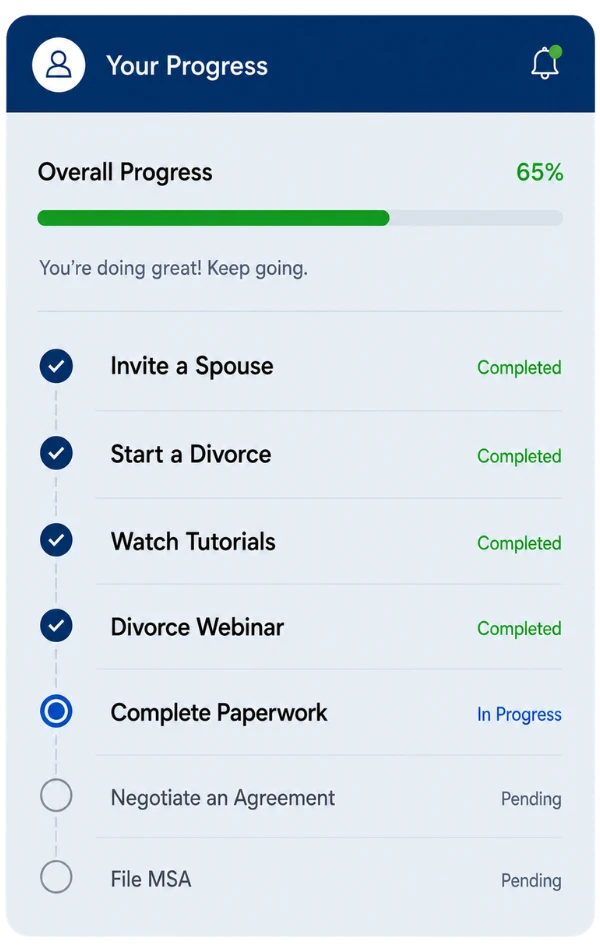
Yes. You can file for divorce online in California. Every California superior court accepts divorce petitions prepared online, and many counties also allow electronic filing. You do not need a lawyer and you do not need to appear in court for an uncontested case. You prepare the court-approved forms online, file them with your county court, serve your spouse, and the judge signs the judgment.
To qualify you must meet three conditions:
The soonest a California divorce can be final is 6 months and 1 day after your spouse is served, because of the state waiting period. Filing online does not shorten that clock, but it does stop the delays caused by rejected or incomplete paperwork. Court filing fees run $435 to $450, and a fee waiver is available if you cannot afford it.
Online divorce is the most affordable of all options, depending on how you divorce and which service you use. For example, with The Complete Divorce, a couple can save $15,000 or more — in contrast to a traditional divorce, which can cost hundreds of thousands of dollars and exposes both parties to greater conflict, stress, and a longer timeline.
Online divorce isn’t for everyone. It’s best suited to low-income spouses, amicable couples, and parties pursuing an uncontested divorce, summary dissolution, or mutual divorce (using a joint petition). The joint petition is an effective tool for a streamlined process, along with countless other benefits.It’s also a good fit for e-filers, self-represented individuals ( pro se / pro per ), and anyone who wants a divorce but can’t afford an attorney.

In California there are two grounds for divorce; irreconcilable differences and incurable insanity. California is a no-fault and hence it does require any spouse to prove faults or wrongdoing in marriage or issues like adultery or even domestic violence.
The grounds — different from causes of divorce — are the minimum requirements to start a divorce. This lets the court know that both spouses have grown apart from each other and there is no other way to save the marriage — it is beyond repair.
With this policy, the court can focus on the legal issues of the divorce, like property division, child custody, and spousal support, instead of trying to prove whether the fault is legitimate.
For California courts to consider your uncontested online divorce petition, you must meet the residency requirements and agree on all divorce matters. These requirements are explained in detail below:
California has a minimum six-month waiting period — also known as a cooling-off period — before a divorce can be finalized. This is mandatory, so it cannot be reduced or waived, no matter what kind of divorce you are seeking.
This period begins once your spouse is served with the divorce petition or files a response, whichever comes first.
You can use this time to reconsider your decision and possibly reconcile, or to use mediation to resolve your differences and reach a settlement agreement outside of court. This allows you to end the marriage peacefully.
Yes, online divorce is 100% legitimate and secure. It has been trending and rising in California, and across the United States, since Covid-19. Importantly, though, your service provider also needs to be legitimate.
For example, it should have good reviews, and its forms should not be generic ones that apply to the entire United States. It should also be founded and led by a family law and divorce expert rather than a paralegal.
One such service in California is The Complete Divorce — founded and led by Dina Haddad, an attorney-mediator and recognized Super Lawyer. It is 100% legitimate, as the founder herself assists parties with everything from “we file for you” to divorce workshops and “we review for you” services — saving couples from do-it-yourself (DIY) divorce errors and court rejections.
The Complete Divorce aims to create a secure, efficient, and lawful experience that helps couples complete the entire divorce process from start to finish with confidence.
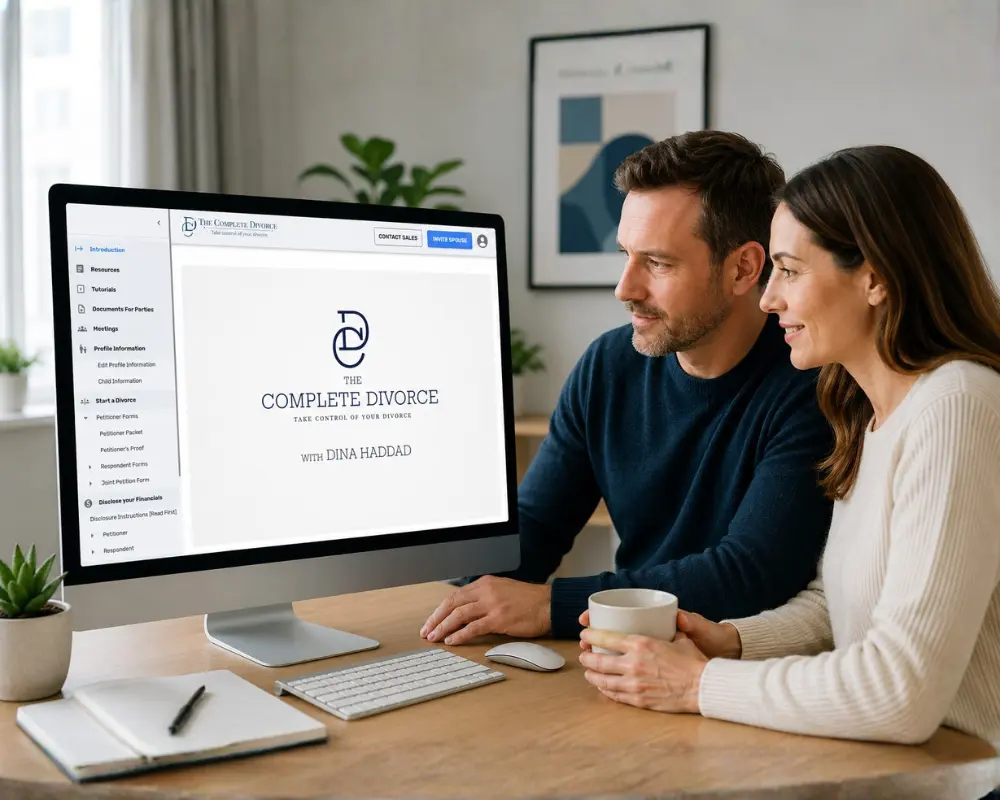
California allows you to file for an online divorce without a lawyer, or alternatively, using a fully guided divorce. You can file for divorce yourself, and in most cases this benefits the parties a great deal, because the cases are so simple that they don’t even require court hearings.
A simple divorce or legal separation can be finalized without appearing before a judge. For legal separation — unlike divorce — you only need to agree on the issues, as it has no residency requirement.
Gather all of the necessary documents and information. Physical and financial preparation is one of the most important steps in a divorce. You’ll need a realistic post-divorce budget and a clear understanding of your assets and debts.
Filing begins the divorce process, but note that California provides different forms for different aspects of a divorce.
For example, the FL-100 starts the divorce, while the FL-110 is used to notify your spouse that you have filed a divorce action. Familiarize yourself with the forms, then fill them out as accurately as possible. Print two copies of each and submit one to the court for proper documentation. You can keep the other for your personal records
The next phase is to give the divorce papers to your spouse to acknowledge and sign. You can notify them of the proceedings in person, through a process server or sheriff, or by other legal methods.
Before delivering them, make sure the information in the documents is accurate. This will prevent complications later in court.
Once served, your spouse has 30 days to respond to the divorce and agree to the terms you specified. If they respond and agree, the divorce can proceed smoothly.
But if they fail to respond within the 30-day period, you can ask the court to enter a default judgment based on the information provided.
A default judgment allows the court to grant the divorce without input from your spouse. However, this only happens if your spouse was duly notified and deliberately chose not to respond.
Once the court has received your documents and the six-month waiting period has passed, you can submit the final divorce agreement — such as a marital settlement agreement (MSA) — to the court to finalize the divorce or legal separation.
California offers various forms to address the different areas of a divorce, which allows for greater accuracy. These forms contain legal jargon and can therefore feel complex to non-lawyers, which may tempt them to make mistakes in cases of self-representation, DIY, or e-filing.
While bringing in an attorney to complete the forms adds extended billing, higher divorce costs, and more conflict, it does prove beneficial for avoiding incomplete filings and errors.
However, The Complete Divorce was created with the whole picture in mind — divorce cost, court rejection, paperwork errors, court backlogs, and convenience. For a simple divorce case, it’s better to equip yourself with The Complete Divorce through its monthly subscription and/or by reading its free resources. For now, here are five steps to help you fill out the forms accurately:
Read all of the necessary information and instructions before attempting to fill out the forms. Misinterpreting or misunderstanding the information will lead to issues further down the line.
Gather the necessary information before filling out the forms and filing the petition. This includes everything from your marriage license to your financial documents.
Make sure the information you provide is accurate and reliable. You can make filling out the forms easier with TCD, as we guide you through each part of the document.
Divorce in California comes with some additional costs, primarily the court filing fee, which costs $435–$450. This fee covers the cost of processing your paperwork in court after you’ve submitted the documents.
You may also pay other fees for amendments and other filings. If you are using a lawyer, you may pay a retainer fee of $5000 to $50,000. But you don’t always need a lawyer as you can file for divorce yourself and even online at your own convenience.
It’s also worth noting that if you can’t pay the filing fee for divorce in California, you can request a fee waiver by completing the Request to Waive Court Fees Form (FW-001). This also requires you to submit financial details for the court to decide whether to approve your request.
With this, you can technically get a free divorce if the California courts assess your finances and determine that you truly cannot afford the filing fee.

In California, the divorce timeline depends heavily on the specifics of the case, along with state regulations. Typically, it takes around six months from filing to finalization.
This time frame includes the mandatory six-month waiting period after divorce papers are served, which is intended to allow for any attempts at reconciliation and to ensure that both parties have adequate time to deliberate on the decision.
However, The Complete Divorce streamlines the process and makes it significantly more convenient and faster by ensuring that all necessary documents are completed and submitted on time. This means your case takes the shortest possible time and isn’t delayed unnecessarily.
With our guided divorce program, you’ll be done sooner than you think — saving yourself weeks, even months, of correcting errors and waiting for your case to be addressed.
After a divorce, child support and custody become crucial considerations in the state of California as laws protect the child’s welfare during the divorce. If the parents have disagreements regarding custody and support, court intervention will be required.
Child custody can be categorized into two categories, legal and physical. Legal custody is the right to make important decisions that impact the child’s welfare, while physical custody is where the child resides. The court reviews parental and child factors like health, welfare, overall safety, substance abuse, parent’s ability to care for the child, etc to determine custody.
For determining the child support, courts review both parents’ income, time with the child, etc. The most important goal is enabling the child to feel safe, loved, and emotionally cared for while having a healthy relationship with both parents. These factors are necessary for the child to mature into a stable and independent adult.
The property division in California divorce is regulated by community property law, which implies that any property and liabilities accrued during the marriage are considered community property and are usually split equally between the parties.
On the other hand, the property acquired before marriage, or through gift or inheritance, is separate and remains with the respective individual. In an effort to ensure fairness in the distribution of property, the court takes into account several criteria.
These criteria include the marriage duration, the economic condition of both spouses, and other contributions that each spouse made to the family, such as income earning, household chores, and taking care of children.
The court’s objective is to ensure that every matrimonial property division is just considering all aspects of both party’s affairs. To lessen or avoid going to court, the spouses may take the option of dividing their properties and debts through mediation or other agreed-upon methods.
With this, there is no need to set aside a specific day to deal with the issues in court and have it done in an amiable fashion instead.
No. You do not need a lawyer to file an uncontested divorce in California. The Complete Divorce is a guided DIY platform: every court-approved, county-specific form and instruction you need is included, and a California divorce expert is available if you want your documents reviewed.
File an uncontested divorce in California by meeting the residency requirement, agreeing with your spouse on property, debt, support and custody, completing the court-approved forms, serving your spouse, and filing a marital settlement agreement with your judgment. Couples who agree on everything may also qualify for summary dissolution or a joint petition (FL-700).
Yes. If you want help filing your divorce papers, our California divorce experts offer “we file for you” and “we review for you” services, plus a divorce strategy session, so your paperwork is checked before it reaches the court.
To file for divorce in California you must have lived in California for at least 6 months, and in the county where you file for at least 3 months, before filing. If you meet the state requirement but not the county one, you can still file and amend later.
Yes, you will be required to enter credit card information when you sign up or buy our online or DIY divorce related services.
Yes. California courts accept divorce petitions prepared online, and you can complete an uncontested divorce without a lawyer and without a court appearance. You must have lived in California 6 months and your filing county 3 months. You prepare the court-approved forms, file them with your county superior court, serve your spouse, and the judge signs the judgment.
An online divorce in California costs the court filing fee of $435 to $450 plus the service you use. The Complete Divorce is $49.99 per month and you can cancel anytime. A contested divorce through an attorney typically runs $15,000 or more. If you cannot afford the filing fee, form FW-001 can waive it entirely.
The minimum is 6 months and 1 day from the date your spouse is served, because California imposes a mandatory waiting period that cannot be waived. Uncontested online divorces usually finalize in 6 to 9 months. Filing online does not shorten the waiting period, but it prevents the months of delay caused by rejected or incomplete paperwork.
Yes. If your spouse will not sign or respond, you can still finish the divorce in California by default judgment. After your spouse is served, they have 30 days to respond. If they do not, you may ask the court to proceed without their participation, and the judge can grant the divorce on the terms in your petition.
To file for divorce in California: confirm you meet the 6-month state and 3-month county residency rule, complete form FL-100 (Petition) and FL-110 (Summons) plus FL-105 if you have children, file them with your county superior court and pay the $435 to $450 fee, serve your spouse, exchange financial disclosures (FL-140 and FL-141), and submit your judgment. Irreconcilable differences is the only reason you need to give.
The best online divorce service in California is one that is led by a California family law attorney, uses county-specific court-approved forms rather than generic nationwide templates, and has verifiable reviews. The Complete Divorce is founded and led by attorney-mediator Dina Haddad, a recognized Super Lawyer, and costs $49.99 per month versus $15,000 or more for a traditional attorney-led divorce.
Yes. The Complete Divorce supports all 58 California counties including Los Angeles, with the local forms and cover sheets each court requires. Los Angeles County also accepts electronic filing, so in most cases you can file your divorce petition without visiting the courthouse.
No. Agreement makes it faster and cheaper, but it is not required. California is a no-fault state, so one spouse can end the marriage on their own by citing irreconcilable differences. If your spouse does not respond within 30 days of being served, you can finish by default judgment.
In most uncontested cases, yes. If you and your spouse agree on all terms and your paperwork is complete and correct, a California judge can grant the divorce by written judgment with no hearing. A court appearance is usually only needed when terms are disputed or the judge wants clarification.