Online Divorce
Divorce smartly without a lawyer. Save yourself $10,000+.
- 100% Legit Divorce Program
Types of Divorce in California
When people search for “types of divorces in California”, they often expect several options. However, there is really only one legal method to obtain a divorce: dissolving the marriage.
Terms such as uncontested, contested, default, and Summary Dissolution, all represent the different ways an individual may go through their divorce – but essentially it is still a divorce. Instead, they are just different procedural paths.
The Complete Divorce – California’s most prestigious and comprehensive program allows parties to divorce amicably, online that save uncontested divorce couples from trauma and spending hundreds and thousands of dollars. From expert guidance, divorce forms to support calculations, The Complete Divorce has everything for you in their divorce tool kit. Start your divorce today for just $49.99/mo subscription.
This article will walk you through the different types of divorces (aka procedural paths), to help you choose the one that best suits your situation.
Start your FL-100 Petition. Our software is easy to use – led by California divorce attorney, Dina Haddad.
These two answers rebuild the rest of the interview. Whole sections appear or disappear — you'll never be asked something that doesn't apply to you.
Every answer saves the moment you type it. Close the tab, come back next week, land on the same question.
These two answers tick the case type and the residency box on page 1 of FL-100. Next come your dates.
The date of separation is when you decided to no longer be married (both by words and actions).
The date of separation must be after the date of marriage.
These five answers fill page 1 of FL-100 — the case type, the residency box, both dates and the children box. Print the form from the panel on the right and they are already on it.
Building your FL-100…
Warning
To file for divorce in California, at least one spouse must have lived in the state for six months and in the county where filing for at least three months to file for divorce. This doesn't apply to legal separation. Consider changing your response.
Types of Divorce in California: Processes, Filing Options and Legal Paths
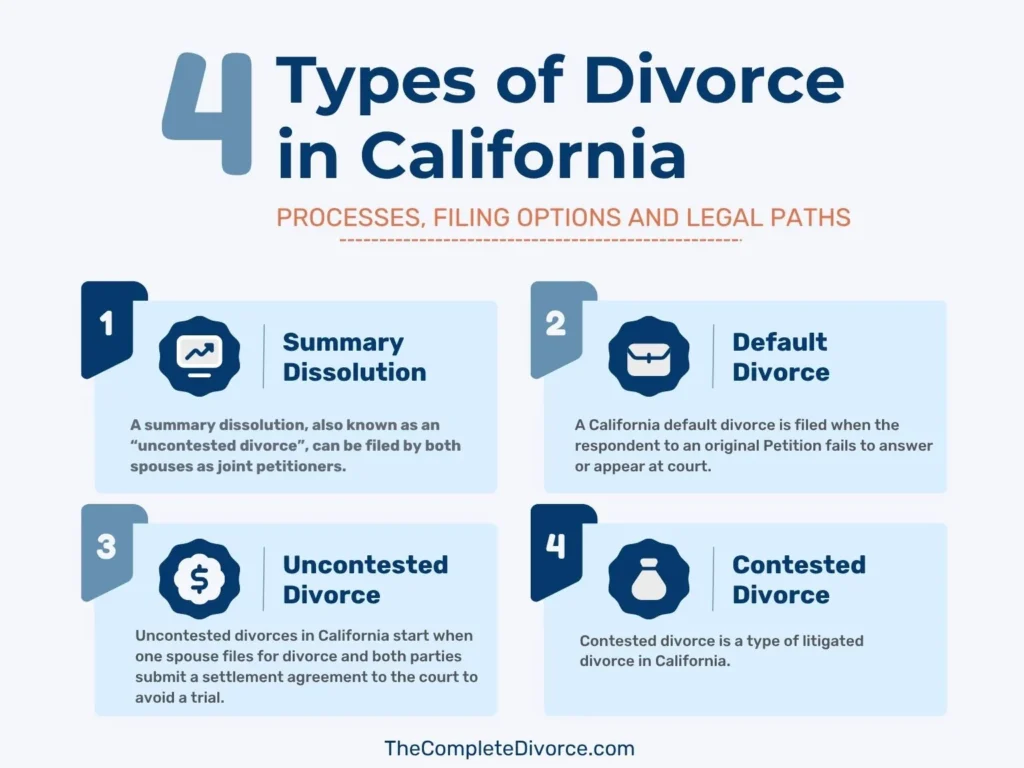
When referring to “types” of divorce in California, there is an important clarification: California will recognize only one legal action; dissolution of marriage. The terms such as summary dissolution, uncontested, and contested are merely procedural paths by which the California court determines how quickly or slowly the divorce process will unfold.
Under the California no-fault law system, you can simply end your marriage for irreconcilable differences. In order for either party to initiate the filing process, one spouse must meet specific residency requirements in the State of California: six months total in-state, and at least three months within the county where they wish to have their divorce filed.
Regardless of what procedural route is taken, all cases begin with the same two divorce documents in California: FL-100 (Petition), and FL-110 (Summons).
Both spouses must also fill out financial disclosure forms such as FL-140, FL-142, and FL-150. There is a required six month wait time from the date your petition is filed for both spouses before the court issues a final divorce decree. The following are the procedural paths/types of divorce in California.
See More: Filing a Divorce by Yourself
1. Summary dissolution
A summary dissolution, also known as an “uncontested divorce”, can be filed by both spouses as joint petitioners. As such, there is no need for service of papers.
This is available to couples that have been married less than 5 years, do not have any minor or adult children from the marriage, do not own any real estate; and do not have issues regarding marital assets and financial obligations which they cannot agree upon.
There are filing fees associated with the processing of a summary dissolution and also a 6 month wait after filing before you can obtain your decree.
Benefits:
- Simplified divorce process
- Few court hearings are required
- Low paperwork requirements
You don’t always need a lawyer for this process. A summary dissolution can be done more easily through DIY, fully assisted divorce options.
DIY services like The Complete Divorce help you in the filing process, ensuring all documents are present and filed correctly. Learn more about summary dissolution information (FL-810).
2. Default divorce (when one spouse does not respond)
A California default divorce is filed when the respondent to an original Petition fails to answer or appear at court.
Scenario 1: The true default – the petitioner continues through the divorce process on their own without the input from the other party. The court will review the documents provided before entering a Judgment.
Scenario 2: Default with an agreement — While the respondent has failed to make a formal appearance at court, they agree to enter into an agreement. This contract settles important issues like property distribution, child custody/visitation and spousal and/or child support.
The respondent will sign the final agreement, often a Marital Settlement Agreement, but will not formally appear in the matter by filing a Response or signing the Appearance, Stipulations and Waivers (FL-130).
3. Uncontested divorce (agreement-based divorce process)
Uncontested divorces in California start when one spouse files for divorce and both parties submit a settlement agreement to the court to avoid a trial. Each party will also have agreed upon all matters of their divorce, such as child support, custody, spousal support, and division of property.
Benefits include:
- Faster timeline.
- Legal fees are lower than they would be if going through a contested trial.
- There is less conflict.
If you prefer a DIY divorce without a lawyer, services like The Complete Divorce can help make sure your filing is correct and complete.
4. Contested divorce (litigated divorce proceedings)
Contested divorce is a type of litigated divorce in California. In a California contested divorce, both spouses have differing opinions about community property distribution, child support, or custody which requires the couple to go before the court.
Litigation includes:
- Discovery (the exchange of information)
- Court appearances
- Negotiation, and trial (where the judge determines the final decision)
Due to its complexity, most people require an attorney to represent them in their case. On the other hand, many choose to reach an agreement through a mediator like Families First Mediation. At The Complete Divorce we also offer a mediation session to help parties turn their slightly contested divorce to uncontested divorce.
Read more: Learn about the divorce costs in California
No Matter What Procedural Path You Choose, Divorce need to be Easier.
Regardless of which divorce option you choose, your ultimate objective is to obtain a final judgment of divorce. This is an official document issued by the court ending the legal relationship of husband and wife.
A divorce cannot become effective until at least six months after it has been initiated as required under California law. Once all paperwork and agreements have been completed and signed and submitted to the court, the judge will then sign off on the Final Judgment.
Filing your divorce paperwork incorrectly can lead to months of delays and even rejection. Fortunately, services such as The Complete Divorce can assist you with ensuring that your documents are accurate and on time. We can help you take control of your uncontested divorce and move forward with confidence. Start your hassle-free divorce today.

Written By:
Dina Haddad
Divorce Attorney — Mediator & Founder of The Complete Divorce
“Hi. I’m Dina Haddad, a divorce attorney-mediator here in California. I’m so tired of couples not having a process that’s easy to complete their divorce. They are getting lost, wasting time and money, and beyond frustrated with their results.
That’s why I created The Complete Divorce, California’s premier online divorce program. I took my successful mediation practice and condensed it into an affordable and winning program.”
FAQ — Divorce Types
Q. What is the fastest type of divorce in California?
Summary Dissolution (California) or uncontested divorce are the two fastest options as they do not require any court appearances that delay the process. However, both types of divorces will have a required six month wait after filing for dissolution.
Q. Can a spouse stop a divorce?
No. California has a “no fault” system which allows a spouse to cite “irreconcilable differences,” regardless of whether or not their spouse agrees with this characterization, and continue through the divorce process.
Q. What’s the difference between contested and uncontested divorce?
A contested divorce California is when there are disagreements about issues such as assets, debts, children etc., and therefore requires court intervention. On the other hand, an Uncontested divorce means that you and your spouse agree on all aspects of your divorce.
Q. How long does divorce take?
The divorce timeline in California consists of a minimum of six months and one day after either the service of process was completed or when you filed jointly. Depending on how complicated your divorce case is, it may take longer than the minimum amount of time.
California premier divorce program.
Making California divorce simple and lawyer-free.
- Filing & Review Support
- 1-on-1 Divorce Meeting
- Child support calculations
- MSA Filing Support
 ⭐⭐⭐⭐⭐
⭐⭐⭐⭐⭐
2000+ divorced without a lawyer.