
A blank FL-110 summons can look frightening with both the English and Spanish sections filled with legal jargon. Luckily, you only need to complete a few fields.
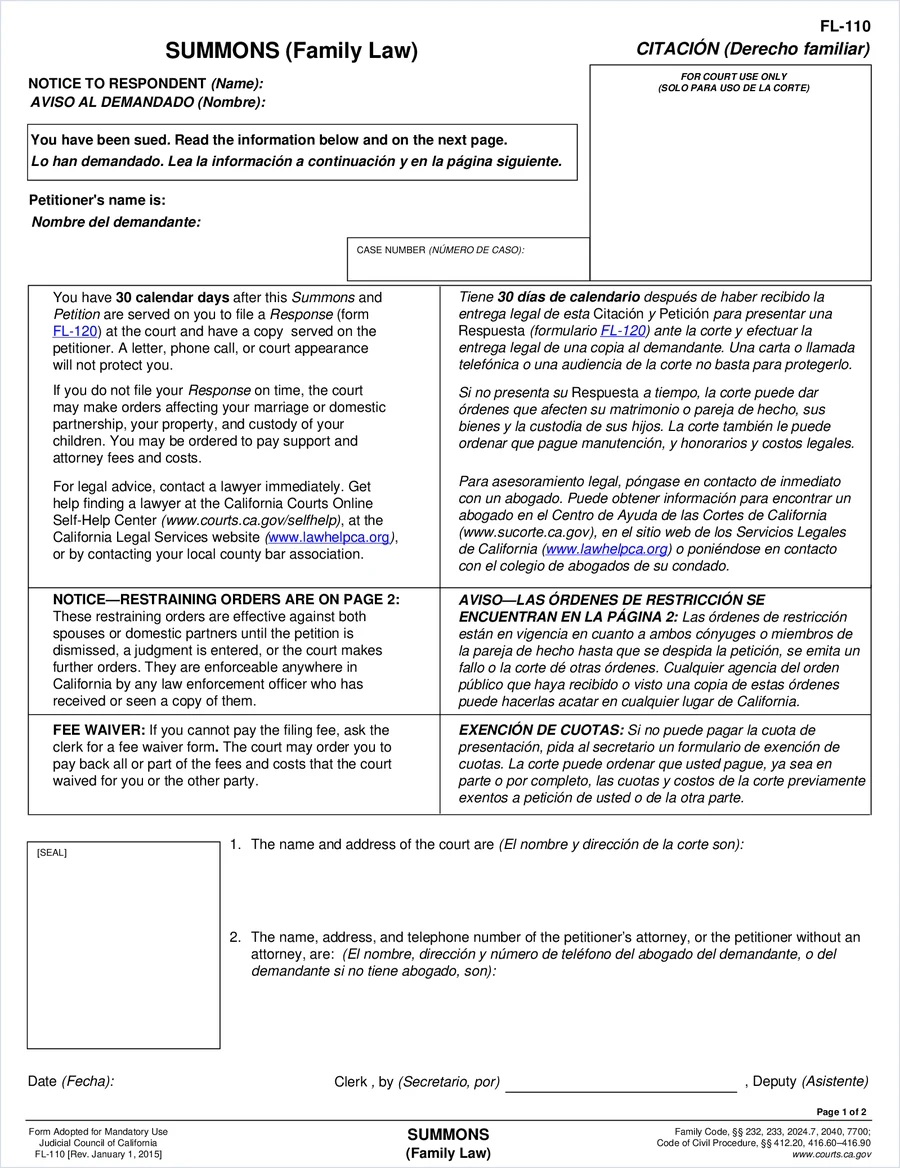
A blank FL-110 summons can look frightening with both the English and Spanish sections filled with legal jargon. Luckily, you only need to complete a few fields.
The court clerk fills in the rest. This guide will describe each field on pages 1 and 2, explain what to leave blank, and provide tips to avoid filing delays.
If you want assistance with your FL-110, the other forms, or even the entire divorce — The Complete Divorce is here to help you from start to finish.
California attorney-mediator, Dina, has everything for couples they need to finish divorce amicably. Start your divorce amicably with $24.99/mo and move forward with confidence.
The FL-110 is the official California family law divorce summons. It notifies the respondent that a divorce case has been filed, provides the due date to respond, and notifies the respondent of the automatic restraining orders (ATROS).
FL-110 has two functions. The first is to notify the respondent of the case and to provide the respondent the opportunity to respond.
The second is to provide standard family law restraining orders also known as ATROS, which are included on the second page of the form. These restraining orders address issues involving children and issues regarding insurance and property.
Fl-110 is used by the Judicial Council statewide for divorce, legal separation and nullity cases. The form cannot be substituted for a letter.
The 30-day period for the respondent to file a response begins the day the respondent is served. The ATROS protects the petitioner from the respondent beginning when the summons is filed, and the respondent is served.
Making Your California Divorce Paperwork Easier Than Ever
Want Help with FL-110? Let us be on your side.
Get your paperwork error free with The Complete Divorce expert-led sessions, divorce workshops, and divorce forms video tutorials.
 ⭐⭐⭐⭐⭐
more than 2,000 California couples helped
FL-110s are served with FL-100s but they differ from each other. FL-100s are your requests to the court.
You sign them and provide the court with your proposals regarding property, spousal support and custody.
The FL-110 is a summons, and notifies your spouse of the case, and provides them with the date by which they must respond to the petition. You do not sign the FL-110.
The FL-110 and FL-100 both belong in the filling packet, and will also be served with a FL-105 Declaration, if you have minor children.
The spouse who begins the case, known as the petitioner, fills out information on the FL-110. Once the court clerk reviews and accepts the filing, a summons is issued.
Complete the Respondent’s information, the Petitioner’s information, information for the court, and your contact information. Leave the case number blank, the court clerk assigns numbers after accepting a case.
Don’t complete the date, or the signature of the clerk or deputy, or court seal. Leave the pre-printed language unchanged. You do not sign the FL-110. The court clerk signs and dates the summons.
Related: Can You Divorce in California If the Spouse Won’t Sign?
Get all your information before filling out the FL-110. Courthouse details, your contact information, and both spouses’ legal names are required.
You can prepare for these documents using a Pre-Divorce Checklist and Do-It-Yourself Divorce Checklists for the necessary steps to take before filing.
Also make sure you use the latest California Divorce forms. Check the revision date at the bottom of the forms. Older forms will most likely get rejected.
Check your residency requirements. At least one spouse must live in the state of California for at least 6 of the last 30 months and at least 3 months in the county of the court of filing. Spell both legal names as they appear on government identification.
Also be prepared to pay the filing fee. The first appearance fee is approximately $435 – $450. If you cannot afford it, consider the FW-001 fee waiver process.
Page 1 is where you enter your information to file your divorce. Complete the form in the order it appears. Some fields are left for the clerk to complete. These instructions will explain each field.
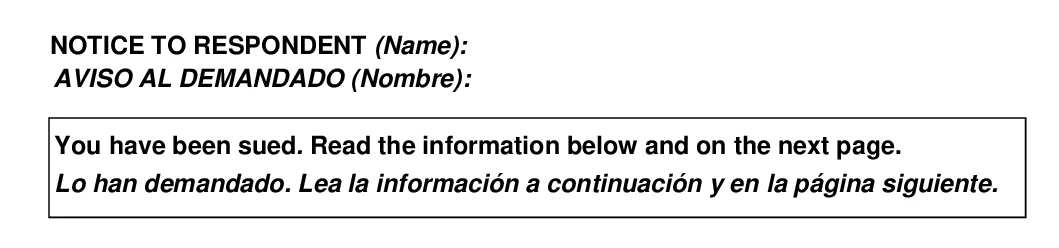
The respondent is your spouse who is not filing for divorce. You are the petitioner. On the line provided, write your spouse’s full legal name as it appears on their ID.
Use your spouse’s full legal name including middle name. The Court wants the complete legal name. Do not use nicknames, initials, or alternate names.
The form is bilingual but you only need to complete the English side and leave the Spanish line empty.

On the line provided, enter your full legal name as it appears on your ID. The name must be exactly as it appears on your ID and FL-100 (Petition for Dissolution of Marriage) in order for the court to process your paperwork and create the final judgment of divorce.
The case number is assigned by the court and given to you once your petition is filed.
The case number should not be guessed or reused from an unrelated case. An incorrect entry will cause a delay in processing.

Insert the name of the branch of the Superior Court handling your divorce. Also provide the address of the branch you have identified.
You can check the Court’s website and use the branch name and address listed. Some counties have several courthouses, and family cases may go to a different building from civil cases.

Since you are not represented by a lawyer, you will have to provide your contact information. You will give your name, your mailing address and your telephone number.
The court and your spouse will use this information to contact you and send you court documents. Use a mailing address where you will receive court documents. Do not leave this section blank.

Leave the bottom section and court seal box entirely blank. These are completed by the clerk once your paperwork is accepted, including the issue date, a signature, which is printed “Clerk, by ____, Deputy”, and the court seal.
A clerk’s signature and court seal formally issue the summons. An endorsed-filed stamp is a court document stamp that indicates the court received and filed your paperwork.
It is different from the clerk’s signature and issuance of the summons. Do not sign or date either of the sections yourself.
Page 2 has no fields for you to complete, but read it before filing. It has four automatic temporary restraining orders (ATROS) and two legal notices.
These orders become effective as soon as the divorce case is filed. You do not need to request these orders from a judge.
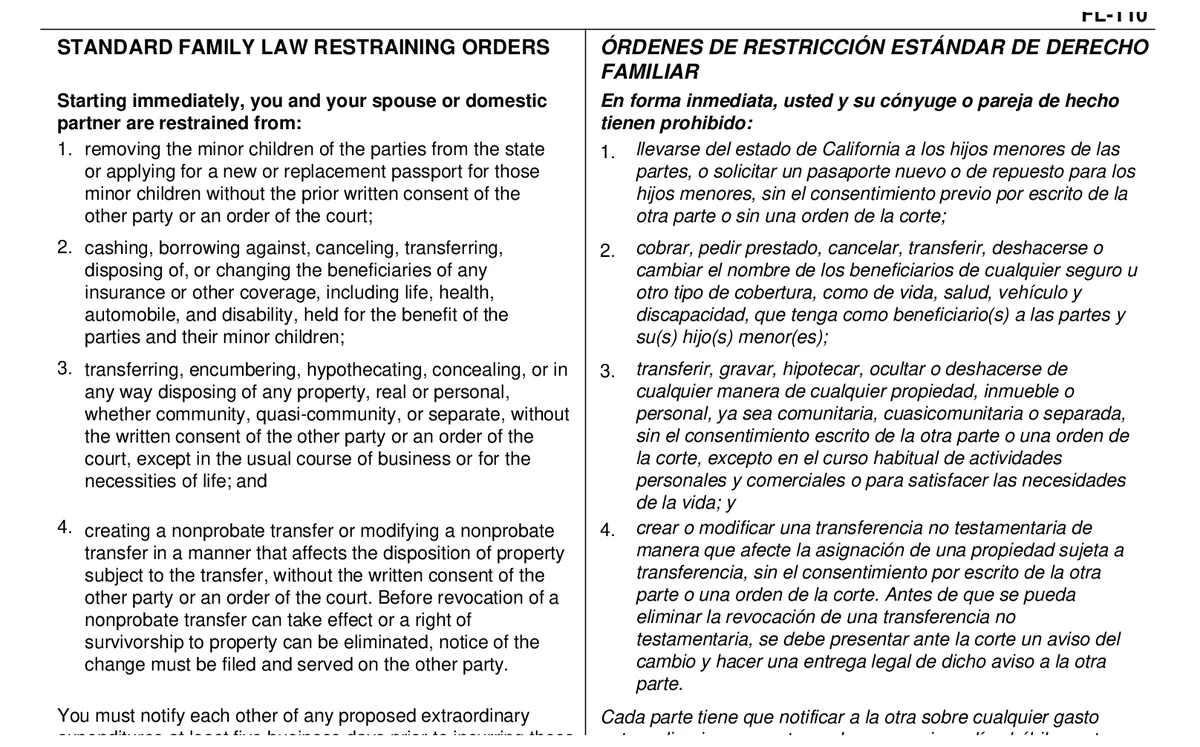
The FL-110 restrains both spouses from:
You can use property for the necessities of life and pay attorney fees. Other extraordinary expenditures require written consent of the other spouse and at least five days’ notice to the other spouse and an accounting to the court.
The ATROs bind both spouses but activate at different times. Per Family Code §2040, the petitioner becomes bound when the summons is filed.
The respondent becomes bound when served. After the summons is filed, closing a joint account, removing a spouse from health insurance, or selling a car becomes a violation of the orders. Make sure you check the orders before altering financial or property situations.
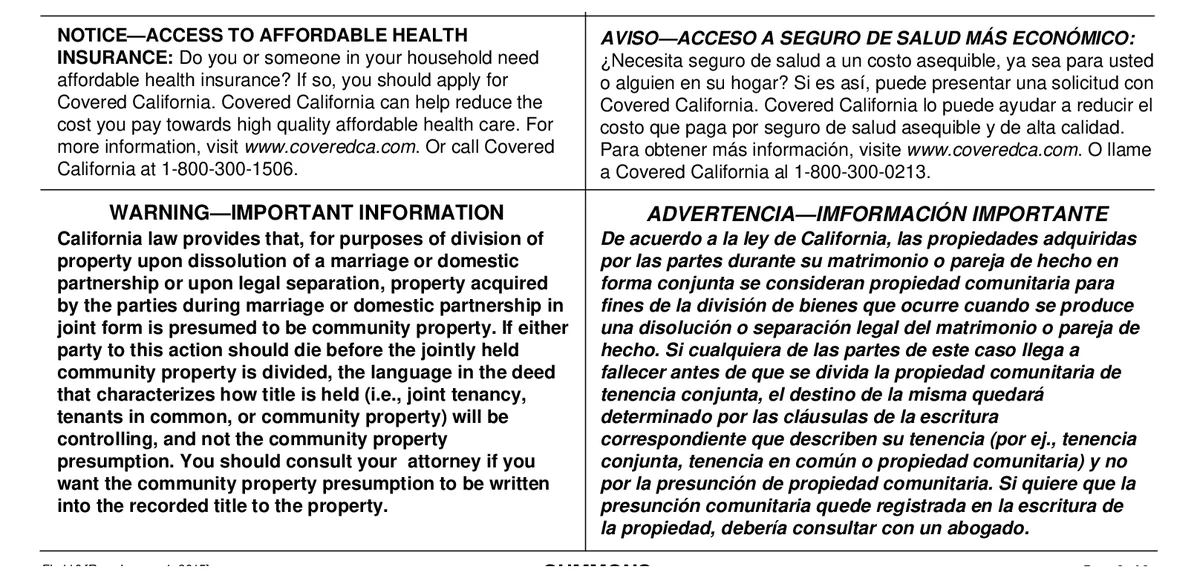
Two informational notices appear at the bottom of page 2. The Covered California notice provides information on health insurance for spouses who lost coverage and how to find more affordable coverage options.
The community property notice details the presumption that jointly titled property belongs to both spouses and how deed and title language affect ownership when a spouse dies. You do not have to complete either of these notices.
The FL-110 is just the first step. It must be filed with your FL-100 Petition and other necessary child-related forms.
After the clerk issues a summons, arrange to have it served on your spouse. Proof of service must be filed with the court. Your spouse has 30 days from the time service was made on him or her to respond.
The completed FL-100, FL-110, and any required supporting forms must be filed with the Superior Court clerk in your filing county.
Many counties permit or require the filing to be done through an approved electronic means. Other counties have their own set of rules for self-represented filers. Los Angeles County has specific rules for the paper-filing process.
To find out what your county court’s rules are, check your county court’s website. The current filing fee is approximately $435 to $450, depending on what county your case is filed in.
To have the filing fee waived, complete and submit Form FW-001 to the court, it’s one of the few ways to file for divorce without money.
You cannot serve the divorce papers yourself. Someone who is at least 18 years of age and is not involved in the case and is not a process server must serve the FL-110 and FL-100.
The server fills out FL-115, Proof of Service of Summons and gives it to you to give to the court. Your spouse has 30 days from the date served to fill out the FL-120 Response.
Minor mistakes on the FL-110 can result in a delay for filing your divorce papers. Before handing in your paperwork, make sure you have done the following:
Since January 1, 2026, spouses that come to an agreement on all terms of divorce can, under SB 1427 (Chapter 190, Statutes of 2024), file a joint petition for divorce as indicated on form FL-700, listing each of them as “Petitioner 1” and “Petitioner 2,” respectively.
With a joint petition, there is no respondent. Therefore, neither spouse needs an FL-110 summons, and there is no service of process between them.
However, within 60 days of filing, each spouse must exchange a preliminary declaration of disclosure as required by the Family Code §2104.
Couples with few assets and no minor children can also consider summary dissolution in California. However, for those spouses with disagreements or unresolved terms, the FL-100 and FL-110 processes still apply.
Doing the FL-110 yourself means reviewing court requirements, completing the right forms and double-checking field accuracy.
The Complete Divorce does the legwork with county-specific preparation and reviews the FL-110. It prepares the whole initial filing packet for your court.
Each form gets a thorough review by a family-law expert in California. TCD also provides help in serving your spouse and with filing proof of service, as well as same-day processing.
They can assist you with the initial petition and through the final judgment including using the FL-700 to accomplish a joint petition.
You can remain in control over your divorce case without having to hire a full-service attorney, giving you an affordable uncontested divorce in California. The Complete Divorce minimizes the risk and guesswork by reviewing and preparing the FL-110 for you.
The FL-110 may look long and difficult, but it really isn’t that complex. You don’t complete most of the fields.
Review the current form and check your entries. File it with your petition, let the clerk issue it, serve your spouse, and file proof of service. Remember, the ATROs restrict you from filing.
Complete the form carefully, or let The Complete Divorce handle the paperwork. Start your divorce with The Complete Divorce for $24.99/mo.

Divorce Attorney — Mediator & Founder of The Complete Divorce
“Hi. I’m Dina Haddad, a divorce attorney-mediator here in California. I’m so tired of couples not having a process that’s easy to complete their divorce. They are getting lost, wasting time and money, and beyond frustrated with their results.
That’s why I created The Complete Divorce, California’s premier online divorce program. I took my successful mediation practice and condensed it into an affordable and winning program.”
No. The court clerk signs and issues the summons. You don’t have to sign it.
The court clerk assigns the case number so you don’t have to put in a number.
If you don’t have a lawyer, you fill in your name, address and phone number.
Approximately $435 to $450. But if you are low-income you can submit a Form FW-001 to get the filing fee waived.
These restraining orders are to prevent both spouses from removing the children from California, changing the other spouse’s insurance, and transferring, concealing or disposing of property, or non-probate transfers.
You have to put the full name and street address of the Superior Court branch in the county where your divorce is being filed.