
Get California Online Divorce Forms for $49.99/month– Limited Time Offer!
Read our blogs to get tips on California uncontested, online, and DIY divorce.

The Judgment form, FL-180, is the final judgment form for divorce or legal separation in California and legally enforces the orders on asset division, child custody, and spousal support.
This is the closest you will find for a California divorce certificate. Errors in the FL-180 can cause delays to your case and result in costly penalties.
Fortunately, this guide will walk you through each section of the FL-180 along with annotated screenshots and tips if you are self-filing.
Need Help? Our affordable Guided DIY Divorce Program gives you real-time support, checklists, and video tutorials on how to complete the FL-180.
Visit ‘The Complete Divorce’ and sign up today to start your divorce without needing a lawyer.
Making Your California Divorce Paperwork Easier Than Ever
Want Help with FL-180? Let us be on your side.
Get your paperwork error free with The Complete Divorce expert-led sessions, divorce workshops, and divorce forms video tutorials.
 ⭐⭐⭐⭐⭐
⭐⭐⭐⭐⭐
2000+ Couples Successfully Divorced
The FL-180 is the official Judgment form created by California to finalize divorces, legal separations, and annulments.
This is as close as you get to a divorce certificate. It provides legal documentation of the court’s decisions on dividing assets, child custody, and support.
Your divorce will not be finalized if you do not properly complete the FL-180, even if you and your spouse agree on all aspects of the divorce.
The FL-180 finalizes the terms of a divorce and is enforced in default divorces, uncontested divorces, and contested divorces. In default divorces, it finalizes terms on asset division, child custody, and support when one spouse fails to respond.
In uncontested divorces, it confirms the terms agreed to by both spouses, while in contested divorces, it reflects the binding orders of the judge after a trial.
The FL-180 Form can be used in a dissolution (divorce), legal separation, nullity (annulment), or termination of a domestic partnership.
In addition, when a judgment FL-180 Form is filed with the court, it finalizes either temporary orders or orders made by the court after a trial.
Once the FL-180 is finalized, the two parties’ child custody, financial, and property obligations become enforceable judgments at law that both parties are legally bound to comply with.
The Judgment form, FL-180, includes:
Check all that apply:
Missing information or documents can delay or invalidate your judgment, which can make you go through the key stages of a divorce much slower.
Submit the Judgment form, FL-180, after reaching your settlement or court trial. If parties have reached an agreement, like a Marital Settlement Agreement, it will be attached to the FL-180. yo..
Make sure to avoid unnecessary delays by:
Time frame for processing: 4-12 weeks.
You can proceed through the divorce timeline in California quickly with no errors slowing you down if you file the divorce forms correctly. This guide will take you through every step of the judgment filing, from preparing your documents to filing, helping you avoid rejections.
You’ll want to start off strong with a complete set of paperwork in hand. The required documents you will need are:
Pro Tip: You can create a folder specifically for the divorce – digital or paper – to stay organized. You can save yourself weeks of processing by having all forms available.
You need to be precise and accurate when filling these sections to prevent the courts from rejecting your form. Here’s how to do it section by section:
Attorney or Self-Represented Party:
Contact Details:
Pro Tip: Self-represented parties should write “SELF-REPRESENTED” in the attorney field.
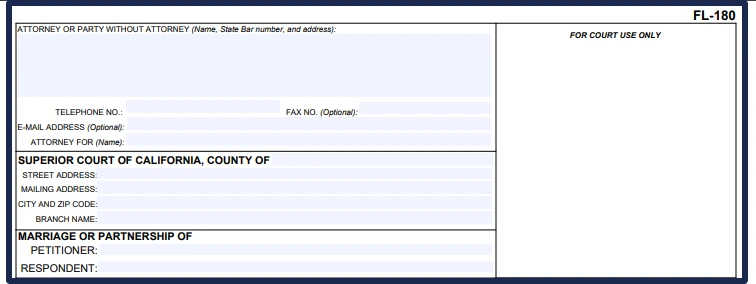
Mark one box only:
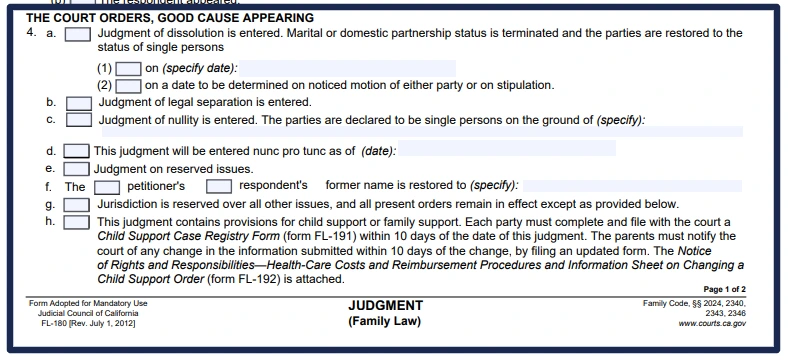
For Dissolution:
Legal Note: “Nunc pro tunc” is rare – consult an attorney before using.

Safety Alert: These orders are enforceable immediately upon signing.
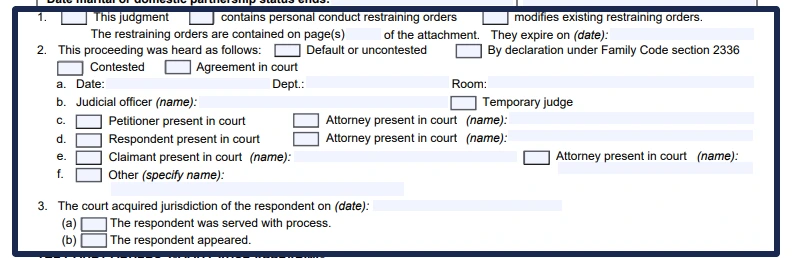
Only check one:
Complete all applicable sub-sections:
Pro Tip: For default cases, include service date (Proof of Service required).
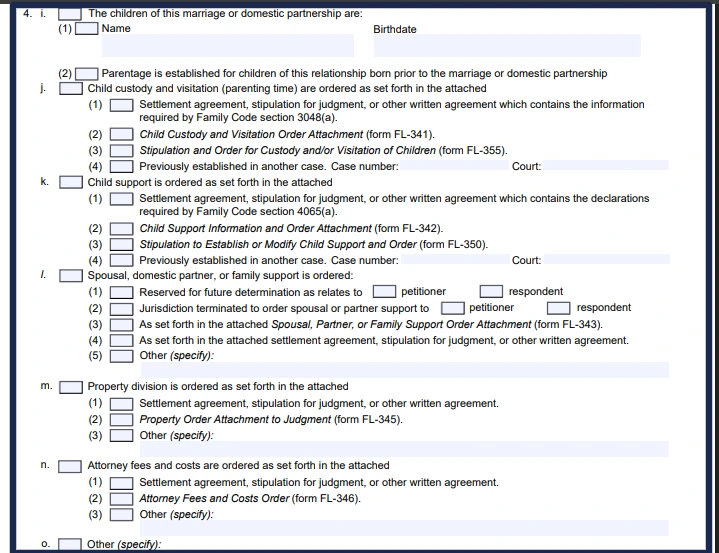
Attach either document depending on your situation:
A. Custody/Visitation:
B. Child Support: FL-342
Required: Complete FL-191 (Registry Form) within 10 days.
Attach either document depending on your situation:
A. Spousal Support:
B. Property Division:FL-345
Key Advice: Describe assets/debts with specific identifiers (account numbers, VINs).
Critical Tips:
File the original completed form along with the required copies with the court clerk to finalize your submission.
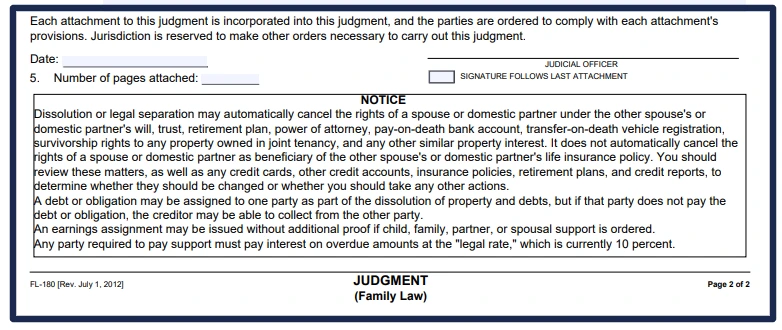
Failure to include the right court forms can result in your Judgment being rejected. For child support orders, you must include:
If a property needs to be divided, it is important to address the details for ownership. For example, include instructions on when the title will transfer or whether the mortgage must be refinanced, and by when, by the party taking ownership.
If pensions are being split, you will want to include instructions on who will be responsible to obtain the QDRO and the timing to do so. If an account has to be closed or funds divided, by when and who is responsible to do so.
Deadly Error: If you fail to later obtain a QDRO for your retirement accounts, the court cannot enforce the division.
To file your Judgment, FL-180, either file it in person, send it by mail, or e-file where permitted by each county’s rules–check local court websites.
If you are filing online or doing it by yourself, be sure that all online filings are formatted and include payment confirmations.
Once you submit your FL-180, you should keep your copies of each document you submitted as well as verification of filing (receipts, timestamps) for your personal records.
If you file by mail, use certified mail with a return receipt to demonstrate the actual date of filing. If you filed electronically, be sure to preserve your confirmation emails.
To verify court acceptance of your FL-180, contact the clerk’s office 4 weeks after your filing.
When calling, have your case number on hand and confirm the status of your FL-180 form. Many courts have online case tracking systems as well.
For DIY uncontested divorces, look for a notice in the mail, it might state the next steps or a signed judgment copy. If you do not receive a notice within 30 days, follow up promptly.
“Connect with The Complete Divorce for expert assistance in preparing, reviewing, and finalizing your divorce forms. Trust divorce specialist Dina Haddad to guide you through the process with confidence.“
Once your FL-180 judgment is entered, a party can ensure compliance with the orders of the court by either filing a motion with the court or enforcing the judgment via wage garnishment.
However, modifications to permanent spousal support will require a substantial change of circumstance—a loss of income, relocation, etc. The modifications will be filed via the FL-300.
In order to comply with asset division, support, or custody orders, you will want to take note of all deadlines and payments and then document the violations with bank statements, emails, or parenting logs explaining the violations.
If your spouse violates the judgment in some manner, you will want to file an Enforcement Motion or Earnings Assignment Order (FL-195).
You may ask the judge to impose whatever penalty is appropriate, including wage garnishment, or lien against property, or contempt of court for non-compliance.
Property division is final in a judgment, unless it was reserved. However, spousal and child support can be modified.
Child support is modifiable if the current child support is no longer guideline child support. Permanent spousal support can only be modified by agreement or demonstrating a significant change of circumstance.
These include events like losing a job , retirement, or significant changes of income.
Mistakes on your FL-180 might slow your case down or void orders resulting in monetary loss or reopening cases against you.
The settlement agreement, such as a Marital Settlement Agreement, should carefully list out the ownership for each asset and debt.
Avoiding the following mistakes is one of the many keys to a successful divorce:
Forgetting or hiding assets can subject you to court penalties and unfair distributions. Make sure you properly disclose these assets in your disclosure forms. Then, its good form to have them properly listed in your final agreement as to how the ownership is being awarded. Full disclosure will best protect you from future challenges and fairly distribute the property under California’s community property laws.
Mixing community property with separate property creates a disastrous enforcement situation.
It is imperative that one is able to clearly identify how ownership is being allocated in the final agreement. The court can only enforce what has been clearly written.
Vague child support orders are impossible to enforce. Specify written amounts, payments duration, and any required extraordinary expenses (education expense, health care needs).
Use the required calculator forms, such as FL-342, for required calculations. Specified terms help prevent petitions to modify the orders and help ensure that support payments continue steadily without issue.
Pro Tip: Have another person look at your forms before filing. Other people will catch errors you may miss and save yourself time and money when filing your papers.
Visit The Complete Divorce for help avoiding these costly mistakes!
California's Best DIY Divorce Program
Get Divorce through our fully-assisted program
⭐⭐⭐⭐⭐
2000+ Couples Successfully Divorced
We offer a free downloadable checklist that covers all the FL-180 requirements, from having all your documents prepared, to the steps filing, and everything else in between.
Our detailed instructions include step-by-step instructions, court tips, and traps for the unwary.
With Dina Haddad’s experience in family law, you are in good hands when it comes to filling out accurate and marriage dissolution forms.
Get professional level assistance without the high cost of an attorney through our DIY divorce guides and tutorials. Sign up today and get your divorce finished with The Complete Divorce fully guided DIY divorce.
The FL-180 is critical for properly completing your California divorce. By completing the FL-180 correctly, you will ensure that any orders on property, custody, and support are enforceable.
Expert guidance can help you avoid unnecessary (and costly) mistakes.
The Complete Divorce provides an array of resources and checklists to make the process easier and more affordable.
Start your properly documented divorce today with The Complete Divorce!

Divorce Attorney — Mediator & Founder of The Complete Divorce
“Hi. I’m Dina Haddad, a divorce attorney-mediator here in California. I’m so tired of couples not having a process that’s easy to complete their divorce. They are getting lost, wasting time and money, and beyond frustrated with their results.
That’s why I created The Complete Divorce, California’s premier online divorce program. I took my successful mediation practice and condensed it into an affordable and winning program.”
Yes. The FL-180 is California’s official divorce decree once signed by a judge and legally ends your marriage and enforces all court orders.
This depends on your county’s rules. If your county allows you to e-file, then you typically do not need to notarize the FL180 documents. However, check your own county’s local rules.
A declaration for default is a sworn statement that your spouse did not respond (a default). An uncontested judgment means both agreed to terms (uncontested), and the court can now finalize your divorce without a trial.