
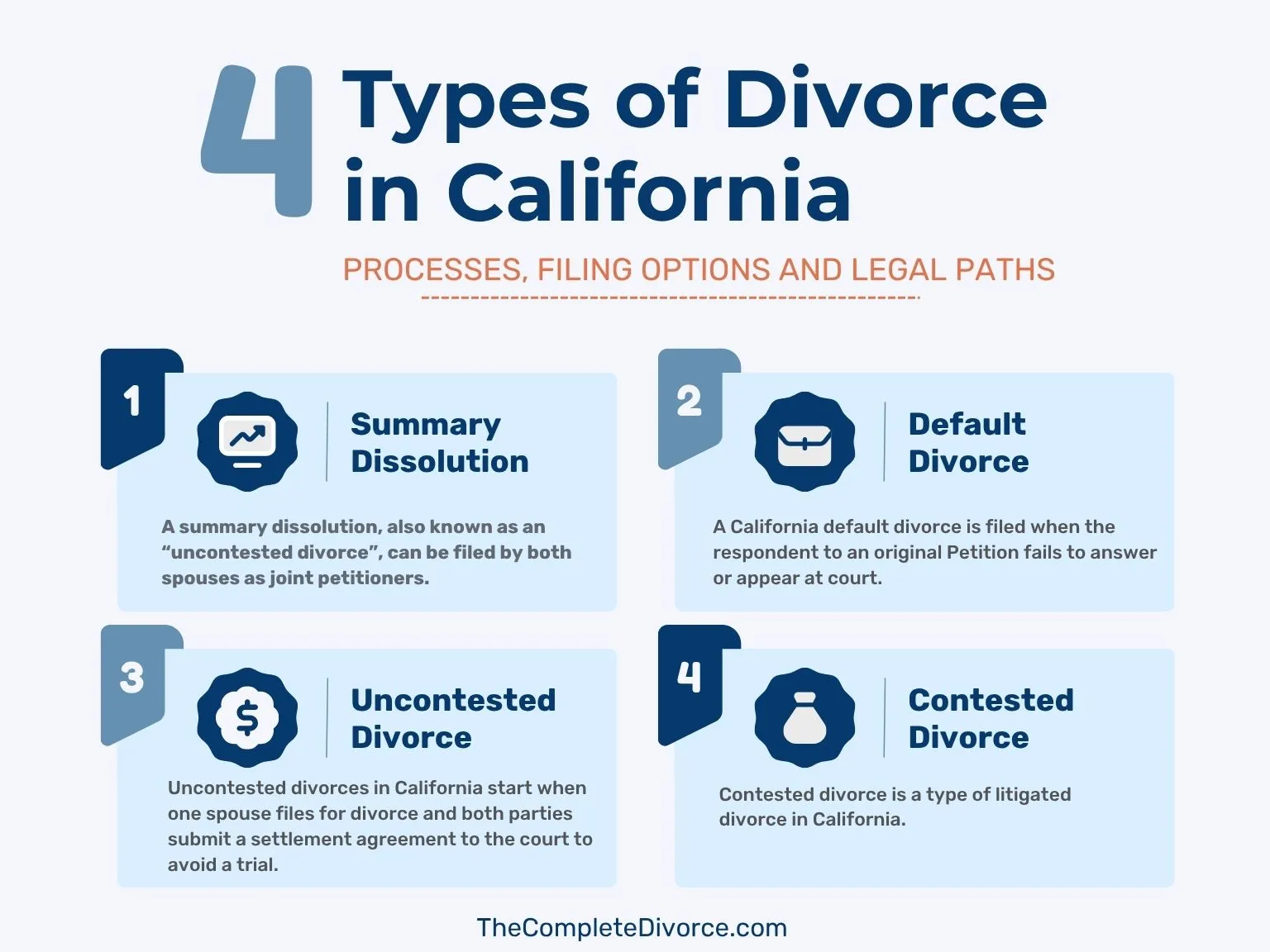
Explore the different types of divorce in California, including uncontested,
Online Divorce
Divorce smartly without a lawyer. Save yourself $10,000+.
If you have decided to end your marriage in California, you probably want it done as soon as possible, at a reasonable cost, and without going to court. The catch: California’s six-month waiting period cannot be waived, so no divorce can be finalized in less than six months and one day.
What you can control is choosing the right legal path, filing on time, and avoiding paperwork delays. This guide covers four ways to get divorced, including the new 2026 FL-700 Joint Petition, and how to finish without an attorney.
Start your amicable divorce with The Complete Divorce for $49.99/month today.
You can shorten the time a California divorce takes by choosing the right method, filing on time, and avoiding paperwork delays. What you cannot do is waive the six-month waiting period, even if you fully agree or face an emergency.
Knowing when the clock starts keeps you from losing weeks. How long a divorce takes in California depends on which filing process you use.
For a standard divorce, the waiting period begins when your spouse is served or first appears in court, whichever comes first. Filing your divorce documents does not start the clock, so file and complete service quickly.
Summary dissolution and the FL-700 Joint Petition have no separate service step: the clock generally starts once you submit all required documents. Either way, starting as early as possible avoids losing weeks before the clock even begins.
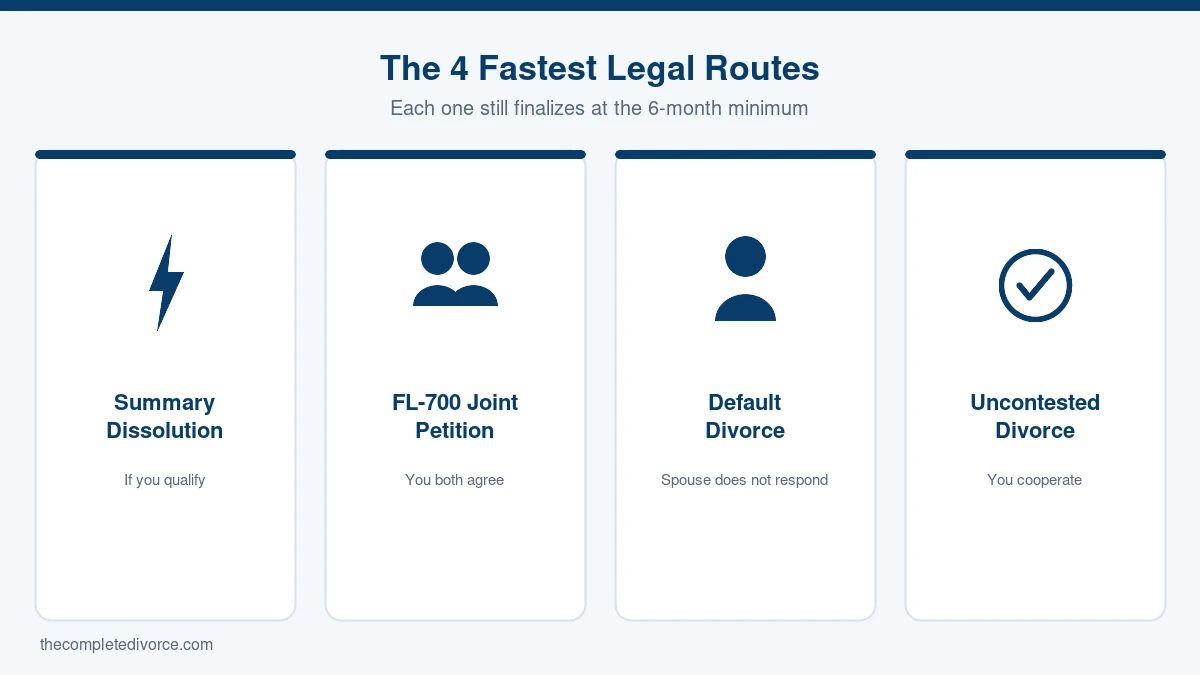
The best route depends on your situation. Summary dissolution is for couples who meet strict eligibility rules. The new FL-700 joint petition is for couples who fully agree. Default divorce works when one spouse will not respond. Standard uncontested divorce fits couples who generally cooperate.
Summary dissolution is California’s simplest divorce, but you and your spouse must meet every eligibility rule. In general, you may qualify if:
To start, read FL-810, complete your financial disclosures, and file FL-800 with your agreement. There are no court hearings, and your dissolution becomes final six months after filing.
Since January 1, 2026, California couples who agree on all final terms can file jointly, in addition to summary dissolution. Unlike summary dissolution, the joint petition is not limited to marriages under five years or capped by asset value, so it helps couples who fully agree but do not qualify for summary dissolution.
You complete Form FL-700 (joint petition) and Form FL-710 (joint summons), listing yourselves as Petitioner 1 and Petitioner 2. Because you file together, there is no process server and no 30-day response wait, though the six-month waiting period from filing still applies.
The limits matter: both parties must agree on every term. If either of you needs a judge to decide a dispute, or you stop agreeing at any point, the joint case cannot continue and you must use the standard process.
Because California is a no-fault state, an uncooperative spouse cannot stop your divorce. You must still serve your spouse properly and get the court’s approval. Learn more about whether you can divorce if your spouse won’t sign.
First, file your petition and serve it. If your spouse does not respond in time, you can file a Request to Enter Default (FL-165). You still must provide all required financial disclosures and documents before the court reviews your case. If you want a cheap uncontested divorce in California, you have two choices:
If you agree on all issues but either do not qualify for summary dissolution or do not want to file jointly, an uncontested divorce is usually the best path. One party files the petition and the other cooperates.
Together you exchange financial disclosures, agree on property division and any spousal support, prepare the marital settlement agreement, and submit the final judgment to the court. You can also request temporary relief if you need it. The six-month minimum still applies, and approval can take longer once your paperwork is complete.
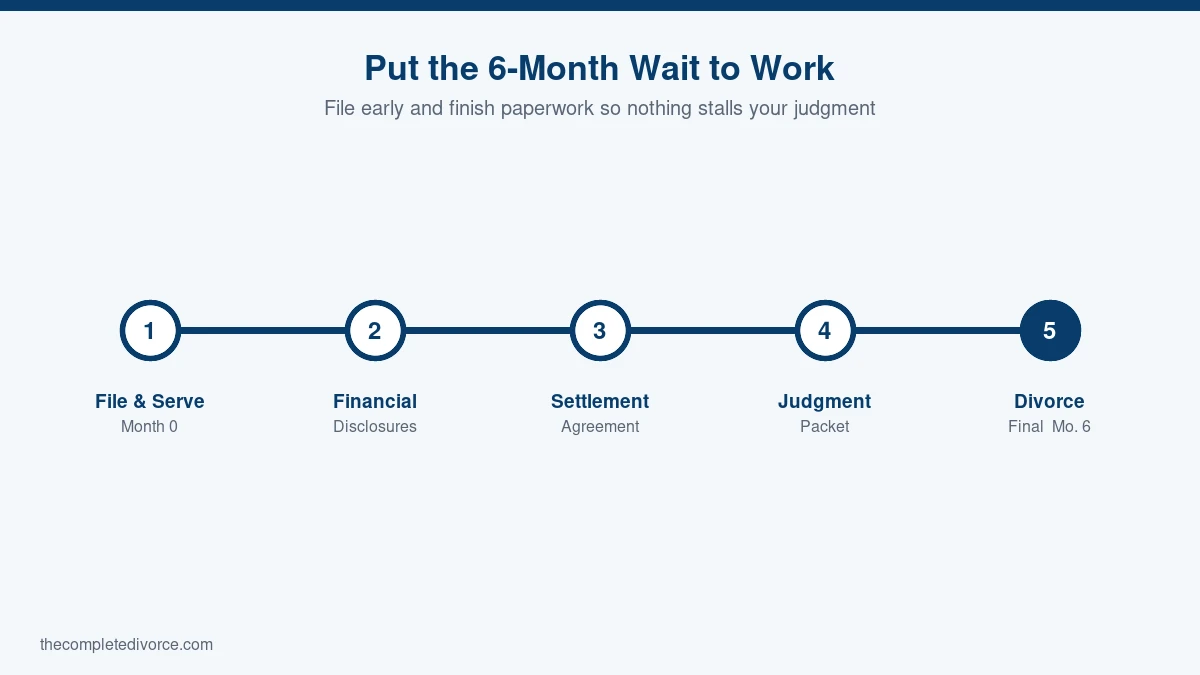
Filing your petition and serving your spouse right away lets you put the six-month waiting period to work. Finish as much paperwork as possible in the first two months after service so missing signatures do not delay your final judgment.
After service, you must give your spouse Preliminary Financial Disclosures before the court approves the divorce, so complete all required divorce forms first. Once you agree on everything, prepare a complete Marital Settlement Agreement. If your county allows it, e-filing speeds things up, and if a small dispute threatens your judgment, consider divorce mediation.
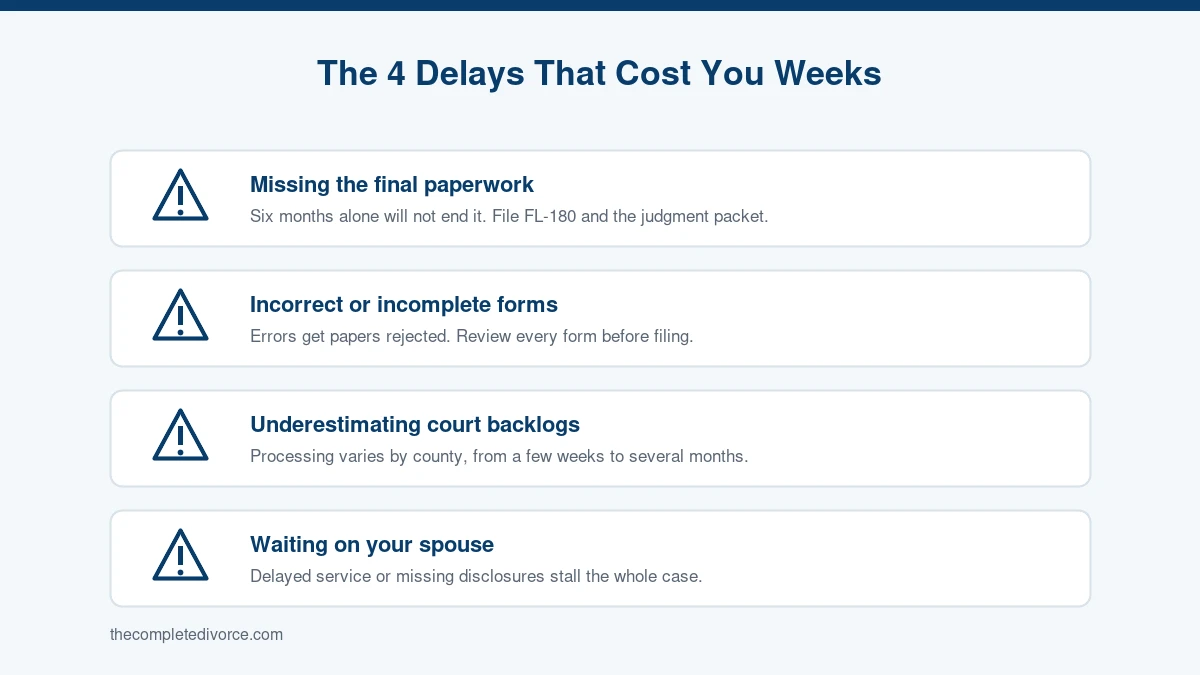
Even with the right process, small mistakes can add weeks or months. Knowing where delays happen helps you finish as fast as the law allows.
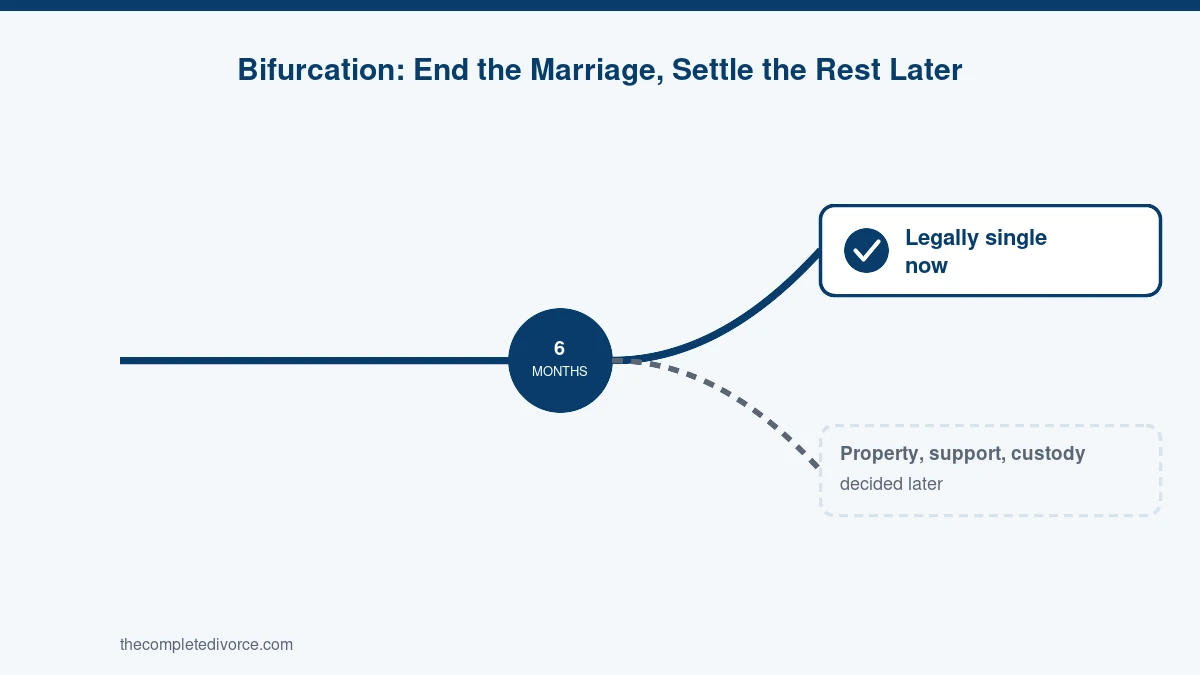
Yes. You can ask the court to bifurcate your divorce, which ends the marriage while leaving property division, spousal support, and custody to be decided later. You file a motion asking the judge to dissolve the marriage now and keep the rest of the case open.
You must meet the court’s requirements, and filing a motion does not guarantee approval. Bifurcation makes sense if you have a real time constraint, for example if you want to remarry or get closure while you finish the details. Keep in mind it adds cost, which matters when you are representing yourself.
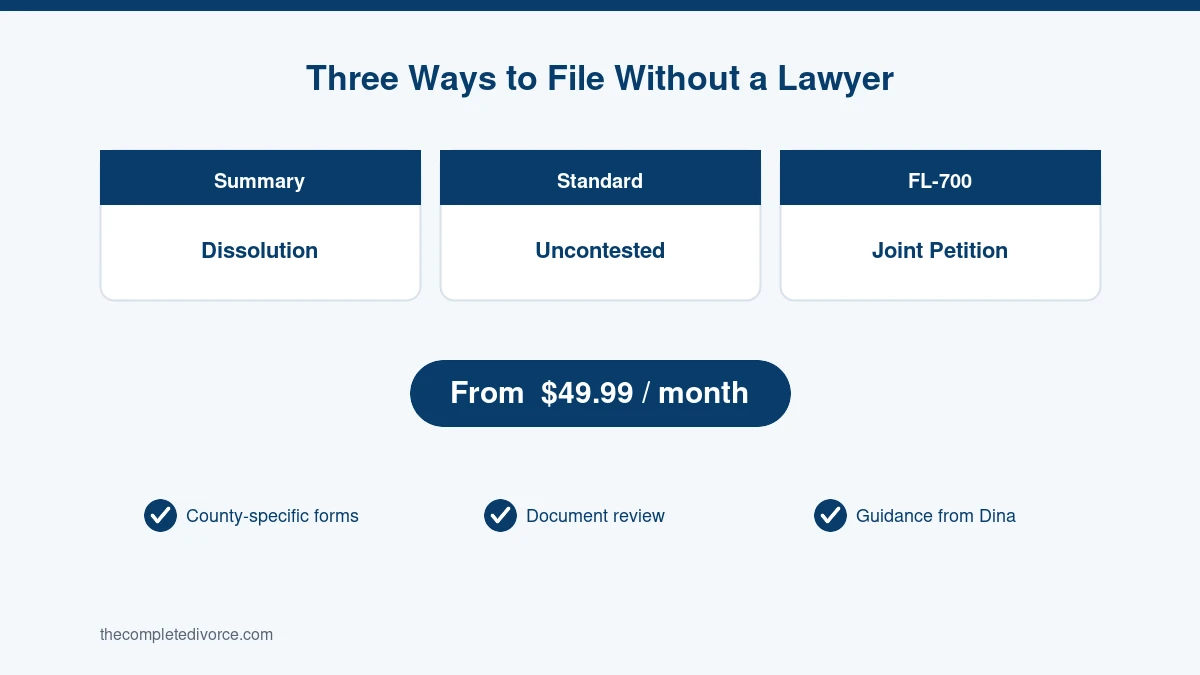
The Complete Divorce helps you prepare and file an uncontested California divorce without an attorney, through a Summary Dissolution, a Standard Uncontested Divorce, or California’s new FL-700 Joint Petition.
These options suit couples with simple divorces, no complex finances or disputes, who want to move quickly. No service can guarantee a completion date, but doing the paperwork correctly avoids unnecessary delays. You get county-specific forms, document review, and guidance from Dina Haddad, all for $49.99 per month.
Begin your fast, amicable California divorce today with The Complete Divorce DIY Guide. Do it once, get it done, and be ready to finish the moment your waiting period ends.

Divorce Attorney — Mediator & Founder of The Complete Divorce
“Hi. I’m Dina Haddad, a divorce attorney-mediator here in California. I’m so tired of couples not having a process that’s easy to complete their divorce. They are getting lost, wasting time and money, and beyond frustrated with their results.
That’s why I created The Complete Divorce, California’s premier online divorce program. I took my successful mediation practice and condensed it into an affordable and winning program.”
You cannot get divorced in California in under six months and one day, but with the right approach and no filing errors, you can finish as fast as the law allows. Your first step is picking the process that fits:
Follow the right process, file everything correctly and on time, and use The Complete Divorce at $49.99/month to finalize as quickly as possible.
Yes. You can speed up your divorce by choosing the right process, filing promptly, and avoiding paperwork delays. You cannot shorten the six-month waiting period required by California law.
No. California law does not allow the six-month waiting period to be waived, even by agreement between spouses.
It depends on the process. For a standard divorce, it starts on the date of service or when the respondent first appears. For summary dissolution and the FL-700 joint petition, it generally starts when you file the petition.
Summary dissolution is usually fastest if you meet every eligibility rule. If not, the FL-700 joint petition suits couples who fully agree on all terms.
No. A judge cannot waive the statutory waiting period, even for an emergency, financial hardship, or mutual consent.
Yes. If your spouse does not respond properly after being served, you can seek a default judgment. You must still follow all requirements, and once the court approves, your divorce proceeds.
California premier divorce program.
Making California divorce simple and lawyer-free.
 ⭐⭐⭐⭐⭐
more than 2,000 California couples helped
Explore the different types of divorce in California, including uncontested,
The Child Custody timeshare schedule details determine who your children