Online Divorce
Divorce smartly without a lawyer. Save yourself $10,000+.
- 100% Legit Divorce Program
How to File for Divorce in California by Yourself: 2026 Guide
The California family laws allow us to proceed without a lawyer and this means you can always file by yourself. In most situations the cases are so simple that they don’t even require court hearings.
Imagine how easier, simpler and in-expensive divorce be if it’s done without a lawyer or court. Actually, when you divorce on your own, and reach an agreement with your spouse you’ve an uncontested divorce.
For this type of divorce, just start by meeting the residency requirement. But if you want a legal separation you just need agreement on issues as there is no residency requirement for legal separation in California.
If you’re going to file on your own just ensure you are completing and filing the forms correctly. This will speed up the divorce process and save you from court delays and rejections. Plus, this will keep the divorce affordable.
If you’re considering filing by yourself or in other words DIY divorce, check out The Complete Divorce. We have been empowering California couples to get their divorce done without a lawyer and court hearings. With us you get the strategies, checklists, flowcharts, court-approved forms, MSA builder and the divorce expert webinar — all enough to help you move forward with peace of mind and confidence. Start a divorce and take the control back.
Start your FL-100 Petition. Our software is easy to use – led by California divorce attorney, Dina Haddad.
These two answers rebuild the rest of the interview. Whole sections appear or disappear — you'll never be asked something that doesn't apply to you.
Every answer saves the moment you type it. Close the tab, come back next week, land on the same question.
These two answers tick the case type and the residency box on page 1 of FL-100. Next come your dates.
The date of separation is when you decided to no longer be married (both by words and actions).
The date of separation must be after the date of marriage.
These five answers fill page 1 of FL-100 — the case type, the residency box, both dates and the children box. Print the form from the panel on the right and they are already on it.
Building your FL-100…
Warning
To file for divorce in California, at least one spouse must have lived in the state for six months and in the county where filing for at least three months to file for divorce. This doesn't apply to legal separation. Consider changing your response.
Requirements for a Do-it-Yourself Divorce in CA
The majority of Californians will divorce as self-represented litigants. This means they will go through their divorce without hiring an attorney. This is completely legal.
Those who are successful often finish their divorce faster than hiring an attorney. A DIY divorce is far less expensive than a traditional divorce. This is especially true when the case qualifies as an uncontested divorce. The following are the requirements for DIY divorce:
- File for divorce
- Complete and exchange disclosures
- Reach an agreement with your spouse
- File the required Judgment forms and your agreement with your county family court.
However, it still requires a lot of time and energy to piece together all the various resources and execute these correctly. Small mistakes can add lots of time and stress to the divorce process. For example, bigger mistakes can create fiction between spouses or require retaining an attorney or mediator, increasing costs. The result is extra frustration and delays.
Success depends on following each step in the correct order. It also requires filing accurate forms in that order. All legal requirements must be met, and precision matters a lot.
1. Meet the California residency requirement
At least one spouse must have lived in California for six months. That spouse must also have lived in the filing county for three months. These requirements must be met before filing. If you have children, the children must be living in California for at least 6 months.
2. Grounds for divorce
Most divorces are based on irreconcilable differences. This ground does not require fault. Incurable insanity is another option, but it is rare. It also requires medical proof. Fault never needs to be proven. If children are involved, mark child custody on your petition. However, unless you intend to move by default divorce, you do not need to provide any additional custody forms or proposals for custodial time.
Divorce Cost and Timeline
When you file for divorce in California by yourself, the divorce costs are much lower. Expenses are significantly less than hiring an attorney. Many California divorces which use an attorney for the process result in fees in excess of $30,000.00 per spouse.
This can happen even when assets are under $1,000,000. For those filing for divorce on their own, using a process like The Complete Divorce, the costs can be well under $500.00 plus court fees.
1. Divorce cost
Court filing fees usually range from $435 to $450 per party. The exact amount depends on the county. Fee waivers may be available if you qualify. This makes self-filed divorce a realistic option. It also allows you to control expenses.
Hiring a lawyer for a standard divorce costs between $15,000 or more. Costs increase when disputes or delays occur. This is where Legal Document Assistants are cheaper. They often charge per form. However, they do not provide ongoing guidance and often the forms are simply prepared and do not capture higher-quality agreements.
2. Divorce timeline
Timelines depend on the court’s backlog and the time it takes parties to complete the process. Case complexity impacts the timing. Cooperative spouses with the right resources finish the soonest. So, your spouse’s cooperation is critical.
Most delays come from incomplete or incorrect divorce papers, unfair agreements, or an uncooperative spouse. Using The Complete Divorce guided online system helps prevent these problems. This makes the process faster. It also makes outcomes more predictable.
Divorce Without a Lawyer
Divorcing by yourself and divorcing without a lawyer are related concepts. They are not the same. When you divorce by yourself, you handle the entire process alone. You prepare all required forms. You file the paperwork yourself. You serve your spouse properly.
Divorce without a lawyer offers a different approach. You may rely on a divorce service, online service, or even divorce mediation. However, you still remain in full control of your case. You are not forced to figure everything out alone.
With The Complete Divorce, you have the ability to divorce on your own and without a lawyer, but still have access to an expert to assist you. The support is professional and clear. Attorney-level fees are avoided. This option is especially helpful for uncontested divorces. It provides clarity. It ensures accuracy. It offers peace of mind.
The Complete Divorce provides:
- One shared divorce platform for both spouses
- Video tutorials, checklists, and clear process flowcharts
- A marital settlement agreement and parenting plan builder
- Bi-weekly divorce webinars with divorce experts
- Printable, editable divorce forms with unlimited updates
- Affordable access at $49.99 per month
Joint petition for divorce (FL-700)
It’s new and very exciting. California just released the Joint Petition (FL-700) for divorces. Spouses can now file just one Petition (FL-700) and do not need to file a Response or serve the Petition or Response papers.
This shortens the divorce filing time incredibly. When the Joint Petition is filed, that starts the six months and 1 day clock for the soonest date couples can have their marital status dissolved. The service date of the Petition or Respondent’s first appearance will no longer apply.
The catch? The parties have to agree on the front-end of their divorce that they will agree to all divorce issues: property division, child custody, child and spousal support, and any other divorce related topics like the date of separation. The court forms lists it as follows:
- Date of separation;
- Spousal or domestic partner support;
- Property division;
- Lawyer’s fees and costs;
- If you have minor children:
- Child custody and visitation; and
- Child support.
- Child custody and visitation; and
Fortunately, you do not need to have an agreement on these items before you file the Joint Petition. You only need to agree that you will reach an agreement.
Most divorce are able to resolve without going to court. This becomes a viable option for them. If you are worried that your case could take a wrong turn, do not worry.
You have the option to Revoke the Joint Petition, using Form FL-720, at any time before the final judgment. Then, you would be required to file the traditional Petition for Dissolution of Marriage (FL-100), but you will be marked “Amended.” You would not lose your timing for the marital status to dissolve or have to obtain a new court case number. For more information, you can review the court’s Informational form.
Summary dissolution
In California, some couples may qualify for a Summary Dissolution. This is often called a simple divorce. It is available only in limited situations. Your marriage must be under five years. You must have no children. There must be no current pregnancy.
Both spouses must agree to divorce. You cannot own real property. Community property must be under $50,000. Debts must be under $6,000. Both spouses must permanently waive spousal support.
Standard dissolution
If even one requirement is not met, a Standard Dissolution is required. This applies when the marriage is longer. It also applies when children are involved. Property ownership triggers this process.
Significant assets or debts also qualify. Any disagreement requires a Standard Dissolution. In these cases, guided support becomes critical. It helps maintain steady progress and prevents months of frustration.
How to File for Divorce by Yourself — The Complete Process
1. Choose your divorce filing process:
Filing for divorce by yourself in California begins with deciding on which of the Petition forms you will file: Petition, FL-100 or the Joint Petition, FL-700.
You must also choose the correct divorce path. But, as noted above, if you choose the Joint Petition and cannot resolve your matter (contested case), then you can Revoke the Joint Petition (FL-720), and file an amended Petition (FL-100).
2. File the petition and serve if applicable
When you have decided on your route, you will file the Petition papers with the court. If you choose the traditional route, you must either serve your spouse, or your spouse must file the Response papers. In many counties, you can also file the Petitioner (FL-100) and the Response (FL-120) together.
Filing and serving divorce papers in California is mandatory. Your spouse must be served by a third party. You cannot serve the papers yourself. After service, your spouse has 30 days to respond. If no response is filed, the case may proceed as a default divorce.
3. Complete and exchange disclosure documents
Once the initial papers are filed, your next step is to complete your Preliminary Declarations of Disclosure:
- Schedule of Assets and Debts (FL-142) [Except for default, we do not recommend FL-160];
- Income and Expense Declaration (FL-150); and
- Declaration of Disclosure and accompanying statements (FL-140).
Unless you are pursuing a true default divorce, both parties must complete and exchange their disclosure documents. These documents are signed under penalty of perjury, which is equivalent to your testimony taken in court. Do a good job. You do not want your agreement to be set-aside because you failed to disclose your property or income.
4. Reach an agreement
Having the disclosures exchanged prior to reaching an agreement is crucial. You want each party to have disclosed all their property and income information to each other so that a true and complete asset picture is being negotiated.
The parties need to reach an agreement on the following:
- Property and debt division (both community and separate property);
- Child custody and child support (when there are minors); and
- Spousal support.
5. File judgment packet with agreement
The last step is to prepare an agreement that you and your spouse will both sign, and then file with the required court forms. These two parts (Agreement + Forms) create your Judgment Packet.
The main judgment form is the “Judgment for Dissolution of Marriage or Legal Separation,” Form FL-180. The Marital Settlement Agreement gets attached to this form. The remaining court form documents support the Judgment.
Within The Complete Divorce, the program will ask you the questions to have these forms completed, and provide you sample forms, a flowchart, and checklists so you have them done correctly.
Once you have that Judgment Packet filed with the court, you are done!
Common Court Filing Mistakes that Delay California DIY Divorces
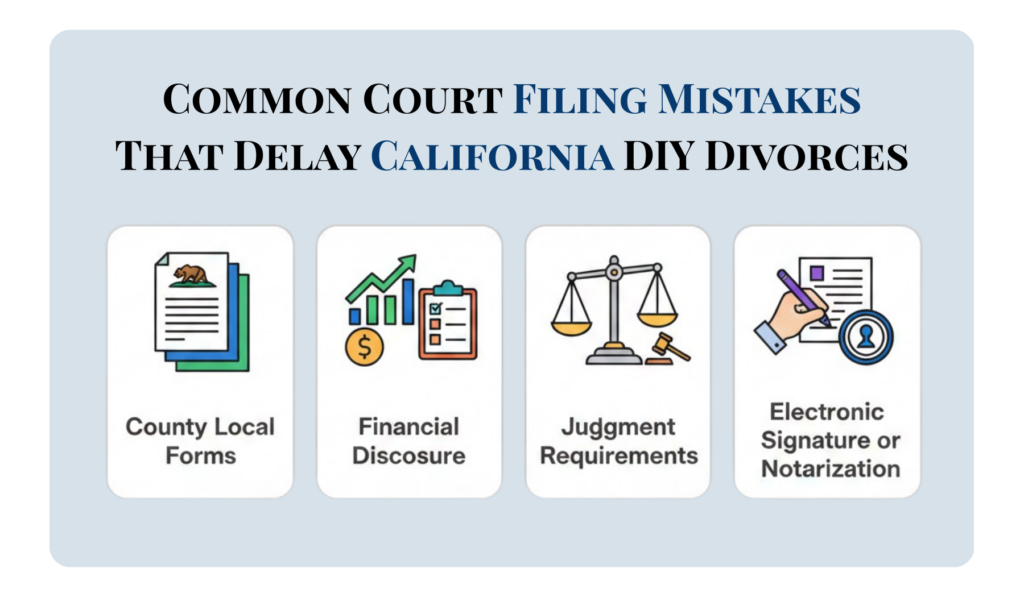
1. County local forms
Every California county has its own local divorce forms. These are required in addition to statewide forms. Local forms often address procedural details. They may cover financial disclosures. Some apply to judgment requirements specific to the county.
Many DIY divorce cases are rejected for a simple reason. A required county form is missing. Before filing anything, you must check your county’s superior court website. Confirm which local forms apply to your case.
Filing only statewide forms is not sufficient. Some counties require additional paperwork. Submitting an incomplete packet leads to rejection. It also causes delays and repeated clerk visits.
2. Financial disclosure
Financial disclosure is mandatory in every California divorce. This requirement applies even in uncontested cases. Both spouses must exchange Preliminary Declarations of Disclosure. This is done using forms FL-140, FL-150, and FL-142 when applicable. These forms list all income. They also disclose assets. Debts must be fully reported.
Failing to disclose information creates serious risk. Intentionally hiding assets has consequences. Either issue can invalidate the divorce later. This can happen even after judgment is entered.
3. Judgment requirements
Your divorce is not final until a judge signs the judgment. Many uncontested cases fail at this stage. A California divorce judgment must be clear. It must address property division. It must also cover debts. Support terms must be included. Child-related issues must be addressed when applicable.
Judges reject cases for several reasons and usually for procedural issues, like missing language or court forms, and not because of the actual agreements. With the Marital Settlement Agreement in The Complete Divorce dashboard, you will have the required legal language and forms included so that you do not face rejection.
An important negotiating note: the judge does not evaluate the quality and fairness of agreements. Many self-represented parties are hoping a family court judge will weigh-in on the fairness of their agreement. In other words, rather than get into a conflict with their spouse, they hope the judge will tell their spouse, “No, the agreement is unfair.” This is not the case. Parties have the right to enter agreements so long as they are not criminal, even unfair agreements. It is your duty and responsibility to only sign what you are agreeable to sign.
4. Electronic signature or notarization
Electronic signatures are generally accepted for California court filings. The Rules of Court expressly permit electronic signatures when the law allows them. California also follows the Uniform Electronic Transactions Act. An electronic signature is not denied legal effect simply because it is electronic.
County practices still vary. Some superior courts accept e-signatures. Many also allow e-filing for family law packets. Other courts still require wet signatures. Some require additional local attachments. Always review your county’s e-filing rules before submitting anything.
Notarization follows different rules. California now allows remote online notarization by statute. Implementation is phased. County practices continue to differ. Some notary rules are still rolling out. Platform requirements may also apply. If a form requires notarization, confirm the accepted method. Verify that the court will accept it.
Note: Divorcing by yourself works only when each step is followed accurately. The process must be completed in the correct order.
Remember details matter. Rejections usually happen for small mistakes. Guided support helps prevent court rejection. It keeps your case moving forward. It avoids years of unnecessary delay. If you need additional help, check out our program: The Complete Divorce. We tailored it so you can use it at any time, and for as long (or as short) as you need it.
Take Control of Your Divorce while Divorcing by Yourself, Online
An uncontested divorce is far easier than a prolonged, lawyer-led battle. With the right guidance, you can complete your online divorce without lawyers. You remain in control of the process. The transition is also smoother for your children.
Choosing the right divorce service in California matters. Mistakes can turn a simple case into a costly delay. Some errors extend the process for years. Affordable guidance reduces risk.
Choose The Complete Divorce and start your divorce today for just $49.99/mo subscription.

Written By:
Dina Haddad
Divorce Attorney — Mediator & Founder of The Complete Divorce
“Hi. I’m Dina Haddad, a divorce attorney-mediator here in California. I’m so tired of couples not having a process that’s easy to complete their divorce. They are getting lost, wasting time and money, and beyond frustrated with their results.
That’s why I created The Complete Divorce, California’s premier online divorce program. I took my successful mediation practice and condensed it into an affordable and winning program.”
FAQ — File for Divorce in California
Q. How does The Complete Divorce help with a do-it-yourself divorce?
The Complete Divorce guides you from sign-up through completion. We walk you through every required form. You get editable, California mandatory court forms. Biweekly webinars provide expert insight. A marital settlement builder helps structure agreements. Filing review reduces errors. Customer support to build confidence.
Q. Can I file for divorce in California without a lawyer?
Yes. California allows uncontested divorces without a lawyer. You must complete the required forms. Your spouse must be properly served. Financial disclosures must be exchanged. Each step must be done correctly. The Complete Divorce provides California mandatory court forms. Our guided checklists keep you on track. Review tools reduce errors. Approval happens faster.
Q. When does the court not get involved?
Court involvement is limited in uncontested cases. This applies when you qualify for Summary Dissolution. For it to be successful, all paperwork must be complete. Agreements must be fair. Documents must be filed correctly. In these situations, the court’s role is minimal. The judge reviews the file. The judge signs the judgment.
California premier divorce program.
Making California divorce simple and lawyer-free.
- Filing & Review Support
- 1-on-1 Divorce Meeting
- Child support calculations
- MSA Filing Support
 ⭐⭐⭐⭐⭐
⭐⭐⭐⭐⭐
2000+ divorced without a lawyer.