
In mediation, you and your spouse work with a mediator
Online Divorce
Divorce smartly without a lawyer. Save yourself $10,000+.
For decades in California, even amicable divorces required that one spouse file as the Petitioner against the Respondent.
As of January 1, 2026, couples who agree on the terms of their divorce have the option to file a FL-700 Joint Petition, which allows both spouses to file as co-petitioners.
Now, you need to first keep your budget, time constraints, and circumstances in mind, before determining whether a traditional divorce or joint petition is the best for you.
This article outlines each option and explains when summary dissolutions and legal separations are applicable.
Start your uncontested divorce either through FL-700 or FL-100 with The Complete Divorce program that is super affordable, easy, and lawyer-free.
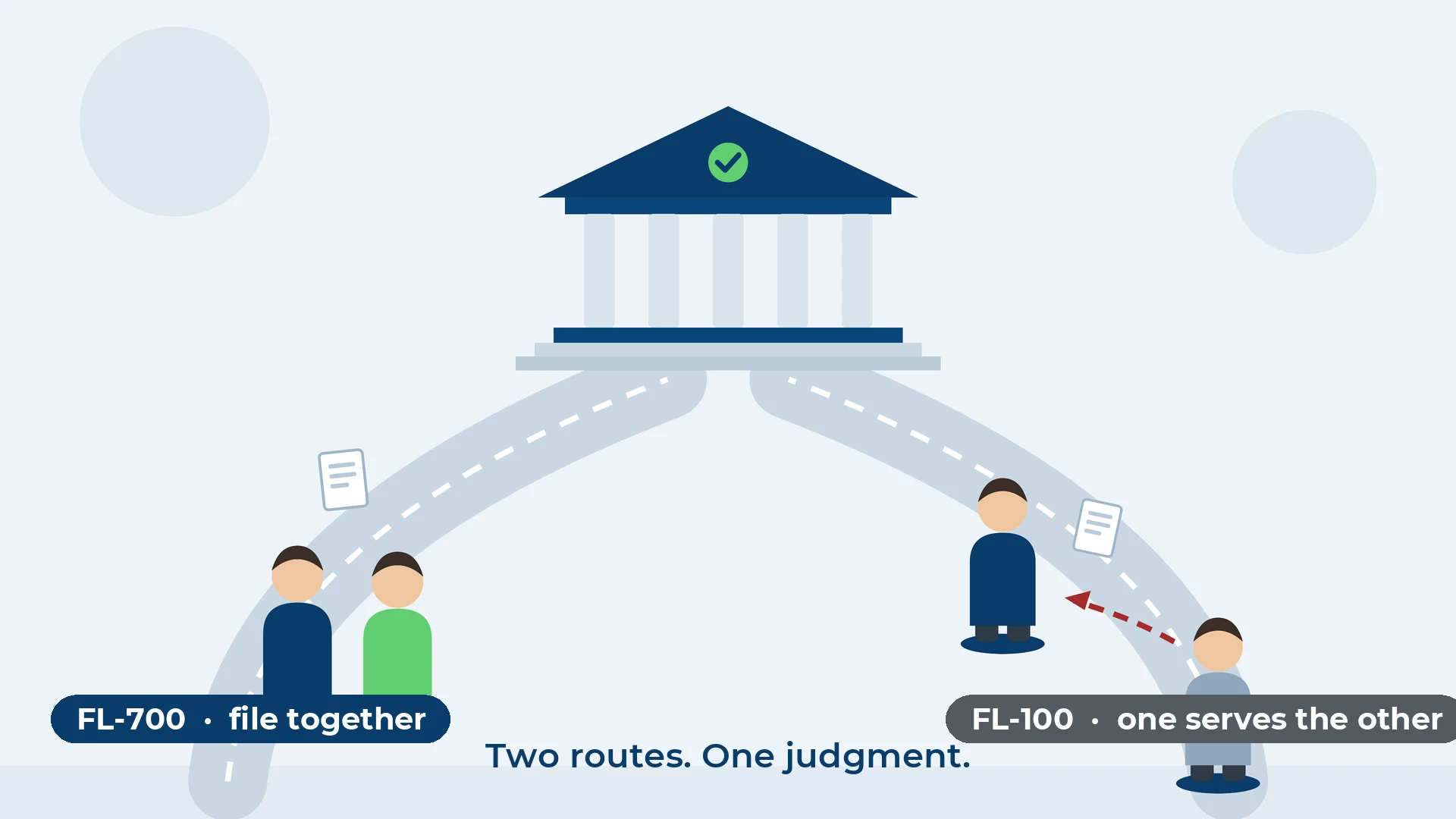
California offers divorcing couples two methods to obtain a divorce: the new Joint Petition (FL-700), and the Traditional Petition (FL-100).
The Joint Petition (FL-700) requires both spouses to sign the same set of documents. The Traditional Petition (FL-100) requires one spouse to file the documents, and the other to either sign the documents or neglect to respond to the petition.
In both cases, disclosures need to be made, agreements reached and a six month and one day waiting period completed.
The FL-700 Joint Petition allows a husband and wife to file a divorce petition together. Each spouse fills in the form and identifies himself/herself as either “Petitioner 1” or “Petitioner 2.”
In a joint petition, there is no respondent. FL-700 is also used for the dissolution of a domestic partnership and a legal separation.
Since both spouses file for divorce voluntarily, neither has to be served divorce papers or file a response using FL-120. The required initial paperwork includes FL-700, FL-710 (the summons) and, in case of minor children, a UCCJEA Declaration, FL-105.
Both spouses must agree to all terms of the final judgments pertaining to the division of property, allocation of debts, if any, and any arrangement concerning the children.
The joint petition for dissolution is available to spouses meeting the requirements for a summary dissolution, or to those who have minor children, or own a home, or who do not meet the financial qualifications for a summary dissolution.
Meeting any of these circumstances does not preclude a spouse from filing for divorce voluntarily.
A traditional California divorce starts with the filing of the necessary California divorce forms, which include Form FL-100 (dissolution petition) and Form FL-110 (summons) by one spouse.
The filing spouse becomes the Petitioner and the other spouse becomes the Respondent. Service is required for the Respondent.
The Respondent has 30 days to file a Form FL-120 (response). If the Respondent does not respond, the Petitioner can move for default. An FL-100 case can be uncontested or contested. Learn more about “can you divorce if your spouse won’t sign?”
While a case is ongoing, either party can move for temporary orders for support or custody or for the other party to be restrained from using property. Orders can also be for the temporary use of property.
Learn More: Filing and Serving divorce papers in California
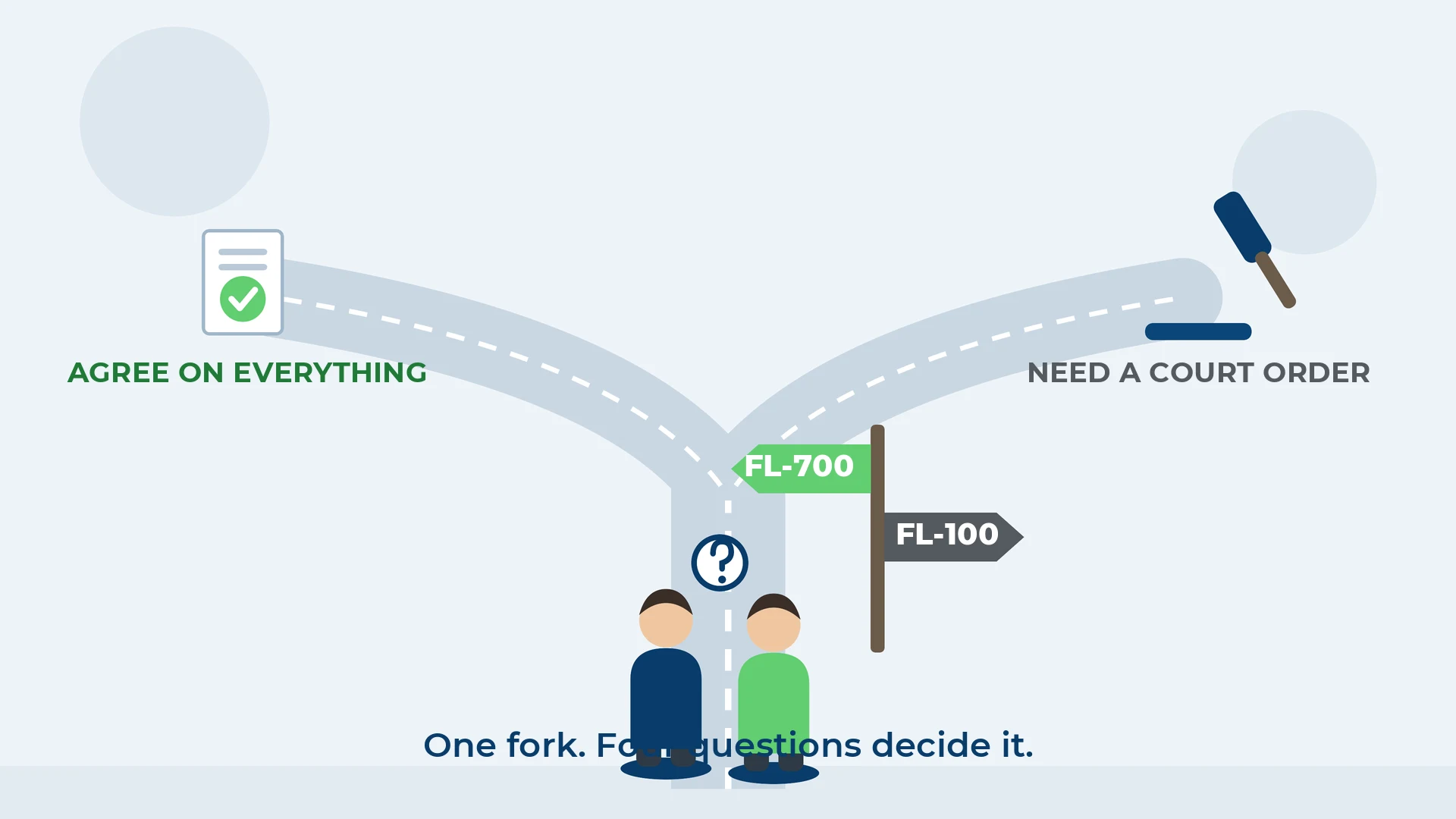
Two questions to start. First, do you and your spouse agree on all terms of the divorce? Second, will either of you need a court order before the divorce can be finalized? If the answers to both questions are yes, then you may want to consider using the FL-700 joint petition to file for divorce.
You will want to consider if you need a court order to establish temporary support or custody before the divorce can be finalized. If you cannot come to an agreement on all the terms of the divorce, using the joint petition would not be the right starting point.
The FL-100 process allows you to begin the divorce process while negotiations continue.
You need to consider if either of you might need a court order to establish temporary support or custody while the divorce case is pending. Using the FL-100 process, either party can request a court order for temporary support or custody. The joint petition does not have this option.
You need to consider if your spouse is cooperating. The FL-100 process allows the divorce case to continue through default if the requirements are met and your spouse is unreachable or refusing to participate. The joint petition requires both parties to participate and sign.
You also need to consider the fees for each process. The FL-700 process eliminates the need for service and a response and is simpler, however, both parties must pay a first-appearance fee. The joint process may be simpler, however it is not always automatically the least expensive option.
The FL-700 is designed for married couples where both spouses agree to joint petition for divorce and do not want to file using the Petitioner-and-Respondent format.
It is also for couples who exceed the limits for a summary dissolution. These couples may hold a home, have children, or have more property than allowed in the summary dissolution process. In this case, they can use FL-700 if they agree to the terms of the divorce.
Neither spouse should need any type of temporary court orders while the case is pending. Both spouses should be ready to exchange financial disclosures and sign a written agreement resolving all of the issues before judgment. Learn more about mutual divorce.
The FL-100 process allows for one spouse to proceed without the other. So take the traditional FL-100 route if your spouse is uncooperative, unreachable or likely to stall.
After serving the California divorce papers, the case can proceed by default if the spouse does not respond.
This route is also taken if either spouse might need temporary support, such as child support, spousal support, or interim custody or exclusive possession of the matrimonial home, prior to the final Judgment. Uncertainty of dissipation of assets, business interests or debts, also supports this process.
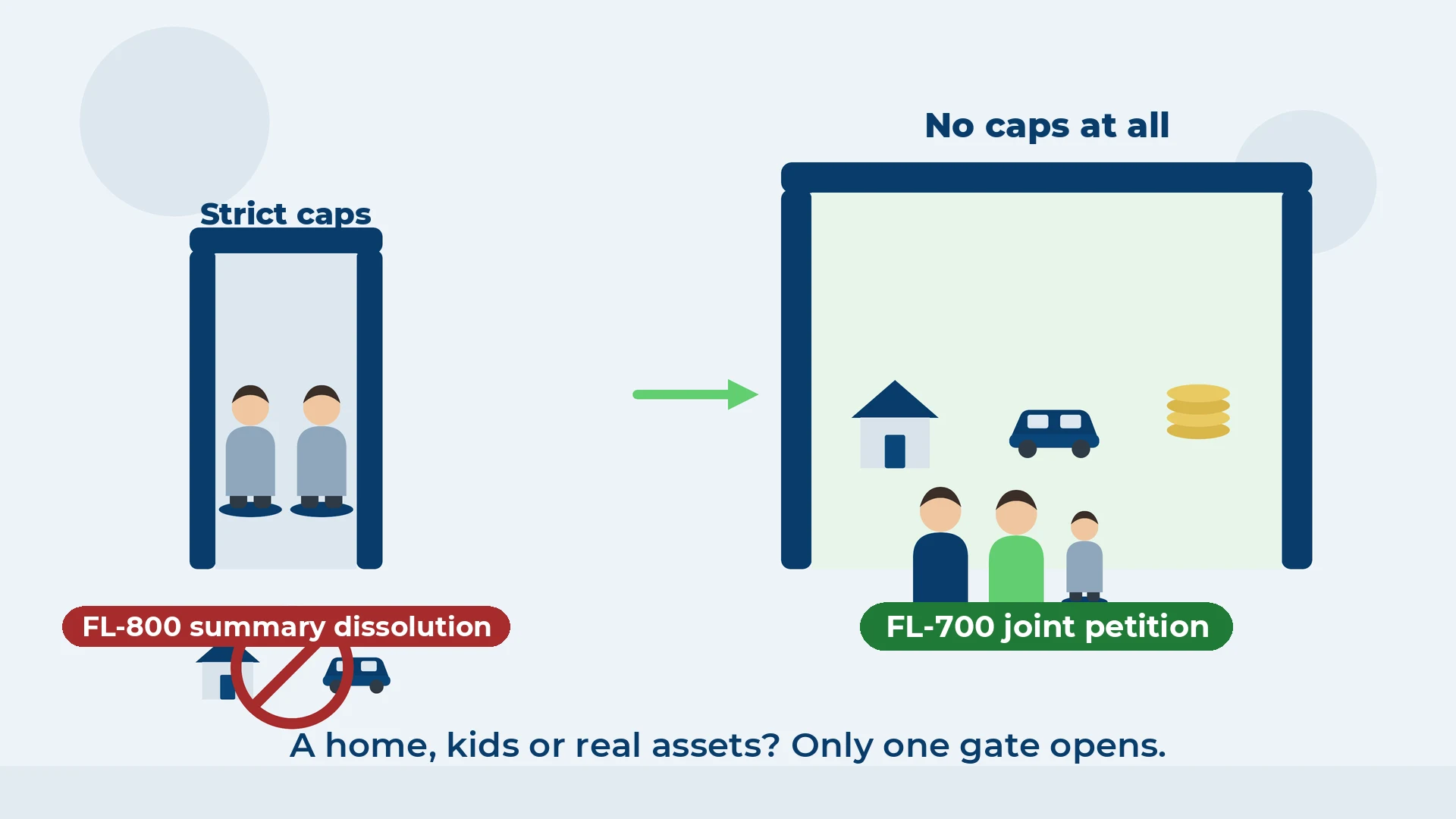
Yes. Summary dissolution has always required a joint petition. Spouses file a joint petition for summary dissolution (FL-800) and apply together. In 2026, the Family Law Act made FL-700 available, which can also be filed jointly, but has different rules regarding eligibility.
The basic rules for summary dissolution are as follows:
Like FL-800, FL-700 has no limits on the marriage length, the value of the property, the existence of children, and community debts.
If a couple owns a home, has children, or the limits of a summary dissolution are exceeded, FL-700 can be used to achieve a divorce as long as all final terms are agreed upon.
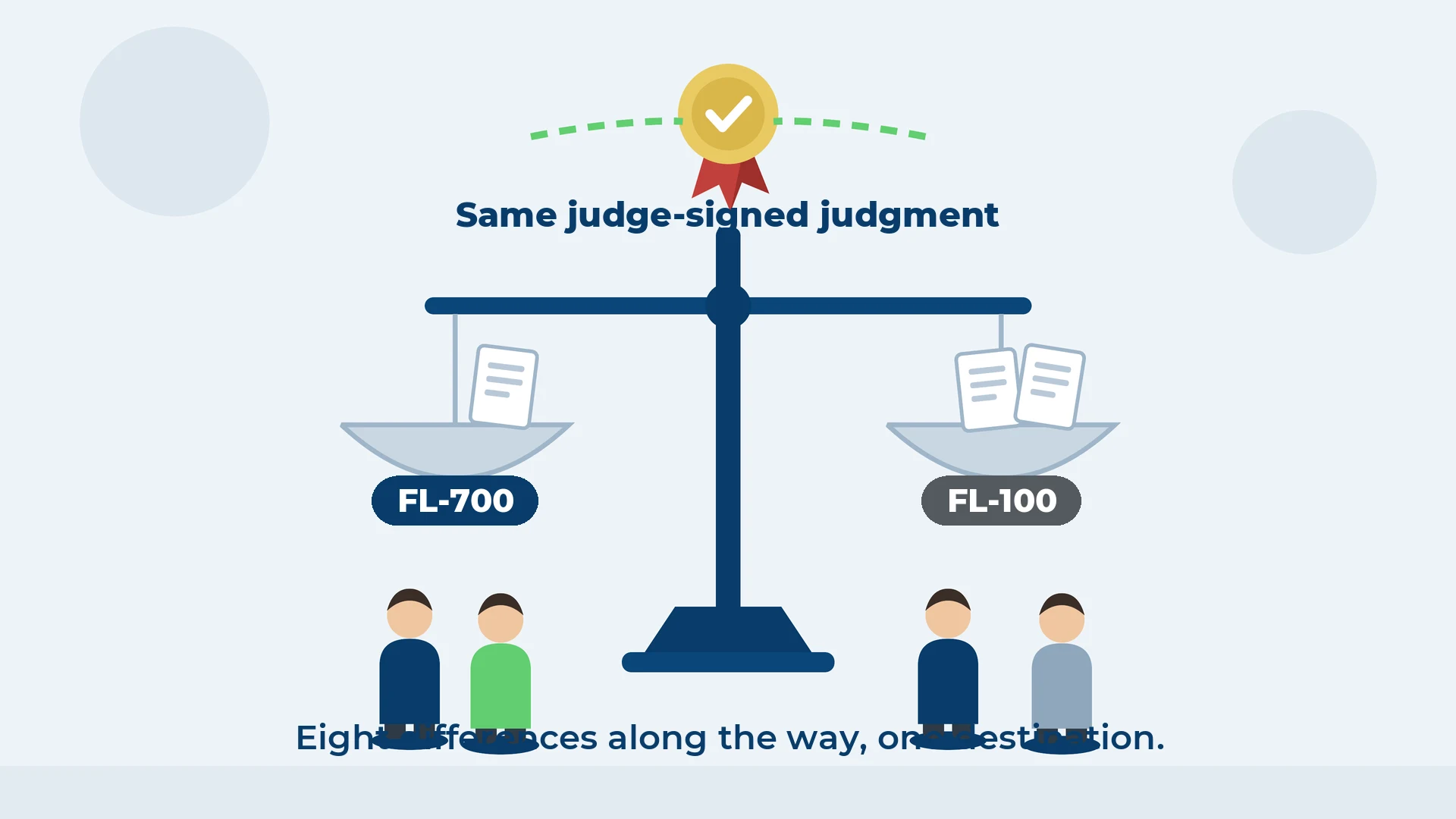
Both end in a judge-signed divorce judgment. However, the routes differ. On FL-700, co-petitioners file jointly, and neither spouse needs to serve the other or file a response.
A competing automatic temporary restraining order is granted when the case is filed. However, the spouses must agree on the final terms, and neither can request a temporary order.
On FL-100, one spouse files, and the other must be served. This also allows a request for temporary orders for support and custody and a request for the order to be issued for the sale of real and personal property.
If the order is granted and the served spouse (Respondent) does not participate, the other spouse (Petitioner) can request a default judgment.
Costs differ as well. On FL-700, the co-petitioners each pay approximately $435. In a traditional default case, the Petitioner may only pay one filing fee if the Respondent does not file a response.
| Feature | Joint Petition (FL-700) | Traditional Divorce (FL-100) |
|---|---|---|
| Who files | Both spouses together | One spouse |
| Party labels | Petitioner 1 and 2 | Petitioner and Respondent |
| Serving papers | Not required | Required |
| Response form | No FL-120 | FL-120 or default |
| Agreement needed | Full agreement upfront | Not required to start |
| Temporary orders | Not available | Available |
| Typical filing fees | Approximately $870 combined | Approximately $435 initially |
| Uncooperative spouse | Cannot proceed jointly | Default process available |
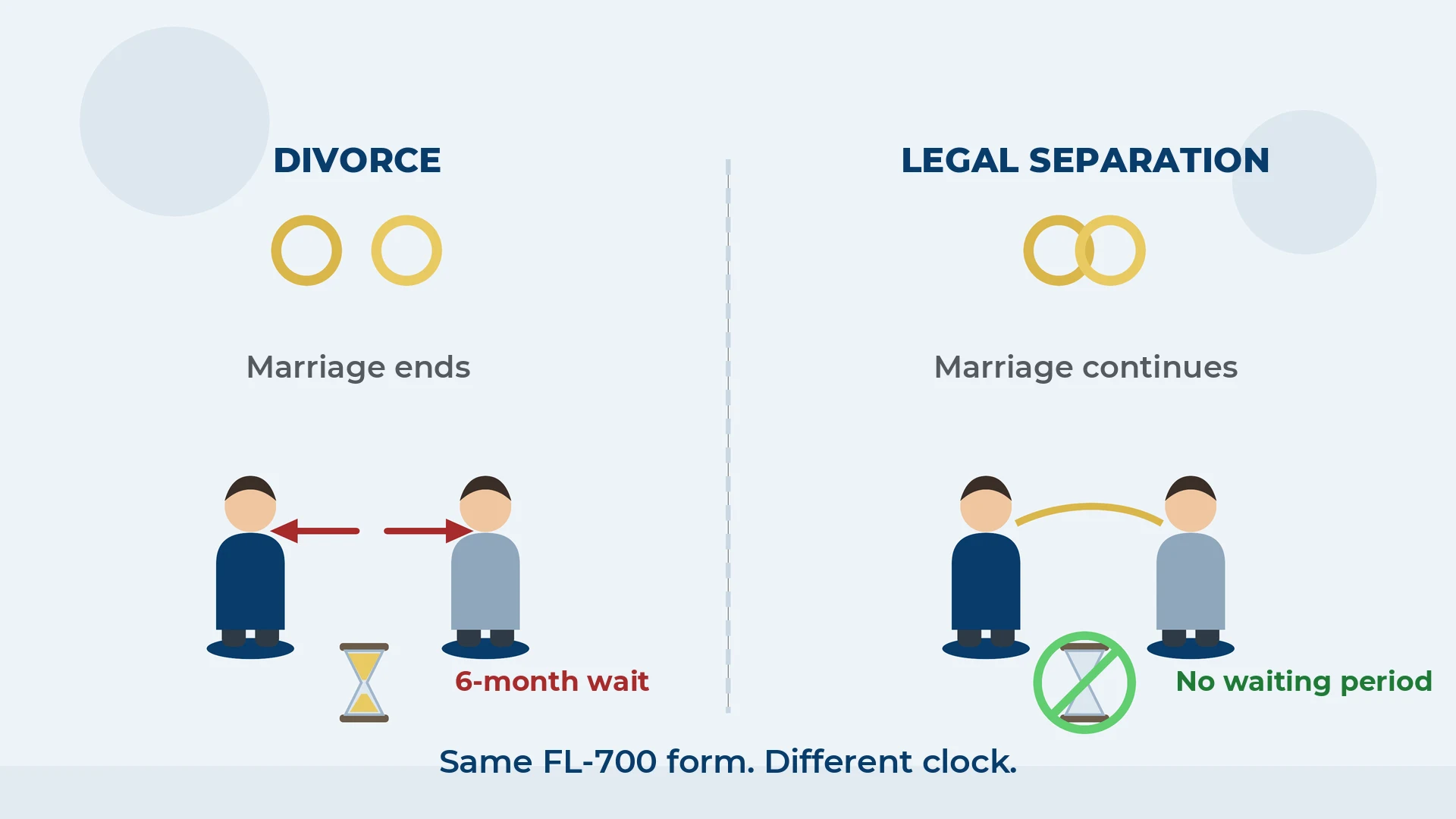
Yes. Partners can use Form FL-700 to jointly request legal separation. The main difference here is timing. Like divorce, the court must first enter judgment, but legal separation does not require a six month waiting period.
Couples may desire to be legally separated for a variety of reasons. These reasons may include: religious beliefs, the residency requirements for divorce, and health insurance coverage.
Legal separation and divorce are very similar. A legal separation does not end a marriage and neither spouse can remarry until they are divorced. Like divorce, couples seeking a legal end to their marriage must file for legal separation separately.
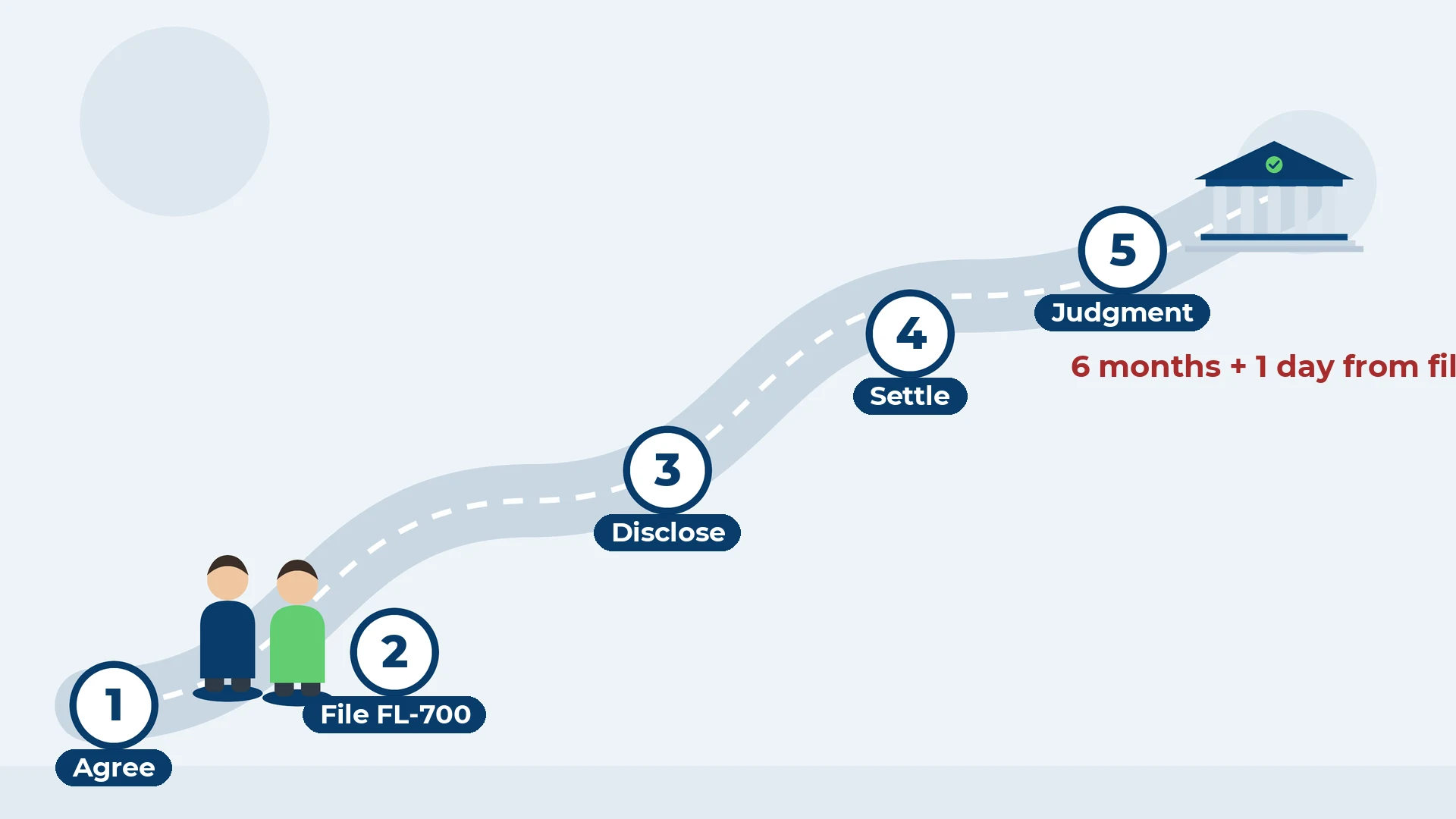
Filing a joint petition has five steps. The first is checking to be sure both spouses agree to the process. The last is submission of the final judgment package.
At any time before judgment is entered, a spouse can revoke the joint petition by filing a Form FL-720. This would make the divorce case proceed using the traditional divorce process.
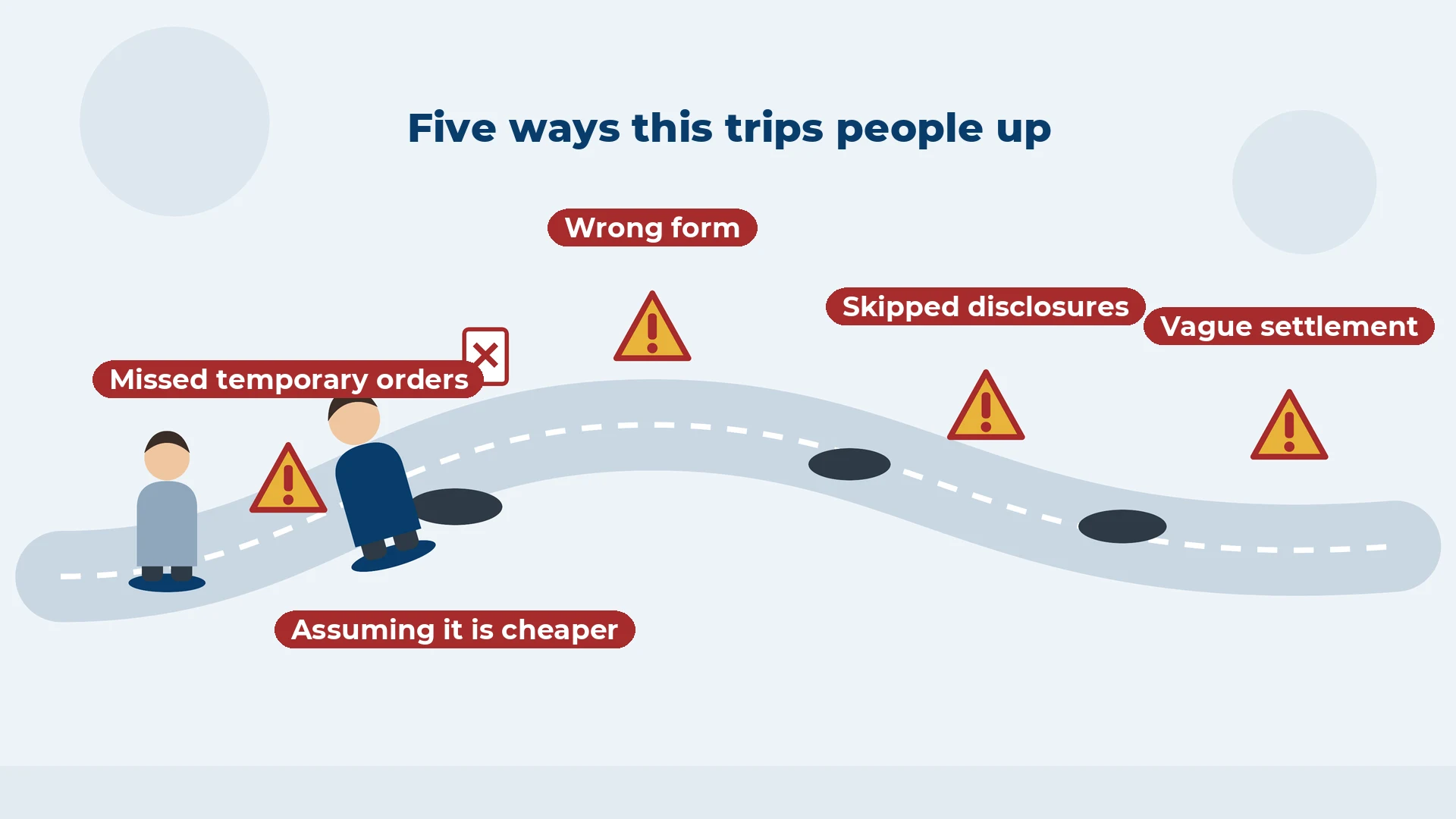
Choosing the wrong procedure can cause you to incur extra costs, delays or problems with your divorce judgment. Here are common mistakes people make.
Another common mistake is forgetting to consider finances. For example, an investigation is needed if a wife has concerns that her husband is hiding assets or that she has less financial knowledge than he does.
The Complete Divorce offers an online divorce process for California couples who wish to proceed with an uncontested divorce.
The service offers assistance with traditional divorces and FL-700 joint petitions. Before couples file, The Complete Divorce evaluates the availability of summary dissolution and joint petitions to help couples decide which documents to file.
The Complete Divorce also has a document review process for the preparation and completion of county-specific divorce documents.
The service reviews divorce financial statements and settlement agreements to identify filing defects. Couples can also expect assistance with the filing process.
The service offers expert-guided assistance at a flat rate, giving you a cheap uncontested divorce in California that is often more affordable than hiring an attorney for a full-service divorce.
Make The Complete Divorce a part of your divorce plan and take control of your divorce today!
You have options based on the unique details of your case. For couples who agree on all terms, the FL-700 joint petition is an option. For couples who do not agree on all terms, a traditional FL-100 divorce is more appropriate.
A traditional FL-100 divorce also allows for flexibility if a spouse is not cooperating or if a temporary court order is needed. If the marriage is short and the couple has no kids or property, the divorce may qualify as a summary dissolution. In the end, the right decision up front may save time and money.
Let The Complete Divorce evaluate your case to see what your next steps should be and what paperwork is needed. Start your California divorce online today.

Divorce Attorney — Mediator & Founder of The Complete Divorce
“Hi. I’m Dina Haddad, a divorce attorney-mediator here in California. I’m so tired of couples not having a process that’s easy to complete their divorce. They are getting lost, wasting time and money, and beyond frustrated with their results.
That’s why I created The Complete Divorce, California’s premier online divorce program. I took my successful mediation practice and condensed it into an affordable and winning program.”
An FL-100 starts a divorce by filing as a “Petitioner” and serving the Response on the other spouse. An FL-700 allows both spouses to file as co-petitioners to start a divorce together.
Not always. A traditional divorce that is default, meaning the Respondent does not respond to the Petition, may cost less than a joint petition for divorce. This is because, in a joint petition, both spouses have to pay a first appearance fee.
Yes. Both spouses must agree to everything, including how they will divide their property and debts, and custody and support issues.
No. The FL-700 process does not provide for any type of temporary orders. These are available in a traditional FL-100 process.
Yes. Summary dissolution uses Form FL-800 and is signed by both spouses. Summary dissolution is different from the FL-700 joint petition and contains different eligibility requirements.
At least six months and one day from the date of filing. The court must receive the financial disclosures, settlement agreement and final judgment.
Yes. You may use Form FL-700 if you want to request a legal separation instead of divorce. Legal separation does not have a six-month waiting period, however, a judge will have to enter a judgment.
California premier divorce program.
Making California divorce simple and lawyer-free.
 ⭐⭐⭐⭐⭐
more than 2,000 California couples helped
In mediation, you and your spouse work with a mediator
In California, ending a marriage doesn’t have to mean conflict,
Community and Separate Property in a California divorce can pose