
In mediation, you and your spouse work with a mediator
Online Divorce
Divorce smartly without a lawyer. Save yourself $10,000+.
You and your spouse have decided to get a divorce. What forms do you need? How long will it take? In California, even if you agree, you can’t skip financial disclosures, paperwork, or the six-month waiting period.
You have three different options: a summary dissolution, the FL-700 Joint Petition, or a standard uncontested dissolution.
Before filing, look for property restrictions, vague parenting plans, and support waivers. The Complete Divorce offers a guided, attorney-reviewed service for $49.99 a month. Start your divorce today.
Start your FL-700 Joint Petition. Our software is easy to use, led by California divorce attorney Dina Haddad.
These two answers rebuild the rest of the interview. Whole sections appear or disappear — you'll never be asked something that doesn't apply to you.
Every answer saves the moment you type it. Close the tab, come back next week, land on the same question.
The date of separation must be after the date of marriage.
These five answers fill page 1 of FL-100 — the case type, the residency box, both dates and the children box. Print the form from the panel on the right and they are already on it.
Building your FL-100…
To file for divorce in California, at least one spouse must have lived in the state for six months and in the county where filing for at least three months to file for divorce. This doesn't apply to legal separation. Consider changing your response.
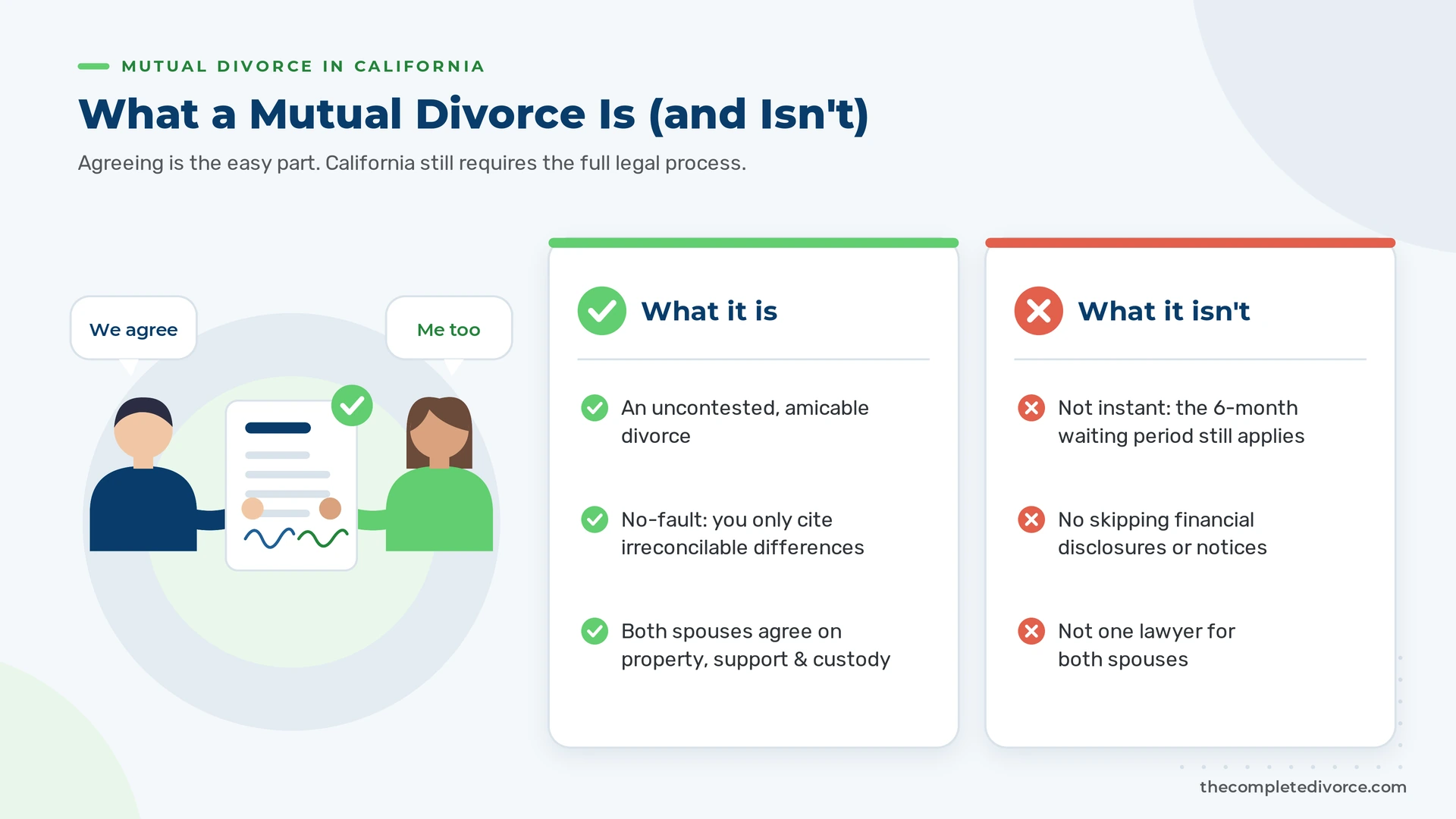
“Mutual divorce” is an informal term for an uncontested divorce, also called an Amicable Divorce, in California.
If you and your wife agree to separate, you can file either an uncontested dissolution or a joint petition (FL-700) to dissolve the marriage. You can both agree to end the marriage and divide your community property and debts.
If one of you files for divorce and the other serves as a respondent, it is considered a default and is legally similar to an uncontested dissolution.
California is a no-fault state; therefore, you are only required to state irreconcilable differences in your Pleadings and Petitions under Family Code 2310.
You still must officially file the divorce documents, serve the other spouse, exchange Financial Disclosure Documents, and enter into a Marital Settlement Agreement.
A mutual divorce is not simple or immediate. You still have to give required notices, finish the required paperwork, exchange financial disclosures, and ultimately get a final judgment.
Even if you agree on all the terms, you can’t avoid the required notices under Family Code §§ 2104-2105.
You also can’t avoid the 6-month wait under § 2339. You also can’t be sure one lawyer can represent you both. If there is a power imbalance due to financial abuse, domestic violence, or any other significant imbalance, you should seek independent legal advice.
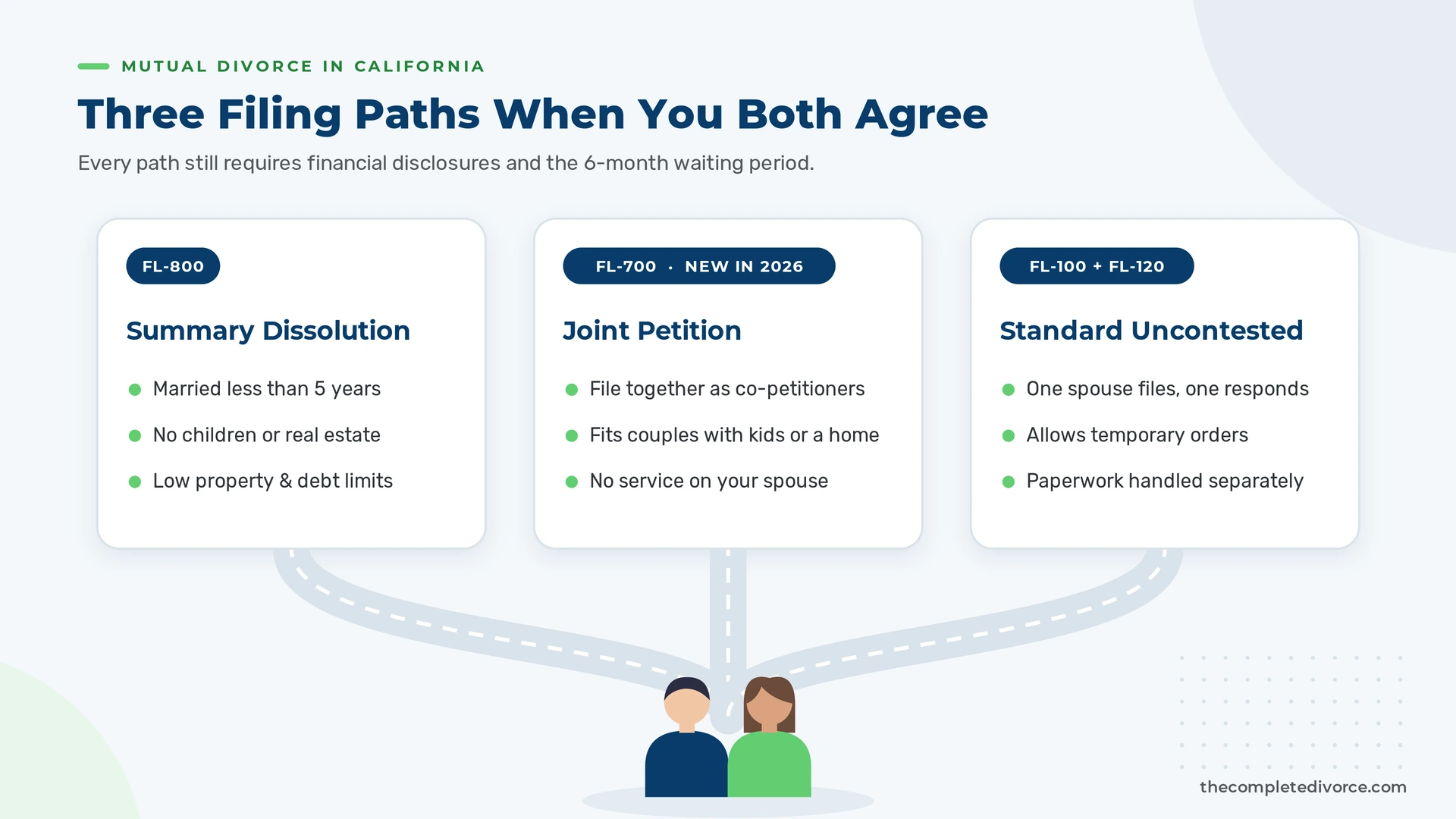
California offers three options, all with a 6-month waiting period, each with different rules and costs. Below is information about the program options, along with eligibility requirements and costs.
Summary dissolution is a simplified process for uncontested divorces. You and your spouse file jointly, create a property agreement, and usually do not need to appear before a judge. There are restrictions to qualify for summary dissolution.
Also note that you must also waive spousal support and meet the residency requirement.
Since January 1, 2026, you and your spouse can file for divorce using the FL-700 Joint Petition. This option lets you file together instead of one spouse filing as the petitioner and the other as the respondent. If you have minor children, you will usually file the FL-700, FL-710, and FL-105.
The joint petition costs about $870; however, one or both of you may be eligible for a fee waiver. In this case, you do not need to serve the papers on the other spouse, but you must still complete financial disclosures.
You are not allowed to request temporary orders. You or your spouse may need to request a temporary order for support or custody, in which case you would need to revoke the joint petition.
A standard uncontested dissolution has one spouse filing a petition, FL-100, and the other spouse filing a response, FL-120. After the spouses exchange financial disclosures and agree on the divorce terms, they file a Marital Settlement Agreement and a Judgment.
You may need to request a Default with Agreement to reach an agreed judgment if your spouse did not file a response. This may also be the better option for you if you need to request Temporary Orders. The waiting period and disclosure obligations still apply.
Pursue a summary dissolution if your marriage is less than five years, you have no kids, no real estate, and if you and your spouse meet the property and debt limitations.
The FL-700 Joint Petition is appropriate if you have kids or a mortgage and agree on all of the terms.
The standard uncontested dissolution is for couples that agree on all the terms but need court orders for custody or child support. It also works for couples who prefer to handle the paperwork separately.
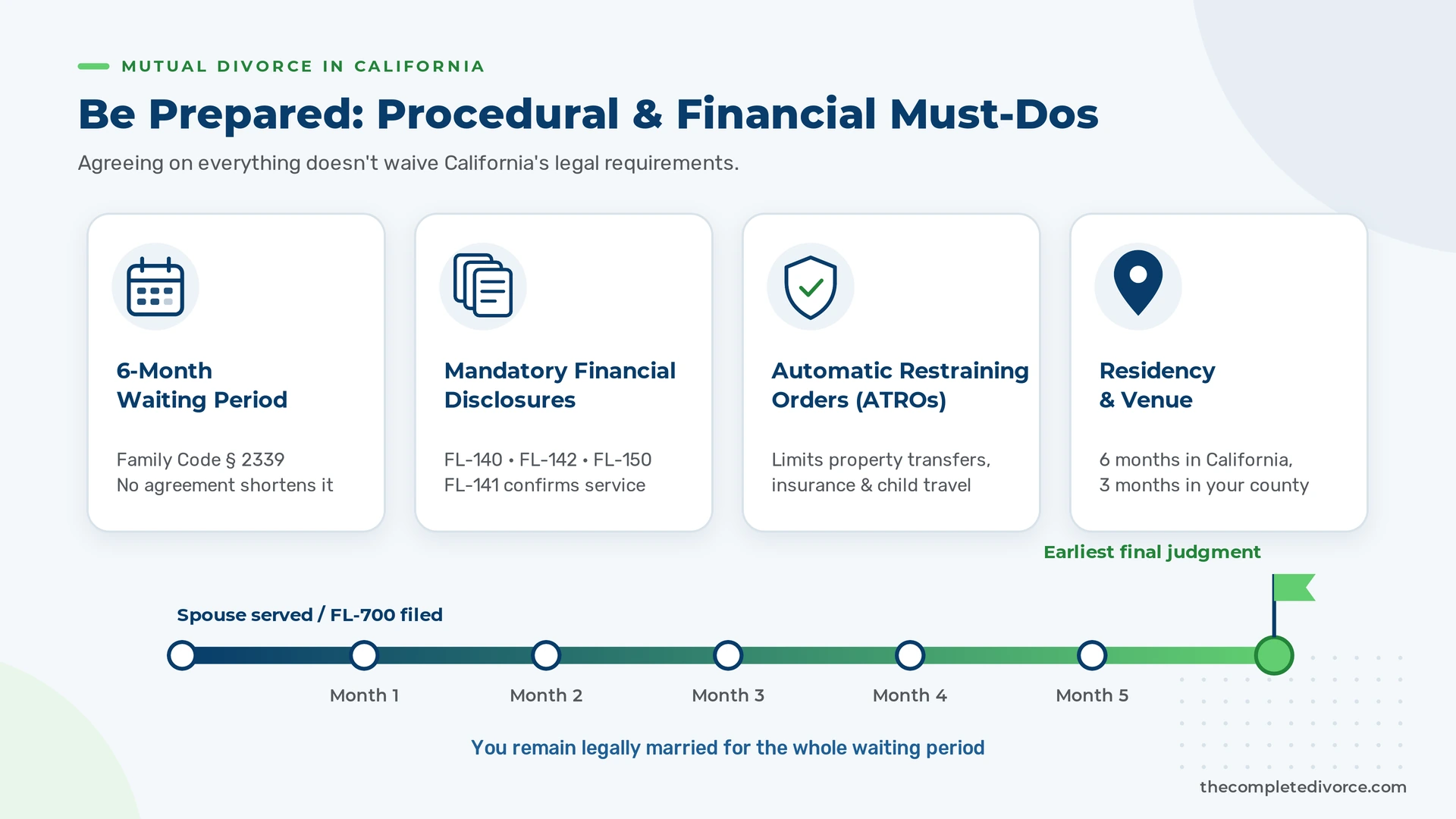
Even if you both agree on every aspect of your divorce, California requires legal formalities, including filing specific forms, making financial disclosure, and observing a waiting period.
Understanding what is involved will help you avoid unnecessary delays, extra costs, and potential problems with your Final Judgment.
You must wait at least six months after your divorce begins before you can obtain a Final Judgment.
The waiting period usually begins when your spouse receives service of process or responds to your divorce papers, whichever happens first. However, the waiting period begins after both spouses file the joint petition on Form FL-700.
An agreement or mediation will not shorten the waiting period. You also stay legally married during this waiting period.
This may create tax implications for you and your spouse. Retirement account distributions and beneficiary designations may also be affected because you remain married.
While it’s likely that you will want to believe your spouse with regard to finances, as a result of the law, you are still required to provide financial disclosure by filing FL-140, FL-142 or FL-160 and FL-150 (to be completed separately for each party) disclosing your income, expenses, debts and all other assets.
In addition to completing these forms, FL-141 is used to verify your spouse received the disclosure(s).
Generally, once you prepare the forms, you should send them to your spouse and then file them. As an exception, if you meet the requirements outlined in FL-144, you may choose to waive final disclosures; however, preliminary disclosure remains mandatory. Penalties apply for hiding an asset or failing to fully disclose assets; moreover, in limited cases, if evidence shows this occurred, your judge may void your judgment.
Learn More: FL-140 / 141 Declaration of Disclosure guide.
When you start your divorce case, Automatic Temporary Restraining Orders (ATROs) limit what each of you can do. Generally, these restrictions include:
Even if you and your ex-spouse agree to the terms of your divorce, the ATROs will still apply to all parties involved.
Be sure to verify with an attorney whether the financial transaction you wish to make is permissible before refinancing your home, selling large amounts of your joint property/assets, or cancelling insurance on either party.
Most routine financial transactions are exempt; however, you should comply with the regulations and give proper notice where appropriate.
In order to file for dissolution in California, at least one of the spouses must reside in California for a minimum period of six months and must reside in the County where the petition for dissolution is filed for a minimum period of three months.
If the spouses do not reside in the same County, it may be necessary to consult with an attorney familiar with venue law in order to determine what venue would be most appropriate given your specific situation and choice of procedure.
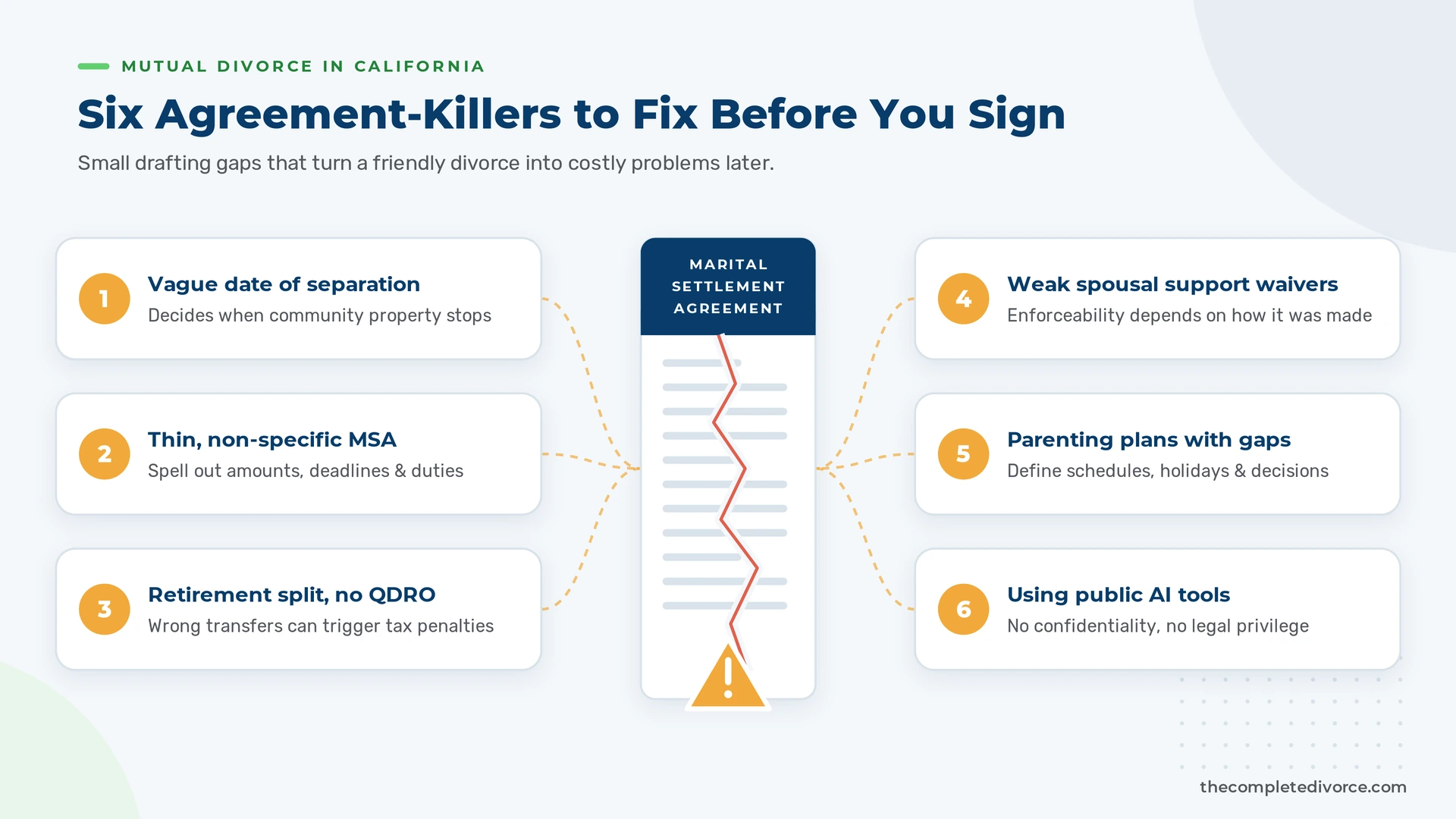
Even when both parties want a smooth divorce, minor drafting errors in an agreement can create costly legal issues down the road. You should address the following six areas before signing your agreement:
Your date of separation matters because it determines when community property stops accumulating. Therefore, if the couple continues to live together for financial purposes, they should determine an exact date of separation and document it in writing.
It is particularly important during this period as the couple receives bonus income, stock options, or RSU’s as the timing of when those items were received, earned, or invested will have a direct impact on how those items are classified. Disputes over an ambiguous date of separation may also delay property division and ultimately lead to further litigation.
Your marital settlement agreement should clearly define how you will divide assets, who is responsible for debt, spousal support, and, if you have a minor(s), who will have physical custody of the children or pay child support.
Also, avoid vague agreements; instead, define the amount, percentage, deadline, and responsibility for each item.
The marital settlement agreement should also include provisions related to income tax filings, dependency on prior tax years, and liability for past joint tax returns.
It is also important to ensure your marital settlement agreement is properly incorporated into or attached to the divorce judgment as required by law.
If you split a 401(k) account, pension account, or other employer-sponsored retirement plan, you’ll likely need a “Qualified Domestic Relations Order” to prepare for this division.
The QDRO gives the Administrator of the Retirement Plan sufficient authorisation to make the distribution in accordance with the terms of the Court’s Judgment.
Incorrectly transferring or withdrawing money from a retirement benefit could trigger taxes or penalties. IRA accounts have their own set of rules and are generally distributed as part of an IRA Transfer Incident To Divorce.
If you agree to divide retirement benefits, ensure to find out what steps to take before distribution and prepare all required documents, rather than waiting several years after the divorce.
Many factors go into deciding whether to waive spousal support, including income, earning capacity, years married, and marital standard of living.
California Family Code Section 4320 states that courts will review these factors, along with others, when determining spousal support.
What appears to be a good and fair waiver of spousal support at this time may appear otherwise in the future if there are financial difficulties for either party.
An enforceable waiver depends on the circumstances surrounding preparation of the Agreement.
If you anticipate potential future need for spousal support prior to entering into Judgment, consult with counsel about the possibility of reopening the issue once the Court loses jurisdiction over the matter.
Agreeing to 50/50 custody does not necessarily mean you have defined exactly what that looks like day to day.
Define both weekdays and weekends, the days you take your children to and pick them up from school, who takes care of your children during their summer break, and how you will deal with disputes.
Consider defining how you will make medical and educational decisions, whether one or both parents can relocate (and if so where), and whether the non-residential parent has to get permission before taking your children out of state.
You may want to include a “right of first refusal” provision that requires the non-custodial parent to be given the opportunity to take the child(ren) when you cannot be available to do so.
Never use public AI tools such as ChatGPT, Claude, or Gemini to enter information about your spouse’s finances, private communications, or your attorney’s strategy. Although these tools offer convenience, they do not provide confidentiality or guarantee protection of legal privilege.
In addition, U.S. courts have treated AI-generated documents differently depending on the circumstances.
The 2026 United States v. Heppner decision addressed privilege in a specific federal criminal case; it did not establish a blanket policy governing the use of AI in divorce proceedings.
Instead, rely on California-specific sources and, when necessary, qualified legal review. Never assume an AI-generated document is legally correct, and it is not protected from discovery.
Divorce in California can be expensive. That is why, at $49.99 per month, The Complete Divorce (TCD) offers an affordable, attorney-led option for managing the divorce process instead of hiring an attorney with a large upfront retainer.
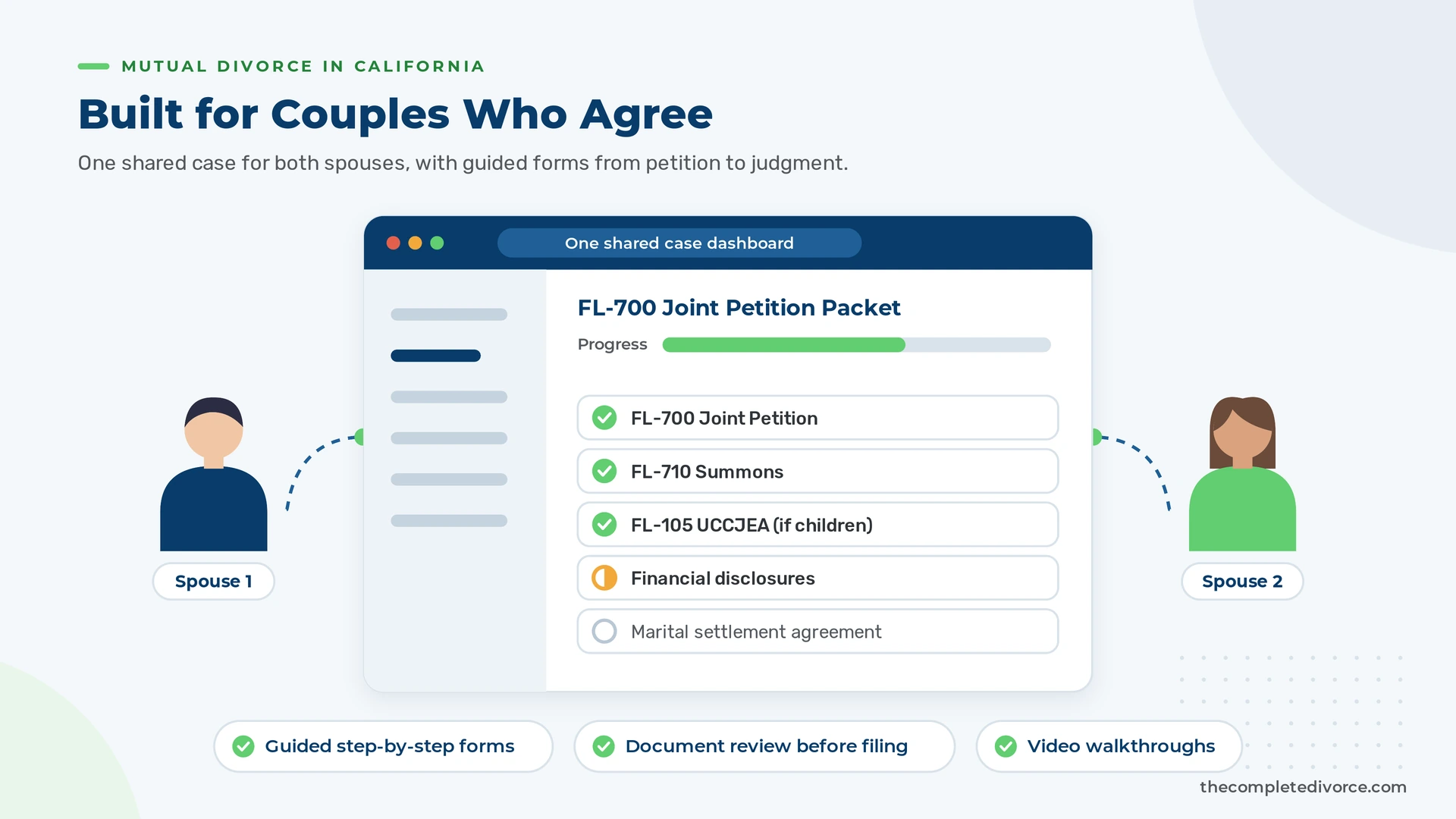
When both spouses decide to file jointly, The Complete Divorce helps prepare the necessary forms for your FL-700 Joint Petition packet, which may include FL-710 and FL-105 if required.
Both spouses have access to the same online case management system, which lets them communicate, work on their case, upload relevant documentation, and complete all other steps required by law.
This cooperative filing method eliminates the need to designate one spouse as the petitioner or respondent.
If you want to go through your divorce without an attorney, The Complete Divorce offers step-by-step instructions and document preparation.
The service offered by the program includes reviewing your documents prior to filing and assisting you in identifying any errors that may be present prior to submission.
The program also offers video walk-through assistance and support resources.
The Complete Divorce helps you prepare paperwork for an uncontested divorce when you and your spouse have agreed on all settlement terms.
Preparation services include your stipulated judgment documents and financial disclosure forms, based on the information you provide. TCD also prepares FL-141, which serves to confirm service of preliminary disclosures.
The Complete Divorce was created for couples that wish to collaborate on a divorce instead of turning it into an argument. A predictable, lower-cost alternative to hourly billing, TCD’s attorney-assisted, step-by-step divorce preparation process includes more attorney support than general AI-generated divorce documents.
Start your mutual California divorce with The Complete Divorce for $49.99 per month and receive attorney reviews and guidance throughout the process.
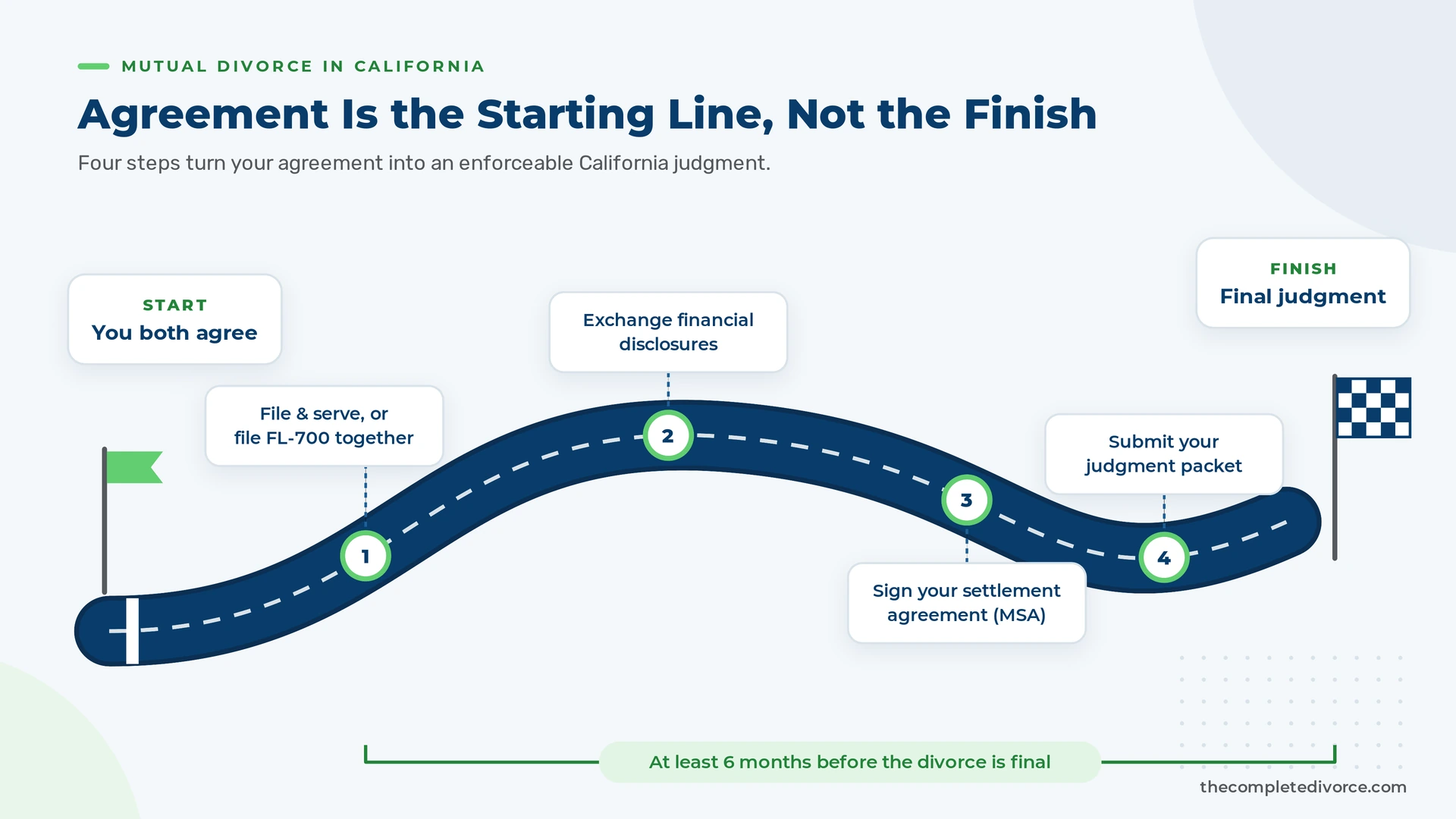
Your divorce is settled; however, you still must follow several procedures to finalise it. These include properly filing the required documents, fully disclosing all finances, reaching a legally binding agreement on dividing your marital assets, and waiting at least six months before filing your final petition.
Therefore, consider your choices carefully. The most common reason divorcing couples have trouble is errors made by their attorneys or by them when filing the right forms.
For just $49.99 a month, The Complete Divorce can help you convert your divorce agreement into an enforceable California judgment using county-specific information reviewed by an attorney.Start your divorce today.

Divorce Attorney — Mediator & Founder of The Complete Divorce
“Hi. I’m Dina Haddad, a divorce attorney-mediator here in California. I’m so tired of couples not having a process that’s easy to complete their divorce. They are getting lost, wasting time and money, and beyond frustrated with their results.
That’s why I created The Complete Divorce, California’s premier online divorce program. I took my successful mediation practice and condensed it into an affordable and winning program.”
“Mutual divorce” is an informal name for a divorce in which both parties mutually decide that they wish to end their marriage. Two options are pursuing an Uncontested Dissolution or filing jointly using FL-700.
Yes. Since January 1, 2026, you and your wife can submit a joint petition (FL-700) as long as you intend to reach an agreement on each of the final issues.
The FL-700 is the document you and your spouse would complete to initiate a divorce action as co-petitioners. This option became available in California beginning January 1, 2026.
Yes. Even though you both agree on all aspects of your divorce, you still need to exchange the required Financial Disclosures, i.e., disclosure of your individual asset holdings, outstanding debt obligations, income, and expenditures.
No. In most cases, attorneys representing divorcing couples cannot also represent both parties. For example, your respective interests may be adverse. However, in a cooperative divorce, alternatives include a neutral Mediator or a Non-Representational Divorce Service.
A minimum of six months. There is a waiting period from the date you serve your spouse in a typical divorce action or from the date you file an FL-700 Joint Petition. It will then take some additional time to prepare the required documentation.
California premier divorce program.
Making California divorce simple and lawyer-free.
 ⭐⭐⭐⭐⭐
more than 2,000 California couples helped
In mediation, you and your spouse work with a mediator

In California, ending a marriage doesn’t have to mean conflict,

Community and Separate Property in a California divorce can pose