Online Divorce
Divorce smartly without a lawyer. Save yourself $10,000+.
- 100% Legit Divorce Program
How to End a Marriage Peacefully in California?
California has a number of ways to end a marriage, such as filing for divorce in California, filing for legal separation, filing for an annulment, or obtaining a summary dissolution.
Most proceedings are based upon “irreconcilable differences” due to the state’s no fault policy. In order to file, you will need to meet the required residency requirements and disclose all of your finances.
Knowledge about these options will help you determine which option is best suited for your situation so that there are fewer delays than necessary.
The Complete Divorce is here to help you with a smoother, smarter, and easier divorce. It empowers California’s amicable couples to divorce without court drama and lawyers. Start your hassle-free divorce today.
Modernizing California Divorce
Complete your divorce without a lawyer.
Move forward with peace of mind and avoid court rejections through our fully-assisted DIY divorce program. This program is founded and led by California divorce expert, Dina.
- Court-approved forms
- Divorce Portal
- Expert Webinars
- 24/7/365 Support
- The MSA
- Parenting Plan
The 4 Legal Ways to End a Marriage in California
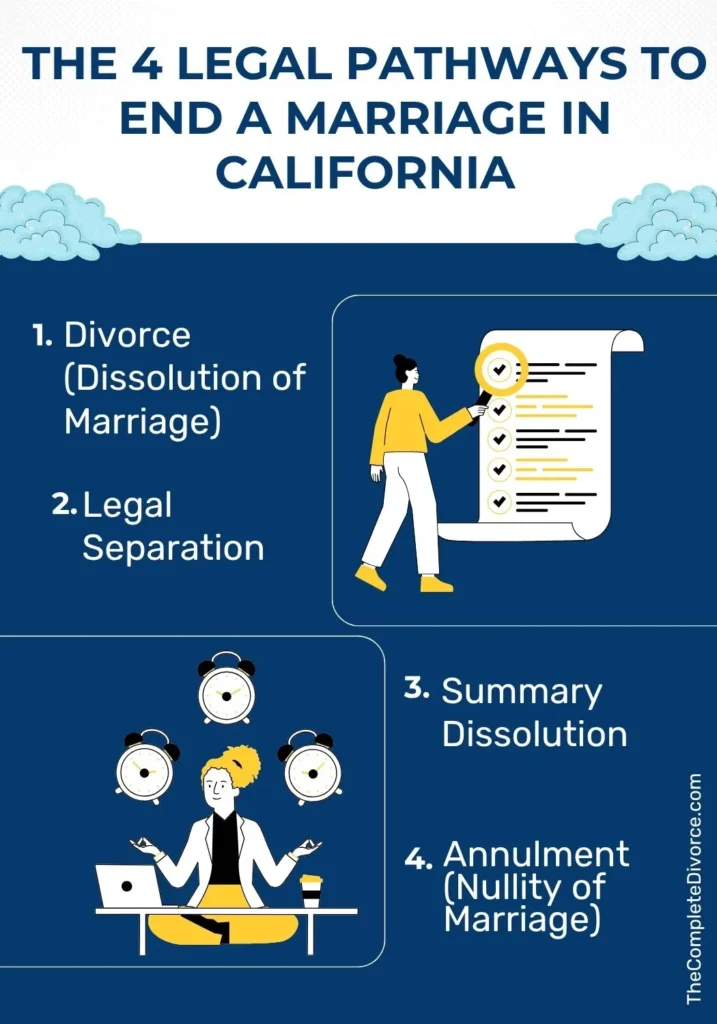
There are many ways that couples can legally end their marriages in California. Each option has a different function depending upon if you wish to continue being married as husband and wife or completely end your marital status.
The first step in ending a marriage in California is to choose the best way for you to end it, which means you need to know what option fits your situation.
1. Divorce (dissolution of marriage)
Divorce is by far the most common way to dissolve a marriage in California. After a divorce has been finalized, each spouse will be returned to their individual marital status and can then remarry. Learn more about how soon after divorce you can marry.
The court system resolves important issues during the divorce, including child custody, child support, spousal support, distribution of community property and who is responsible for the debt.
For a deeper breakdown of how divorce differs from legal separation, see our guide on California divorce vs legal separation.
2. Legal separation
Legal separation in California provides couples with the opportunity to separate while still remaining married. Legal separation also gives spouses the ability to resolve financial and parental responsibilities.
For parties to have a legal separation, both spouses must agree to the legal separation. If one party wants a divorce, the court will order a divorce since California is a no-fault state.
Spouses decide whether they want to continue being married based upon many factors, such as faith-based reasons, health insurance, or unique personal reasons. If two spouses choose to legally separate, they cannot marry someone else until either one obtains a divorce.
3. Summary dissolution
Summary Dissolution is an extremely fast and simple way to finalize your divorce if you qualify. Summary dissolution is applicable to marriages which are less than five years old and have no minor children, limited amounts of property and debts.
In order to complete summary dissolution, both spouses must completely agree on all aspects of the divorce and waive some rights, like right to spousal support. Summary dissolution makes it easier to complete your divorce because there are fewer details required.
4. Annulment (nullity of marriage)
An annulment in California means that the court finds that a couple’s marriage was invalid from its inception.
An annulment usually involves serious circumstances and a couple would need to prove that there were fraudulent activities involved, like the use of force or coercion, or one party was already married when entering into the new marriage. Annulments are significantly less common than divorces.
Ending the Marriage and Residency Requirements
Before filing for divorce or a summary dissolution in California you must meet the residency requirements.
At least one party to the marriage must have resided in the State of California for six (6) months and in the county where they filed the divorce papers for at least three (3) months.
Summary dissolution is available as an alternative to divorce, as well as legal separation.
Step-by-Step Process to End a Marriage Amicably in California
To begin filing the paperwork to start your divorce in California quickly and without a lawyer, you need to understand the different types of paperwork that are required during the divorce process as well as their order.
Step 1: Filing the petition
A spouse initiates the divorce, legal separation or nullity process by filing the FL-100 Petition and FL-110 Summons that outlines their request for property, child custody and spousal support. If there are children, the party must also complete and file the FL-105 (UCCJEA).
Alternatively, parties can now opt to file a joint petition, FL-700. The FL-700 must also include the FL-105 if there are children.
There are many resources available to help couples navigate this very difficult time, such as The Complete Divorce, which provides templates to correctly prepare these legal documents.
Step 2: Notifying the other spouse
Service of process is mandatory. A spouse must be personally served with either FL-115 (service by personal delivery) or and FL-117 (service by mail). If spouses are filing jointly under FL-700, no service is necessary because both parties have agreed.
Step 3: Filing a response
If the joint petition was not used, then the other party (Respondent) must file FL-120, Response, and serve it on their spouse (Petitioner). The Respondent can use mail service using FL-335. If there are minor children, the Respondent must also include the FL-105 (UCCJEA).
Step 4: Financial disclosure
Spouses must submit financial information to each other using: FL-140 Declaration of Disclosure and FL-141 Declaration Regarding Service of Disclosure.
These forms allow for transparency of all assets, liabilities, and income that exist at the time of divorce. This requirement is important for a valid divorce in California.
These forms will include the Declarations of Disclosure: FL-150 Income and Expense Declaration and FL-142 Schedule of Assets and Debts, or FL-160s Declaration of Property
Step 5: Reaching an agreement
Once parties have fully disclosed their assets and debts, couples can negotiate an agreement on issues such as custody, property and support without going through a trial. Couples who reach an early agreement can save money and time.
Using services such as The Complete Divorce can help couples end the marriage with the ease and peace of mind that every amicable, uncontested divorce couple deserve.
We help parties with concrete proper documentation that meets all California divorce laws. Our online divorce program includes a high-quality Marital Settlement Agreement (MSA) that is customizable, fully editable, and court approved.
Step 6: Finalizing the divorce
Once the divorce is approved, the Court will sign the documents (specifically, FL-180 Judgment), and once signed, the couple’s marital status will have been terminated after at least six months and one day from the date of filing.
Ending a Marriage Peacefully and Affordably
You don’t always have to hire an expensive attorney, especially when you want a low-cost divorce in California. Following court procedure in uncontested cases and using quality resources will often save you money.
Some people also want to be their own attorneys (Pro Se) during the divorce process by filling out all of the necessary forms themselves. That is where services like The Complete Divorce (starting at $49.99/month) come in to help make sure everything is done accurately and to keep your costs down.
Special situation: ending a child marriage
Child marriage is a special situation as it can be dissolved by an annulment (nullity) in California. To begin, “nullity” should be selected when completing Form FL-100.
The underage spouse generally has four years from their 18th birthday to file for dissolution; if the person is still a minor, then they will require assistance from a Guardian Ad Litem.
How You End Your Marriage Matters
How you end your marriage in California matters. For example, the marriage that parties terminate amicably, online — using the options like self-representation, divorce without a lawyer or uncontested divorce — can empower parties to not only take control of their divorce but also bring ‘peace of mind’ in the divorce and complete it without spending hundreds of thousands of dollars cost.
However, knowing which of those legal alternatives best fits you will be the keys to successful divorce. Whether to choose California divorce, legal separation, or summary dissolution will be dependent on your specific circumstances.
If your case is uncontested, then using an alternative service such as The Complete Divorce will provide assistance in preparing your documents correctly, avoid unnecessary delays, and keep costs low. Start your divorce today.

Written By:
Dina Haddad
Divorce Attorney — Mediator & Founder of The Complete Divorce
“Hi. I’m Dina Haddad, a divorce attorney-mediator here in California. I’m so tired of couples not having a process that’s easy to complete their divorce. They are getting lost, wasting time and money, and beyond frustrated with their results.
That’s why I created The Complete Divorce, California’s premier online divorce program. I took my successful mediation practice and condensed it into an affordable and winning program.”
FAQ — Ending Marriage in California
Q. Can I end my marriage in California without a lawyer?
Yes. Many couples handle their own divorces in CA. When it comes to uncontested divorces, this is particularly common. You will need to file forms such as FL-100 and serve your spouse using either FL-330 or FL-335. The Complete Divorce, starting $49.99/month, is available to assist you with these details so that you know your work has been done accurately.
Q. How long does a divorce take in California?
There is a minimum 6 months and 1 day from the date of service to the date of completion to actually finalize the divorce. There is a mandatory waiting period and the total time can go past the minimum based on the number of issues, the divorce itself, and the time that it takes to complete the divorce agreement.
Q. What is the fastest way to end a marriage in California?
The quickest way to do this is to meet the criteria to file for summary dissolution California. If that is not the case, a divorce that is uncontested is the way to go as long as there are agreements and forms that are filed correctly.
California premier divorce program.
Making California divorce simple and lawyer-free.
- Filing & Review Support
- 1-on-1 Divorce Meeting
- Child support calculations
- MSA Filing Support
 ⭐⭐⭐⭐⭐
⭐⭐⭐⭐⭐
2000+ divorced without a lawyer.