

In mediation, you and your spouse work with a mediator
Online Divorce
Divorce smartly without a lawyer. Save yourself $10,000+.
You are in your vehicle at 11 p.m., looking up on Google how to begin a divorce in California. You may not have discussed this divorce with your spouse, and you may still be deciding which type of divorce is right for you.
No matter your situation, it’s smart to prepare before filing, as it can save you costly errors. The pre-divorce checklist below covers what you need to do before filing, including legal restrictions that kick in once you file.
Before submitting any forms, let us help you organise your paperwork with The Complete Divorce.
Dina Haddad, divorce attorney-mediator, has prepared the pre-divorce checklist for California couples to help them take control of their divorce and do it productively and cheaply. Start your divorce today.
Start your FL-700 Joint Petition. Our software is easy to use, led by California divorce attorney Dina Haddad.
These two answers rebuild the rest of the interview. Whole sections appear or disappear — you'll never be asked something that doesn't apply to you.
Every answer saves the moment you type it. Close the tab, come back next week, land on the same question.
The date of separation must be after the date of marriage.
These five answers fill page 1 of FL-100 — the case type, the residency box, both dates and the children box. Print the form from the panel on the right and they are already on it.
Building your FL-100…
To file for divorce in California, at least one spouse must have lived in the state for six months and in the county where filing for at least three months to file for divorce. This doesn't apply to legal separation. Consider changing your response.
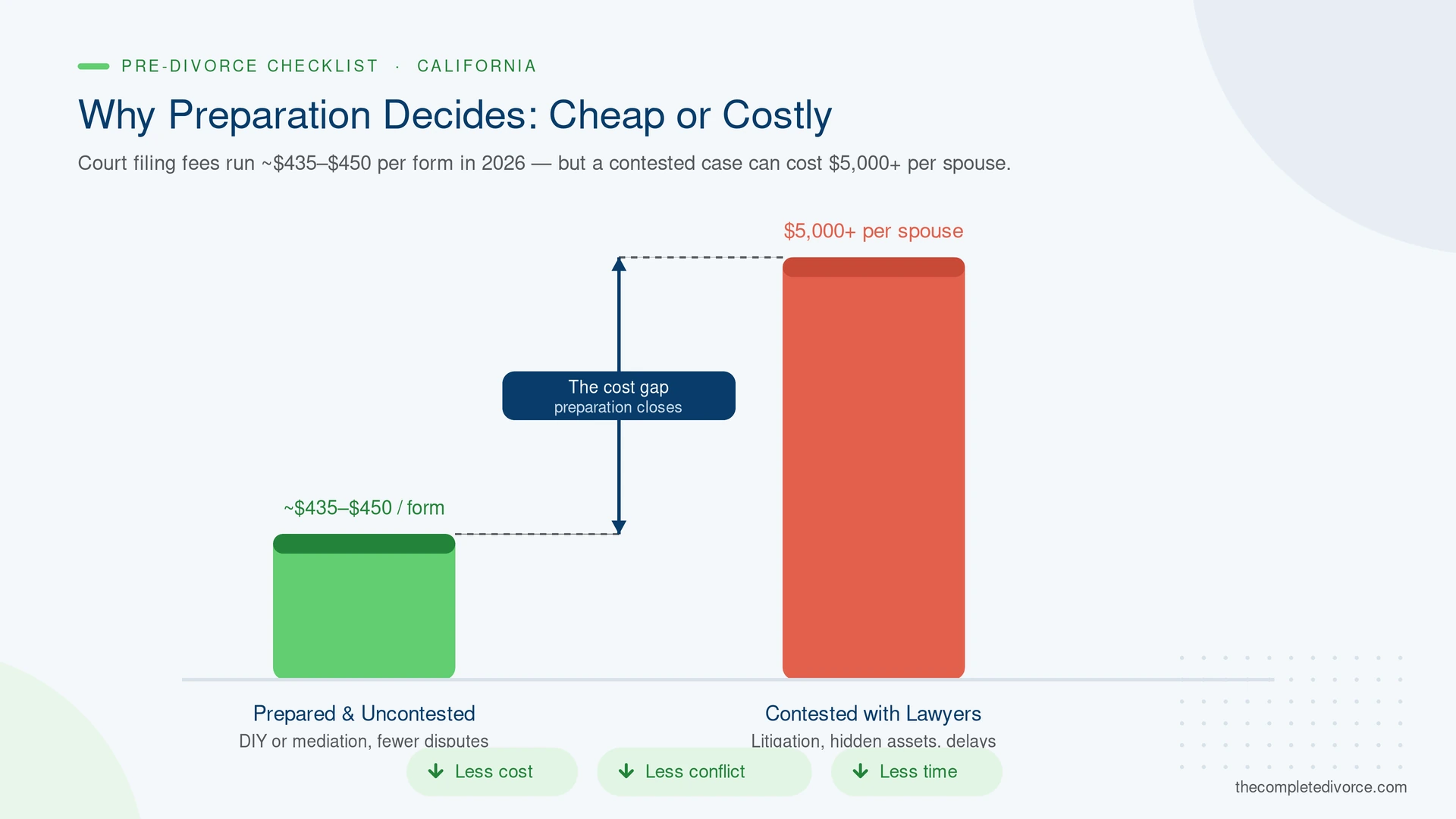
Before you file for divorce in California, preparation can help you avoid disputes over paperwork and legal fees.
If you are torn between a contested and an uncontested Divorce in California, note that uncontested divorces often cost less than contested cases, which can cost each spouse five figures or more.
Resolving issues related to money, property, and children early in the process will also likely save money by reducing the chance of expensive litigation.
Your divorce cost depends on how you handle it and whether you and your spouse agree. As of 2026, court filing fees are generally between $435.00 and $450.00 per document, before additional expenses.
A DIY divorce with guidance will include the cost of forms and online services, which is why it is often considered a low-cost divorce in California.
Mediation is slightly more expensive but will allow you to negotiate the terms of your divorce without going through trial.
A contested divorce with lawyers will probably cost each spouse at least $5,000.00 or more. Hidden assets, property disputes, custody battles and rejected paperwork all add to these costs. Learn how to turn the contested divorce into uncontested divorce.
Preparation for filing saves time and reduces disputes in the long run. Prepare your financial information early so you and your spouse can complete the disclosures.
Agree on an asset list ahead of time to reduce valuation differences that could cost a lot. Find out which forms your county requires and file them correctly to avoid rejections or delays.
Preparation will help you arrange service quickly after filing your petition. In California, the six-month waiting period begins when the respondent is served with the divorce papers or files their response, whichever occurs first. Prompt service helps you avoid delays.
Read More: DIY Divorce – The Comprehensive Checklist
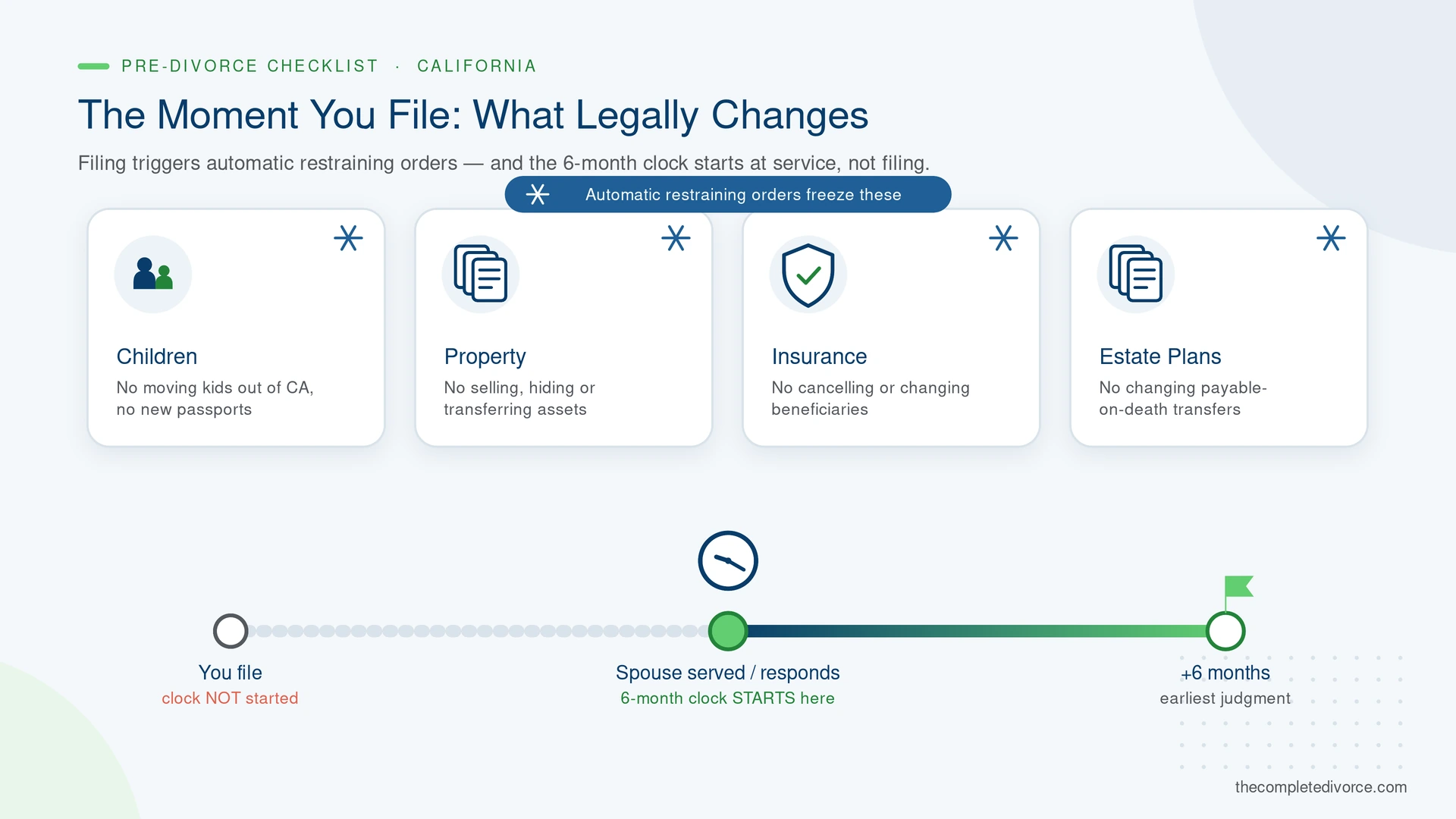
In California, filing a petition for dissolution of marriage (divorce) is more than the beginning of your case.
It triggers legal restrictions on money, property, insurance, and children that can prevent or severely limit both parties’ actions after commencement.
Because these restrictions may help you prepare before filing, two factors matter most: automatic restraining orders and when the six-month waiting period begins.
When you file for divorce through the normal process, the Summons (Form FL-110) automatically includes temporary restraining orders added under California Family Code Section 2040. The automatic orders apply to you when you submit, and to your spouse when they receive service.
Restrictions include:
Always plan all lawful financial changes before filing. Never attempt to hide assets or deplete bank accounts. Both actions could breach your fiduciary duty and potentially harm your case.
The six-month wait to get divorced can begin at one of two times: when you serve your spouse with your divorce paperwork or when you appear as a party in this case.
Simply filing for a divorce does not begin the countdown. Your divorce timeframe has not begun, even though you have prepared all the necessary paperwork and arranged to deliver it to your spouse.
Promptly preparing and sending your paperwork, and arranging service, helps avoid delay.
The newly revised FL-700 Joint Petition differs from prior petitions and establishes that the filing date of the joint petition marks the start of the six-month time requirement.
As with other divorces, it takes at least six months to complete and finalise your divorce.
Before filing for divorce, you will be better positioned to organise your finances and compile documents before the divorce proceedings impose automatic restrictions on both parties.
While preparing for the divorce proceedings, document all relevant financial information, review all assets (property) that may be affected by the divorce, open separate bank accounts as needed, and develop a strategy for how you intend to proceed within the law.
After you file for divorce, certain legal requirements apply to both parties at specific times during the proceedings. Gathering documentation before filing can reduce unknowns as you move through the divorce proceedings.
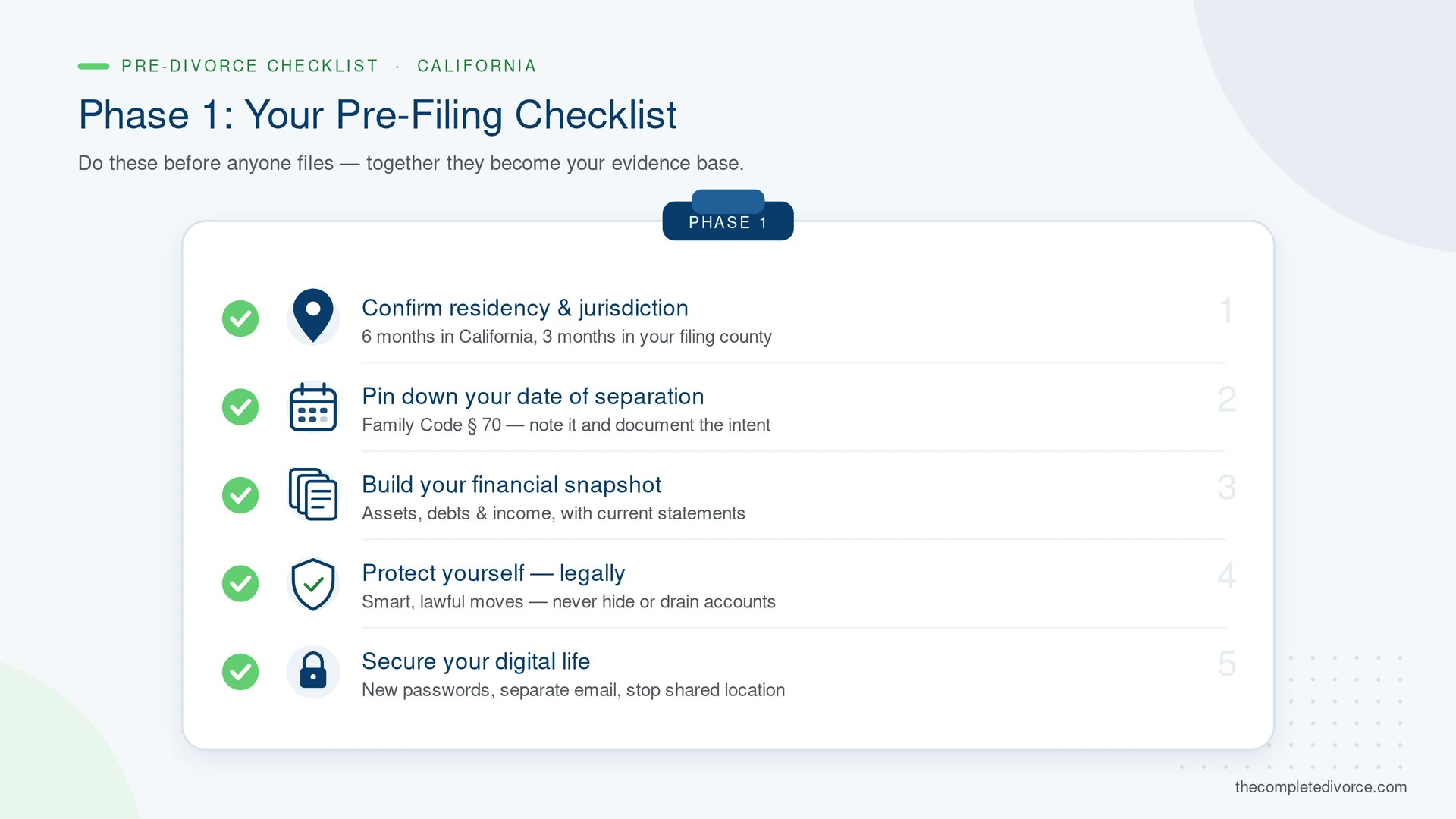
Go down this checklist from top to bottom. Find out whether you qualify to file in California, complete the documentation for your divorce or legal separation, gather all necessary financial information, and establish a lawful way to protect yourself.
Store everything in one place, both digital and physical. The listed items will create your evidence base as well as provide the foundation for filing the actual papers that follow.
Before filing for divorce in California, confirm if you satisfy California’s residency requirements. For most couples, at least one must be a California resident for at least six months and in the county where they file for at least three months.
If neither meets these qualifications, it may be best to wait until you qualify or file for legal separation with the option to convert to a divorce once you qualify.
Date of Separation under California Law (Family Code Section 70): When you decide to divorce your spouse, it doesn’t matter whether you continue living in the same house.
What matters is when you decide you will no longer be married. The law states that this can be based on either verbal communication about wanting to get divorced or by actions which show that you have decided to divorce.
Once there is a clear indication of intent to divorce and that person has acted upon their decision, then they are considered legally “separated” from their spouse.
Having this detail in place makes it easier to prove your separate property in a California divorce.
Create a current and dated picture of your financial situation now that you have access to all of these records.
Record assets (real estate, bank accounts, investments, retirement plans, pensions, vehicles, business interests and valuable items) with current balances and provide the latest statements for each.
Also record debts (mortgages, credit cards, auto loans, student loans, personal loans and tax obligations). California divorce law requires both parties to divide debts along with other assets.
Collect the last 2 or 3 years of pay stubs, tax returns, and documentation of side jobs or self-employment income. Store copies in a private, password-protected location. These documents will be helpful when you are required to submit financial disclosures.
Before you begin the divorce process, determine whether any actions you take in lawful self-defence violate your responsibilities to others or the court’s temporary restraining order.
Before filing, organise and create your own documentation; however, do not hide, deplete, or improperly transfer shared resources.
Once a divorce action has begun, most jurisdictions have automatic restraining orders that prohibit certain actions regarding real estate (property), insurance, and children.
Planning ahead will help you understand where you stand and protect potential evidence; however, it will not give either party an unfair advantage.
If you are uncertain as to whether a particular financial action is permissible, consult with a lawyer prior to acting on the matter.
The goal of preparing documents etc. is not to take control of joint income or exert undue influence over your spouse. Be honest about all actions you take, and seek legal counsel when needed.
Open an account (checking or savings) and have all future earnings sent to that account, but do not use money that you and/or another person share for this action.
Review your credit report and identify what you own jointly and what you own individually. Obtain copies of important documents such as passports, Social Security cards, certificates, etc.
Make a list of emergency contact people. Check who is named as beneficiary in your life insurance policies, wills, trusts, living wills, etc. If you file for bankruptcy, do not make changes to the restricted beneficiaries or coverage on any policy until you are permitted to do so by statute, written consent or Court Order.
Don’t take money or assets from a community fund. Don’t hide, move, or dispose of community property.
This is prohibited and will harm your case. Don’t take kids out of the state. Don’t interfere with their routine for leverage.
Also, don’t talk about your ex, finances, or divorce on social media. Social media posts can turn into evidence. Quit working now to lower child/spousal support.
The Court will look at what you earn in the future (not just what you make now) when determining spousal/child support.
You may also have a digital connection with your spouse. Review who has access to those digital connections prior to separation.
Create new passwords for your individual email and accounts. Also disable location and photos from being shared.
Keep your cloud storage and password manager vaults as separate as possible. Establish a separate account (email) for all communication.
Do not access any accounts without your spouse’s consent.
Delete nothing that is digitally shared. Keep in mind that either party can introduce messages, emails, social media postings, etc., into evidence during litigation. Use language in all communications that you could comfortably explain in a courtroom.
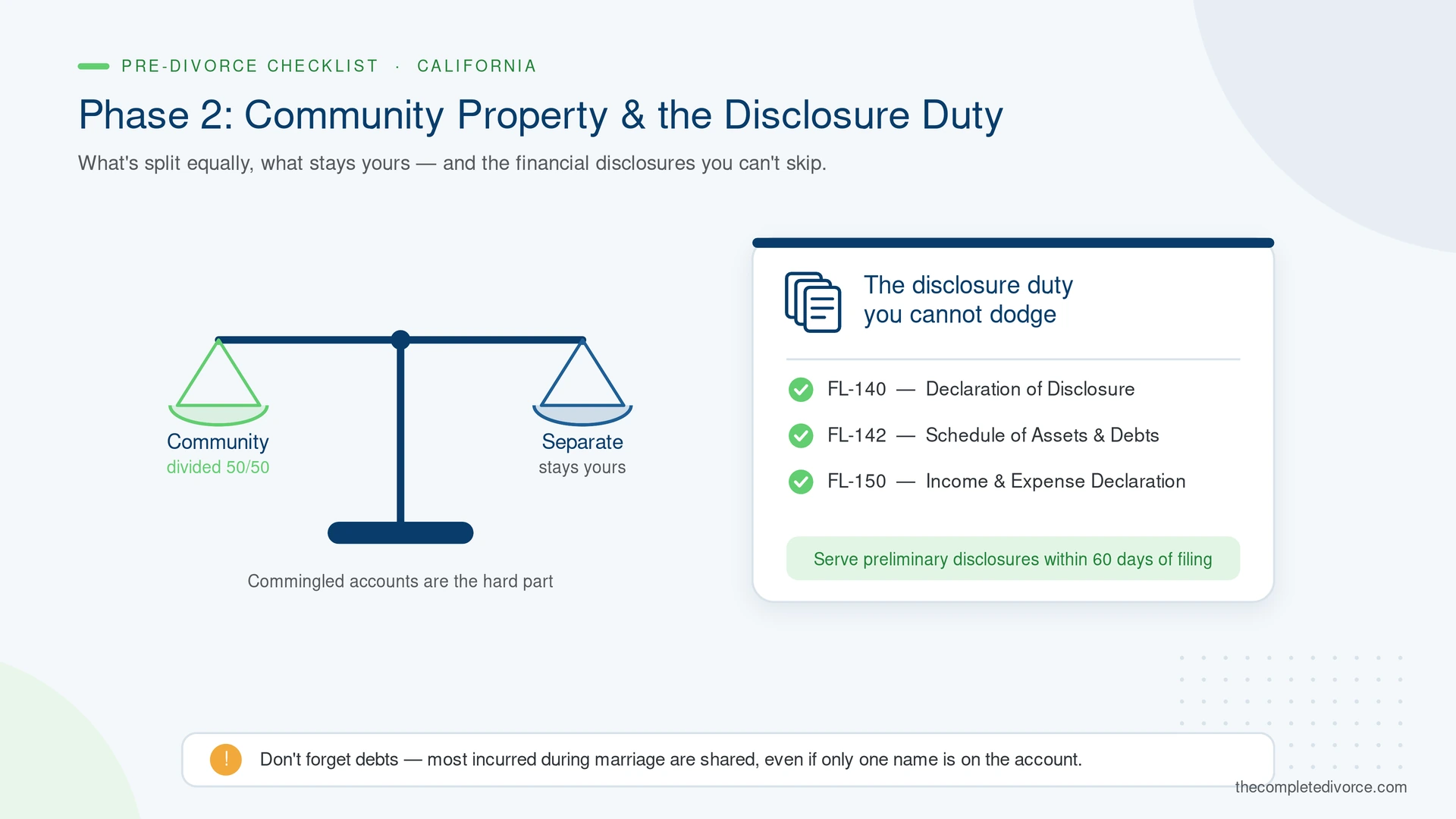
In California, divorce is based on “no-fault” grounds. To obtain a divorce in California under the Community Property provisions of Family Code Sections 2310 and 760, you don’t need to prove fault or wrongdoing by your spouse.
Rather, you will need to identify community assets and debts, identify your separate assets and debts, and disclose all known community and separate assets and debts.
Identifying each item early can help you understand which property you individually own or owe and which items should be divided.
Further, if you can identify these items accurately at the beginning of the process, you may avoid costly post-divorce litigation over the same issues.
As previously noted, full financial disclosure is a legal obligation. However, with proper preparation and documentation from Phase I, you will have a solid foundation for making appropriate identifications of community property versus individual property, evaluating asset values, listing debt obligations, and ultimately preparing complete and accurate financial disclosure statements.
Community property includes all assets that earn income or are acquired during marriage and is generally divided equally.
Separate property includes assets owned before marriage, as well as gifts and inheritances a spouse receives. Both types of property can be difficult to classify when accounts are commingled.
Even if only one spouse’s name appears on the account, most debts incurred during the marriage are classified as a community obligation.
So determine who owns joint balances and payment dates to protect yourself from credit problems that can result from the proceedings.
You cannot avoid making full and honest disclosure of all of your financial information in California. In addition to providing preliminary disclosures through Forms FL-140, FL-142 & FL-150, you must do so within 60 days after filing your divorce petition.
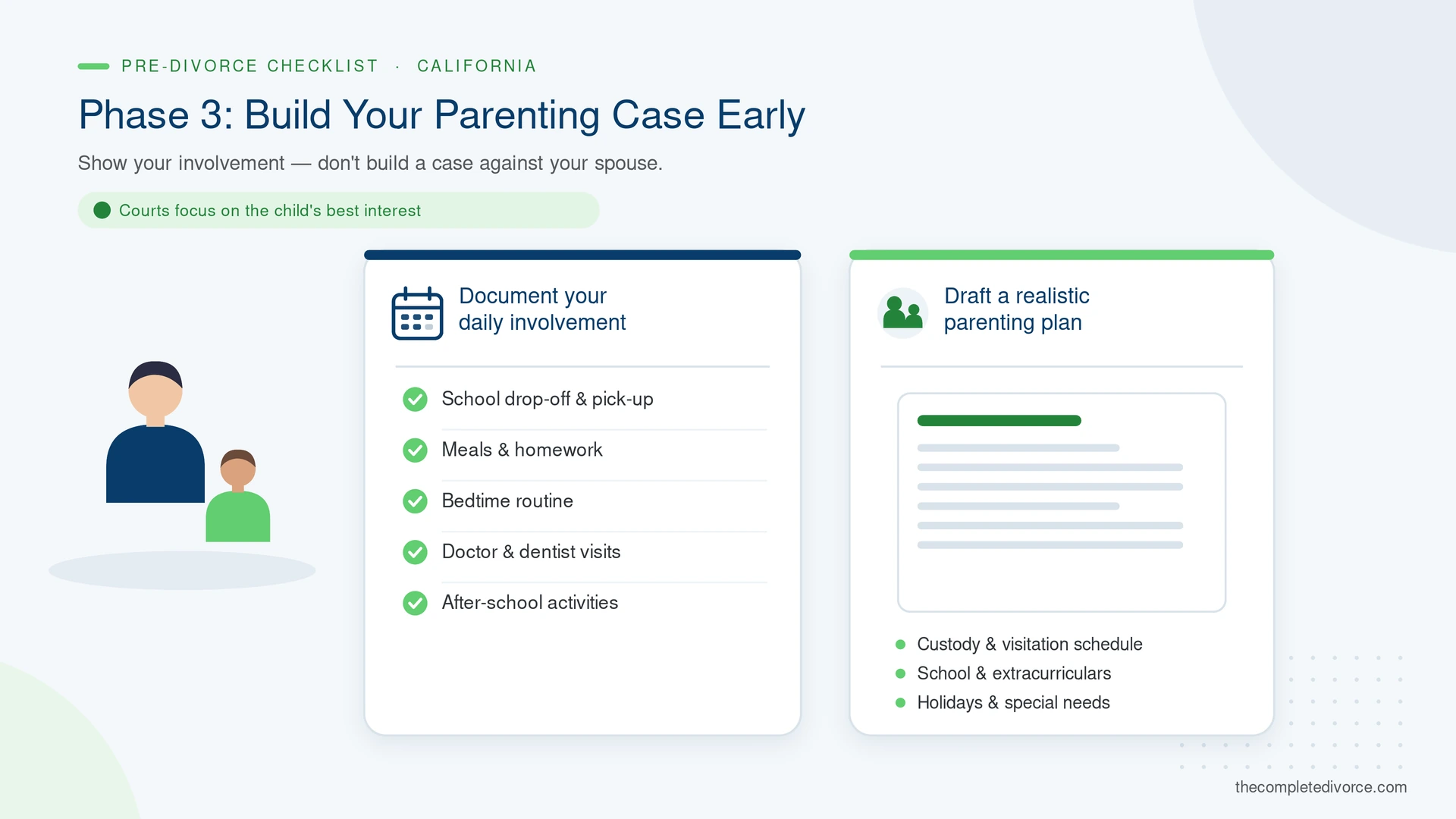
If you have children, prepare as much as possible for a custody battle before going to court.
The court will look at what is in the “best interest” of your child, and most often the court will support each parent having regular contact with their children.
This means your job is to show how involved you are in raising your child (and can provide consistency), rather than trying to build evidence against your spouse.
Documenting your daily responsibilities for caring for your children and creating a parental schedule that works for everyone can help you understand what your children need and provide a basis for discussion or negotiation, if you can reach an agreement.
Document your daily routine as a parent in a calendar or log that includes school drop-off, meal times, homework times, bedtimes, doctor’s visits, and after-school activities.
Store important papers, such as school notes, doctor visit records, and a copy of each child’s activity schedule. These can be valuable if there is ever a dispute regarding custody of your children.
Develop an outline of how you would handle the children’s day-to-day care and create a working plan for both parents’ rights (i.e., custody and visitation), including your children’s school, extracurricular activities, and special needs.
This plan will give you negotiating power when discussing a settlement agreement with your former spouse; it will also give you both something to focus on while you work out a divorce.
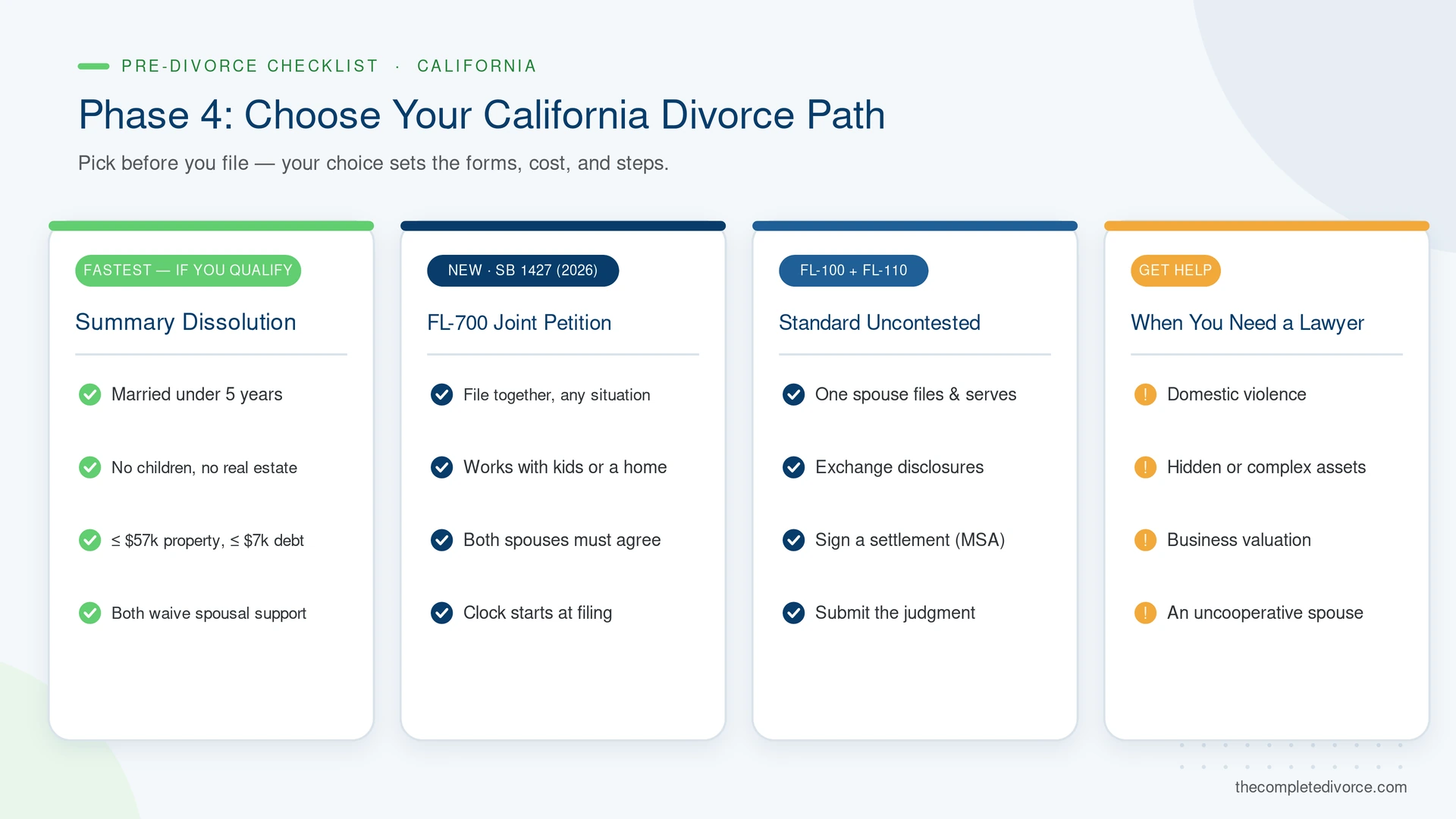
Before you file for divorce, choose a process that suits your situation. Your choice will determine which forms you must use, how much it will cost, and what steps you need to take.
California offers several divorce options, including summary dissolution for eligible couples, joint petition divorce, and uncontested vs contested divorce.
Each option has different requirements, but most have a six-month wait period. Most cases also require financial disclosure. Choosing the right divorce process can help you prevent delays and reduce the need to refile.
A summary dissolution is an easier way to get divorced if you qualify. Here’s what you need:
These strict limitations mean that this process will probably be unsuitable for most divorcing couples.
Since January 1, 2026, if both parties have agreed to all of the conditions, they may be able to get divorced by filing Form FL-700 (together), whether or not they have children, property, or were married for many years.
They would then serve the paperwork on each other, which begins the six-month waiting period.
The Standard Uncontested Dissolution applies when both parties agree to all conditions; however, one party files Form FL-100 and Form FL-110, serves the other party with those forms, exchanges the required financial information, signs a Marital Settlement Agreement, and submits the Judgment.
This option is best when only one party starts the proceeding.
DIY divorces usually work for friendly separating couples; however, there are times when you should seek professional legal counsel.
These include when there is domestic violence, hidden assets, valuation of businesses, difficult separate property claims or an uncooperative partner.
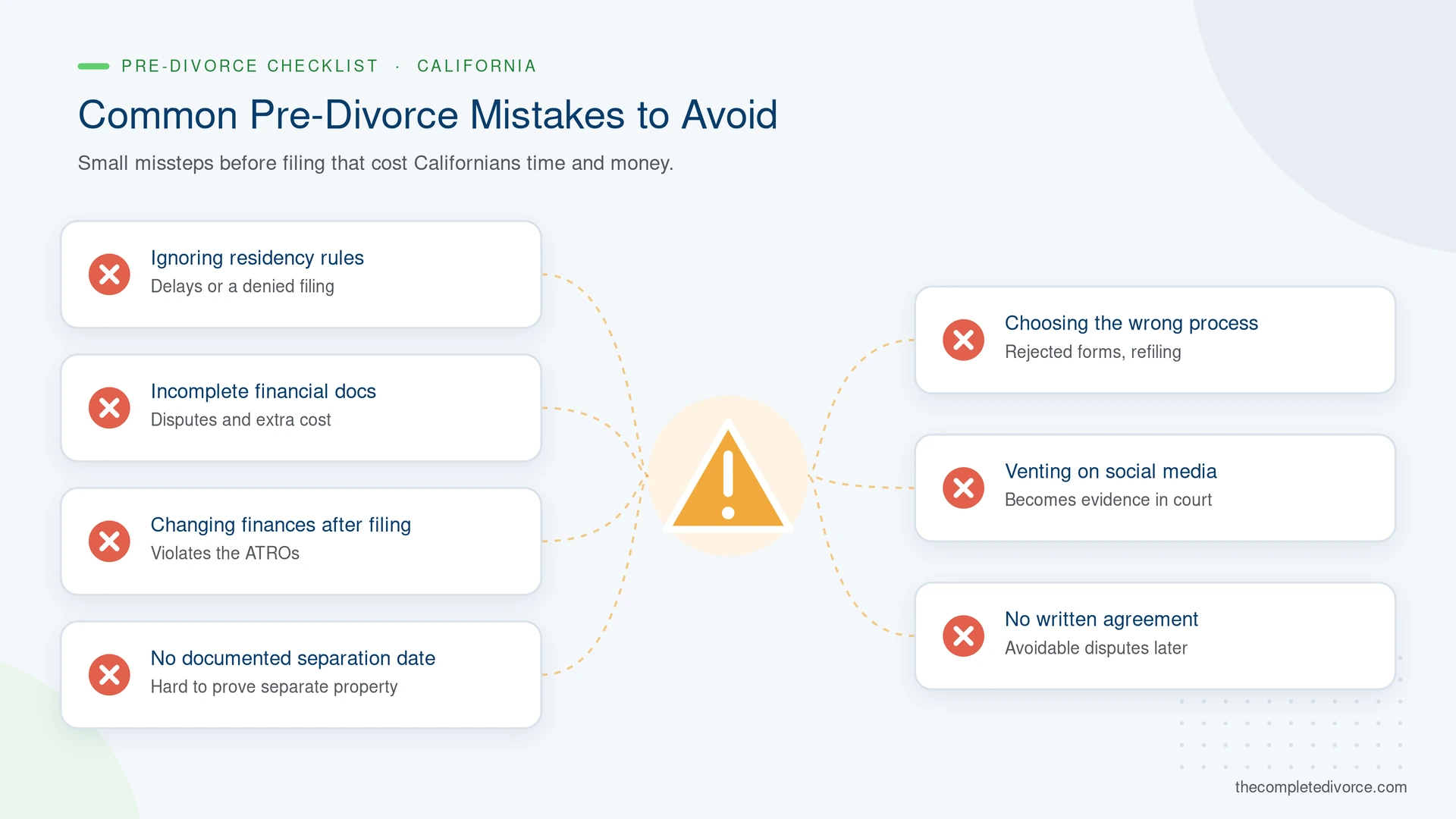
Common errors prior to filing for divorce in California are as follows:
Preparing your case will help you avoid many avoidable costs and time.
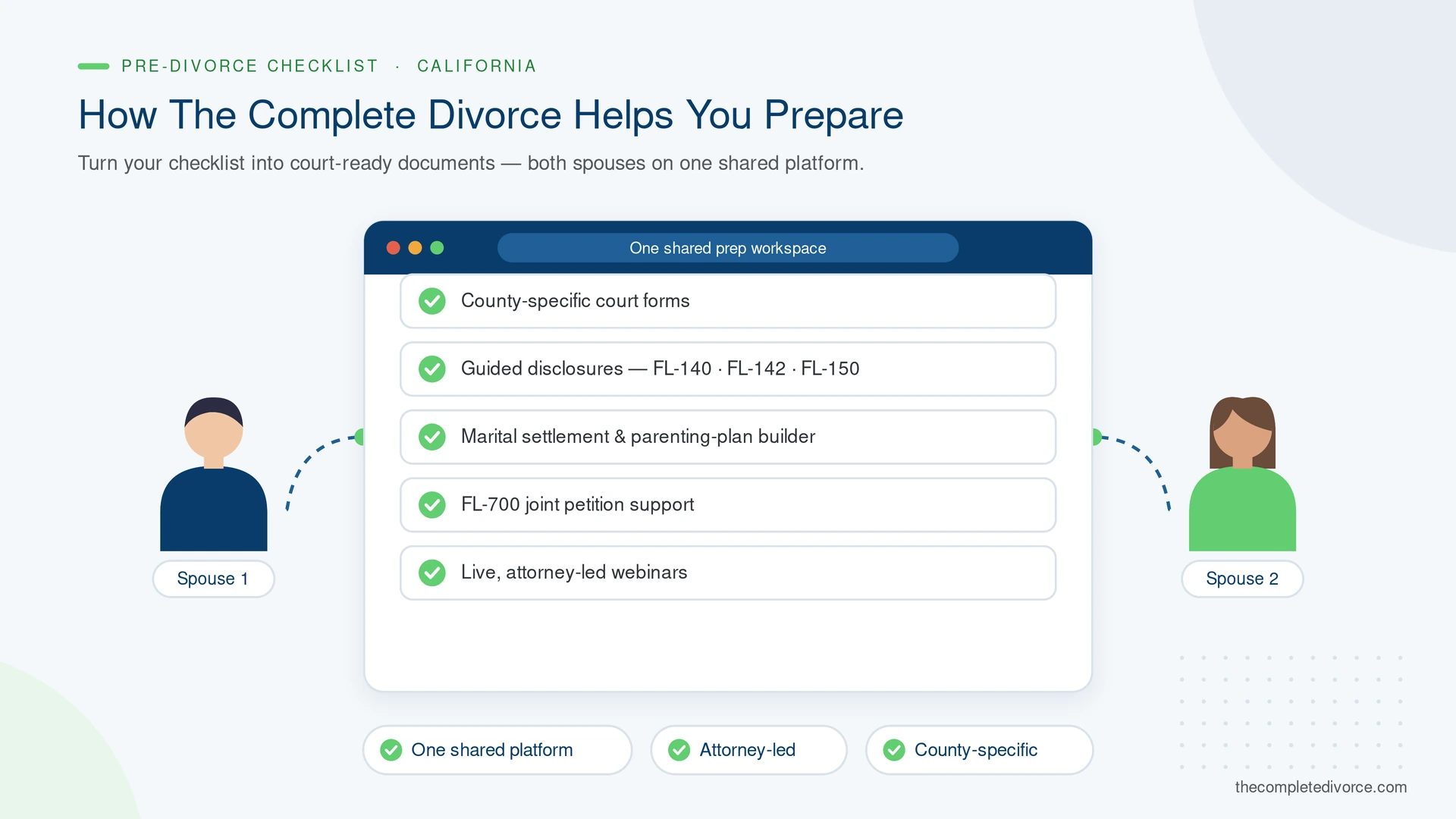
The Complete Divorce helps individuals prepare their own divorce papers at an affordable price. With The Complete Divorce, you can access county-specific court forms for your previous marriage based on the specifics of your case.
You get guided financial disclosures using Forms FL-140, FL-142, and FL-150; a built-in marital settlement agreement and parenting plan builder; support for the FL-700 joint petition; and live, attorney-led webinars. Both spouses work through the process on one shared platform.
The Complete Divorce also offers tools to file a Joint Petition, along with live, attorney-led webinars. Both parties can use the same document repository to complete their individual parts of the divorce.
You have completed the most difficult part of divorce preparation; now let The Complete Divorce turn your checklist into court-ready documents. Explore our Pricing and start today!
Often, the best (and cheapest) California divorces start with careful preparation before filling out the papers.
Verify you qualify, confirm the date you separated from your spouse, gather all financial information, protect yourself legally, understand the laws on property and disclosure, plan for your children, and determine which type of divorce is best for you.
Preparation doesn’t mean you expect a battle. Preparation means that you will reduce your chances of having one. Start your California divorce prepared.
Follow this checklist first. Then, The Complete Divorce will complete your divorce documents for $49.99/month; you can cancel at any time.

Divorce Attorney — Mediator & Founder of The Complete Divorce
“Hi. I’m Dina Haddad, a divorce attorney-mediator here in California. I’m so tired of couples not having a process that’s easy to complete their divorce. They are getting lost, wasting time and money, and beyond frustrated with their results.
That’s why I created The Complete Divorce, California’s premier online divorce program. I took my successful mediation practice and condensed it into an affordable and winning program.”
Confirm residency requirements, confirm your separation date, gather all financial records, review your assets and debts, secure your personal accounts, consider your children’s best interests, and choose the right type of divorce for you.
You or your spouse typically must be residents of the state of California for at least 6 months and of the county where you are filing for at least 3 months.
No. While you should organise your finances and possibly open an individual account, avoid improperly transferring jointly owned funds or making any unauthorised financial transactions.
Gather your tax returns, pay stubs, bank and investment statements, retirement information, deed to the estate, mortgage statements, loan balances, credit card statements, and any other records pertaining to your assets and liabilities.
In general, no. The fact that one party filed first has little bearing on determining how property will be divided or determining child custody. However, filing subjects each party to various legal limitations and requires them to follow certain procedures.
California premier divorce program.
Making California divorce simple and lawyer-free.
 ⭐⭐⭐⭐⭐
more than 2,000 California couples helped
In mediation, you and your spouse work with a mediator

In California, ending a marriage doesn’t have to mean conflict,

Community and Separate Property in a California divorce can pose