Online Divorce
Divorce smartly without a lawyer. Save yourself $10,000+.
- 100% Legit Divorce Program
Can You Use AI to Handle Your Divorce in California?
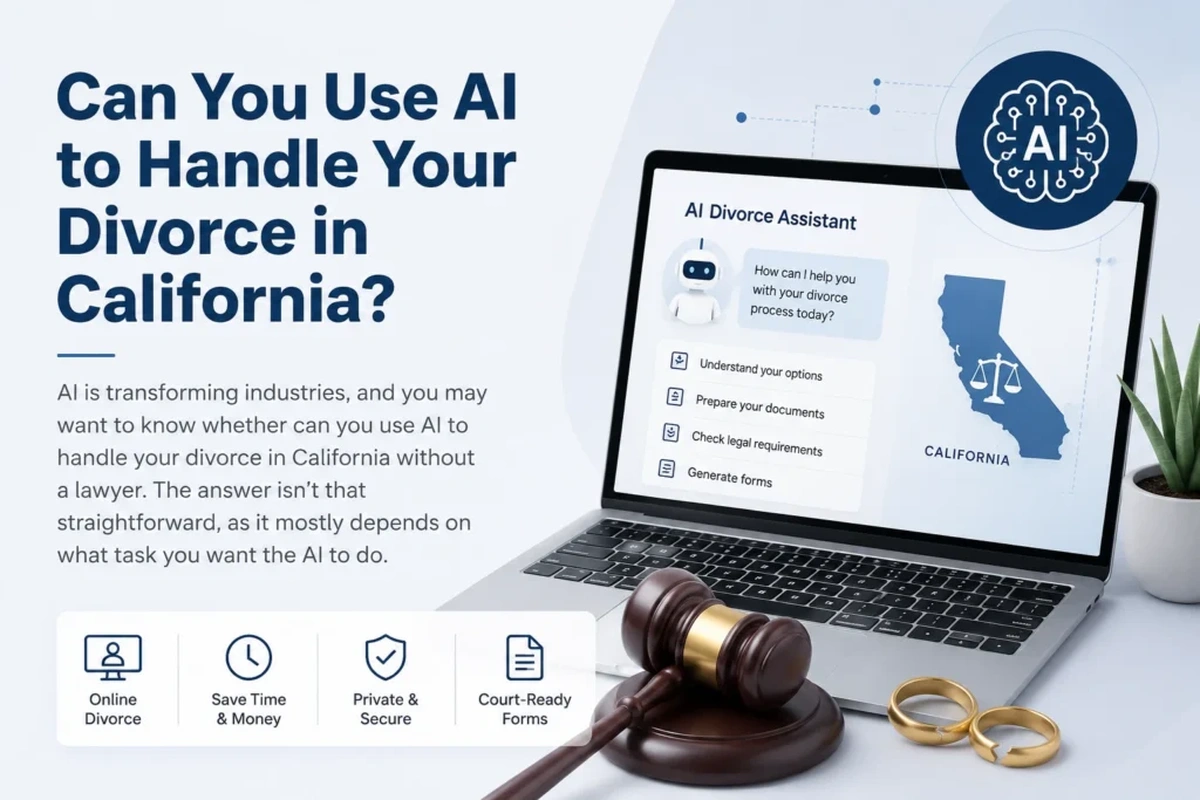
AI is transforming industries, and you may want to know whether can you use AI to handle your divorce in California without a lawyer. The answer isn’t that straightforward, as it mostly depends on what task you want the AI to do.
However, at The Complete Divorce, Dina maximized these technologies with her 20 plus years of California family law experience to create a powerful online divorce system for California couples so that they are able to complete their entire divorce within our platform successfully.
Otherwise, programs like ChatGPT can explain legal terms, organize your financial documents, and even draft some legal documents.
However, they cannot guarantee that each output is legally correct and consistent, and without this assurance, your case can be delayed or completely denied.
This post will cover areas where AI can genuinely help, where it’s better to get legal counsel instead, and how to use it correctly during your divorce in California.
If you are struggling to figure out whether AI or The Complete Divorce can work for you, please reach out to us. We are happy to help. You can also subscribe for $49.99/mo and attend the next live webinar with Dina.
Modernizing California Divorce
Complete your divorce without a lawyer.
Move forward with peace of mind and avoid court rejections through our fully-assisted DIY divorce program. This program is founded and led by California divorce expert, Dina.
- Court-approved forms
- Divorce Portal
- Expert Webinars
- 24/7/365 Support
- The MSA
- Parenting Plan
The Divorce and AI Explained for Californians
Uncontested dissolution is a type of California divorce in which the couple agrees on all the main issues, including how to divide assets (property), debts, support, and any child-related matters.
Since there is no disagreement on any of the key issues, it is generally the ideal choice for individuals using AI technology as part of a guided do-it-yourself (DIY) divorce process.
For those who are new to this process, The Complete Divorce offers an online Complete Guide to DIY Divorce in California.
NOTE
An uncontested divorce is different from a Summary Dissolution, which is a quicker way to get divorced, but has very different rules.
Mainly, it is only available when the divorcing couple has a short marriage, limited property or debt, and no minor children.
California is also considered a no-fault divorce state, which means you can claim “irreconcilable differences” as the reason the marriage should be dissolved.
Before either spouse can file for divorce, at least one spouse must have been living in California for six months prior to filing and in the county where they will file for at least three months.
If you are currently waiting to fulfill the residency requirement for either of these states, AI tools can help you explore the legal process, prepare your paperwork, and organize your financial data prior to your case being formally initiated.
When AI-driven divorce in california is not right?
AI does its best with relatively simple, undisputed divorces. It can never replace a judge’s decision-making in areas of disagreement, such as a couple’s businesses, their real estate holdings, retirement funds that require a Qualified Domestic Relations Order (QDRO), or large amounts of property.
Similarly, divorce cases where there has been physical abuse of one spouse by the other, one spouse is financially controlling the other, or there are power dynamics that favor one party over another must include protections that AI cannot offer.
The same is true of child-custody issues; judges must make decisions about what is in the children’s best interests and take into account family-specific facts rather than generalizations from an AI response.
Additionally, AI struggles when one spouse cannot be found or will not participate in the divorce process due to California’s service requirements and/or alternative methods for providing notice and service under court rule.
Dina’s Keynote: Be realistic about your divorce case. If you have a long-term marriage and a large asset-size, it’s highly unlikely that AI will be sufficient for your matter. Check out options like Families First Mediation that remain affordably but specialize in high-asset complex cases. Alternatively, if you consider your asset size average or simple, The Complete Divorce not only exceeds AI-tools but gives you access to our divorce experts and our live webinars.
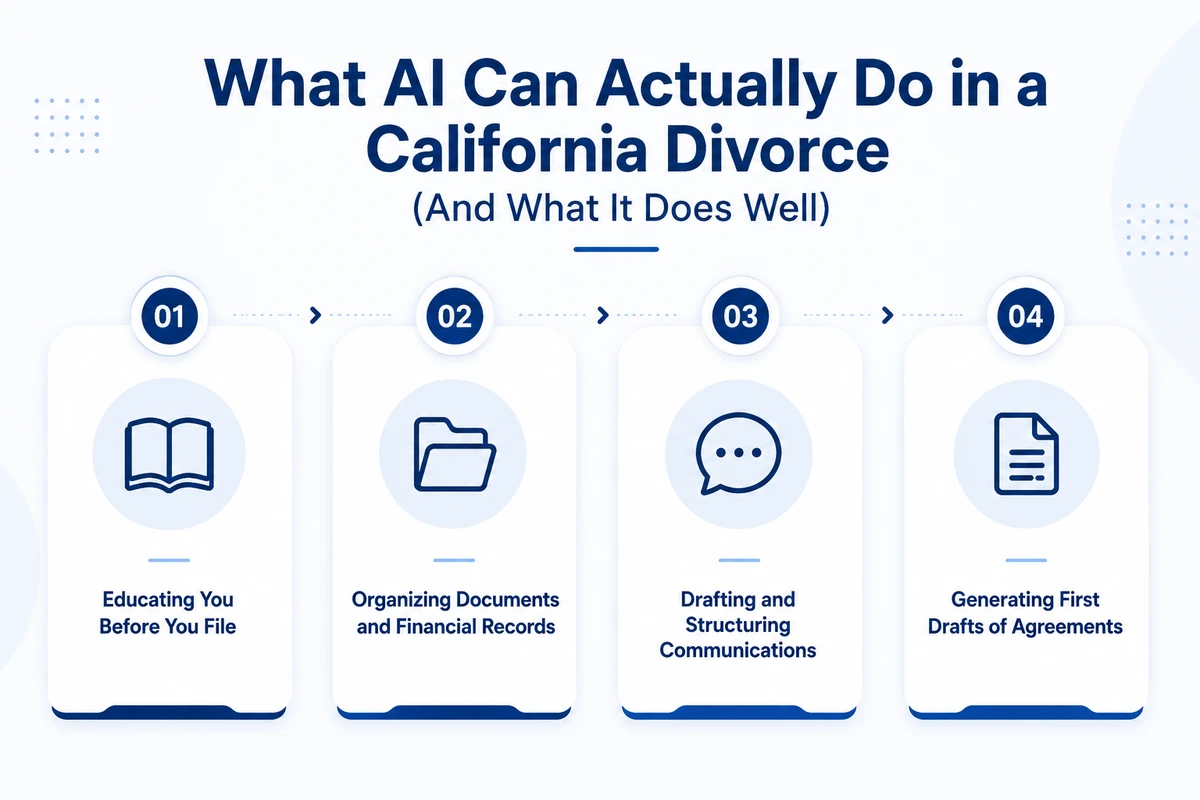
What AI Can Actually Do in a California Divorce (And What It Does Well)
AI is most useful as a support tool to assist in the legal process, not replace it. It can help you understand the divorce process and organize your financial information.
It can also help you draft clear communications, and create first drafts of documents that will be reviewed by your attorney. Used properly, this can save time and help you prepare better before filing or consulting with an attorney.
1. Educating you before you file
One of the main advantages of using AI tools such as ChatGPT and Claude when dealing with the divorce process in California is that they help you understand many of the legal aspects of your divorce such as:
- Definitions of typical family law terminology
- Outlining the steps involved in completing an uncontested divorce
- Explaining the necessary paperwork and procedures required to file a petition for divorce from start to finish.
- Clarifying California’s residency requirements. Examples include: the six-month state residency requirement, the three-month county residency requirement, and the mandatory six months prior to receiving a divorce judgment.
Additionally, AI can identify the most common forms filed in conjunction with a California divorce and describe the form’s intended use. For example, it can describe what FL-100 (Petition), FL-110 (Summons), FL-140 (Declaration of Disclosure), FL-150 (Income and Expense Declaration), and FL-180 (Judgment) are intended to do.
While no one should rely solely upon AI tools to prepare any forms without first verifying them, AI can certainly assist you in preparing the information needed to properly complete all of these forms.
2. Organizing documents and financial records
AI can assist in organizing income records, bank statements, debts, investments, and community property into categories, making it easier to complete your financial disclosure during a California divorce. In addition, AI can summarize long financial reports to help identify potential omissions and other items that should be disclosed.
California law requires that each spouse must disclose financial information using the FL-140, FL-141, FL-142, or FL-160, or FL-150 forms.
Using AI during this process can assist with reminders about which financial records correspond to which form(s). It can also help spot frequently overlooked items such as retirement accounts, employee stock options, business interests, pensions, and personal property.
3. Drafting and structuring communications
Divorce talks often get very emotional, which makes communication difficult. Today, many are using ChatGPT as a “pre-screener for communications”, rewriting their email, texts, etc., in a less emotional and more polite way before they send them.
According to family law attorneys that were interviewed by Washingtonian, one of the most practical ways of using AI, in general, is reducing conflict between parties involved in divorce cases; at the same time, focusing on finding solutions.
However, there are limitations to these benefits. Do not input any confidential litigation strategy, attorney advice, settlement negotiations, or other sensitive financial data into publicly accessible chatbots (including but not limited to Google).
Any data that you provide to publicly accessible chatbots does not enjoy protection under the attorney-client privilege.
The U.S. Courts have recently ruled (in the 2026 case of Heppner) that users who rely upon public AI platforms for confidential legal matters do so at their own risk.
The party in the case waived their right to attorney-client privilege at it related to his searches regarding his legal exposure for fraud.
So, if you use consumer-available AI to help you communicate more effectively with your opposing party, such searches may be discoverable and not protected by attorney-client privilege.
Dina’s Keynote: AI is an exciting addition to family law. Getting a divorce is far too expensive. AI provides accessibility to family law in a much needed way. Just be careful. The strategies I am seeing from clients that are AI-generated can be misleading or confusing.
4. Generating first drafts of agreements
AI can help you draft a marital settlement agreement or parenting plan by organizing your thoughts and helping you better understand how all your ideas fit together. AI may also assist in identifying which other topics still need to be discussed before drafting final documents.
Note that although it is possible that AI can create a draft that appears to be legally sufficient, the AI-drafted document typically will either miss important California-specific requirements or fail to adequately address your individual family needs.
Often, generic AI references outdated or non-existent law, fails to include mandatory language required in a settlement, creates ambiguous wording for custody provisions that do not clarify the difference between legal and physical custody, nor does it provide enough detail regarding the best interest(s) of the children.
In contrast to a highly skilled attorney specializing in divorce, an AI system will not have the ability to recognize potential case-specific risks, and/or take responsibility when a court finds your agreement unacceptable.
Dina’s Keynote: AI contracts are a great starting point and may be sufficient for most. However, do not sign any document you do not fully understand, especially one generated from AI.
Read more: How to tell my spouse I want a divorce?
Why and Where AI is Most Likely to Fail in California Divorce?
AI is trained on a broad collection of legal data, publicly available websites, and generally available online resources, rather than information about you and your California-specific divorce.
Therefore, AI does not have the ability to separately identify the applicable laws in your county, find missing information from cases, or make independent judgments about the law.
As such, AI can be a very good tool as a research assistant; however, it is an unacceptable replacement for California divorce guidance and preparation of California divorce documents.
1. The county-specific form problem
There are 58 counties in California. Many of these counties have their own unique filing requirements (forms), cover sheets, and other procedural guidelines that supersede state-wide judicial council forms.
Typically, generic AI tools, like ChatGPT, provide statewide explanations of California law and do not take into account how specific county filings may vary.
For example, a filing packet prepared using an FL-100 form accepted by one county may require additional local forms when filed in a different county. These types of filing variances are among the most common causes of delay for pro se filers when completing a filing package, leading to rejection.
2. The hallucination risk is very real
The largest concern for generative AI is “Hallucinations”, where it will produce false information confidently.
Researchers at Stanford University found that even lawyers’ legal AI developed by large law firms “Hallucinated” at an alarmingly high rate, producing false answers to a significant number of legal questions.
In a divorce case, this could mean creating a fictional child support calculation, incorrectly stating how long you must pay your spouse spousal support, or failing to include a mandatory disclosure document.
The Courts in California are taking steps to ensure the accuracy of AI-generated legal documents. Since 2025, Court Policies on the use of AI have included requirements to verify all materials produced using AI and to disclose whether all public-facing work was produced solely through AI.
3. The attorney-client privilege gap you need to know
While public AI tools like ChatGPT, Gemini, and Perplexity can be used to facilitate conversations regarding your financial situation, settlement objectives, legal strategy, and issues you have with your spouse, they do not offer attorney-client privilege.
As a result, information you submit through these types of public chat tools may not be afforded the same level of confidentiality that is offered when speaking with your lawyer.
Publicly available chat tools should be utilized for educational purposes, idea generation, and organizational uses.
However, drafting confidential settlement strategies or parenting plans should be completed under the direction of an experienced professional who will also conduct a thorough review of all documents.
4. Child support and support calculations that don't reflect california law
Many AI child support/spousal support calculators rely on generalized assumptions rather than California guidelines or case-specific financial information.
If your spousal/child support obligation is included in an MSA (Marital Settlement Agreement) but with the wrong amount, this can affect your future finances for years. Therefore, independent verification before signing any agreement is essential.
5. Child support and support calculations that don't reflect california law
Many AI child support/spousal support calculators rely on generalized assumptions rather than California guidelines or case-specific financial information.
If your spousal/child support obligation is included in an MSA (Marital Settlement Agreement) but with the wrong amount, this can affect your future finances for years. Therefore, independent verification before signing any agreement is essential.
6. Property characterization
California community property laws are fact-based and often cannot be applied by artificial intelligence. Artificial intelligence systems typically do not accurately characterize individual assets as being either separate property or community property.
They also usually do not trace commingled funds and recognize when a retirement account has a qualified domestic relations order (QDRO).
For example, if a house was purchased with money from a premarital account, the artificial intelligence system would not automatically recognize this because it does not know how the down payment was made.
Even after you provide the explanation, there is no guarantee the artificial intelligence system will interpret California law appropriately.
7. The california divorce forms where AI may not pass
A very important thing to understand about California divorce paperwork is that many forms (such as FL-100, FL-110, FL-115, FL-140, FL-141, FL-130, FL-180, and FL-190) must be completed in full with specific information for submission to the court.
Each form has its own set of completion instructions, document filing rules, and signature expectations. There is also supporting documentation required on certain forms, and there may be specific formatting requirements that the clerks at the courthouse expect when submitting documents.
Dina Haddad outlines all these details throughout The Complete Divorce, so users know how to fill out their papers correctly and avoid common filing errors. If you submit incorrect paperwork, it often gets returned to you in its entirety instead of just being sent back what was wrong.
This delays your case from moving forward; you’ll likely have to resend everything again, it will cost you money again, and/or may even extend the amount of time until you reach California’s required minimum of six months before your divorce becomes final.
Read more: Amicable divorce in California
The Smarter Approach: Dina-Led Expert Guidance + The Complete Divorce + AI
While AI is a great resource to help learn how divorce works, organize the information you have learned, and draft the initial drafts of some of your divorce documents, it does not provide the same level of California-specific direction as The Complete Divorce.
Instead of getting general answers from an AI, you will get court-approved forms, be able to use guided tools, and have access to experts who understand California divorces.
In addition to county-specific divorce forms, The Complete Divorce helps you complete the online divorce process by providing a structured Marital Settlement Agreement and Parenting Plan Builder.
Users also get step-by-step video tutorials, bi-weekly live webinars with Dina Haddad answering questions, and the ability to schedule one-on-one sessions with an expert to review property division, support, or child custody agreement(s).
You can subscribe to The Complete Divorce for just $49.99/month (cancel at any time) and get hands-on direction and assistance for far less, helping you get the cheapest divorce without needing to hire a traditional attorney.

Written By:
Dina Haddad
Divorce Attorney — Mediator & Founder of The Complete Divorce
“Hi. I’m Dina Haddad, a divorce attorney-mediator here in California. I’m so tired of couples not having a process that’s easy to complete their divorce. They are getting lost, wasting time and money, and beyond frustrated with their results.
That’s why I created The Complete Divorce, California’s premier online divorce program. I took my successful mediation practice and condensed it into an affordable and winning program.”
FAQ — AI to Handle Your Divorce
Q. Can AI complete California divorce forms accurately?
No. AI can explain and help you draft responses to divorce forms, but it is unlikely that it will be aware of all of the requirements specific to your state (California), your county, or other required disclosures.
Always review any form before submitting it for filing. The Complete Divorce provides California only automated form fill that was built and continues to be monitored by California family law attorney Dina Haddad.
Q. Is using ChatGPT for a California divorce legal?
Yes. Using ChatGPT as a tool to learn about the divorce process and organize information is a legal use of ChatGPT. It should not replace California-specific legal advice or an expert review.
Q. Does information I type into AI tools stay private during a divorce?
No. Public AI tools are not protected by the attorney-client privilege. Do not input confidential legal strategies, financial details, settlement discussions, etc., into these tools.
Q. Can AI create a parenting plan that a California court will accept?
Yes, but only as a starting point. ChatGPT may be able to draft a parenting plan. However, you must review this plan to ensure it complies with California law and reflects your family’s circumstances.
Q. What's the difference between an AI divorce tool and The Complete Divorce?
ChatGPT provides general information about divorce. Instead, The Complete Divorce includes California-specific forms, expert guidance on how to complete those forms, document review, educational resources, and support from Dina Haddad to assist you in completing your divorce correctly.
California premier divorce program.
Making California divorce simple and lawyer-free.
- Filing & Review Support
- 1-on-1 Divorce Meeting
- Child support calculations
- MSA Filing Support
 ⭐⭐⭐⭐⭐
⭐⭐⭐⭐⭐
2000+ divorced without a lawyer.