
Divorce is unchartered territory. It’s a complicated and unfamiliar legal
Online Divorce
Divorce smartly without a lawyer. Save yourself $10,000+.
Planning an ideal shared custody schedule for your kids can be stressful. Is it better to have week on and week off, a 2-2-3 split, or to alternate weekend visits? The best custody time-share arrangement in California depends on your child’s age, your work schedules, how far apart you live, and how well you communicate.
In this article, we’ll explain several typical custody time-share arrangements, offer tips for agreeing on an arrangement that doesn’t require going to court, and provide information about reasonable visitation.
We’ll also guide you through putting your agreed-upon schedule in writing using The Complete Divorce’s services.
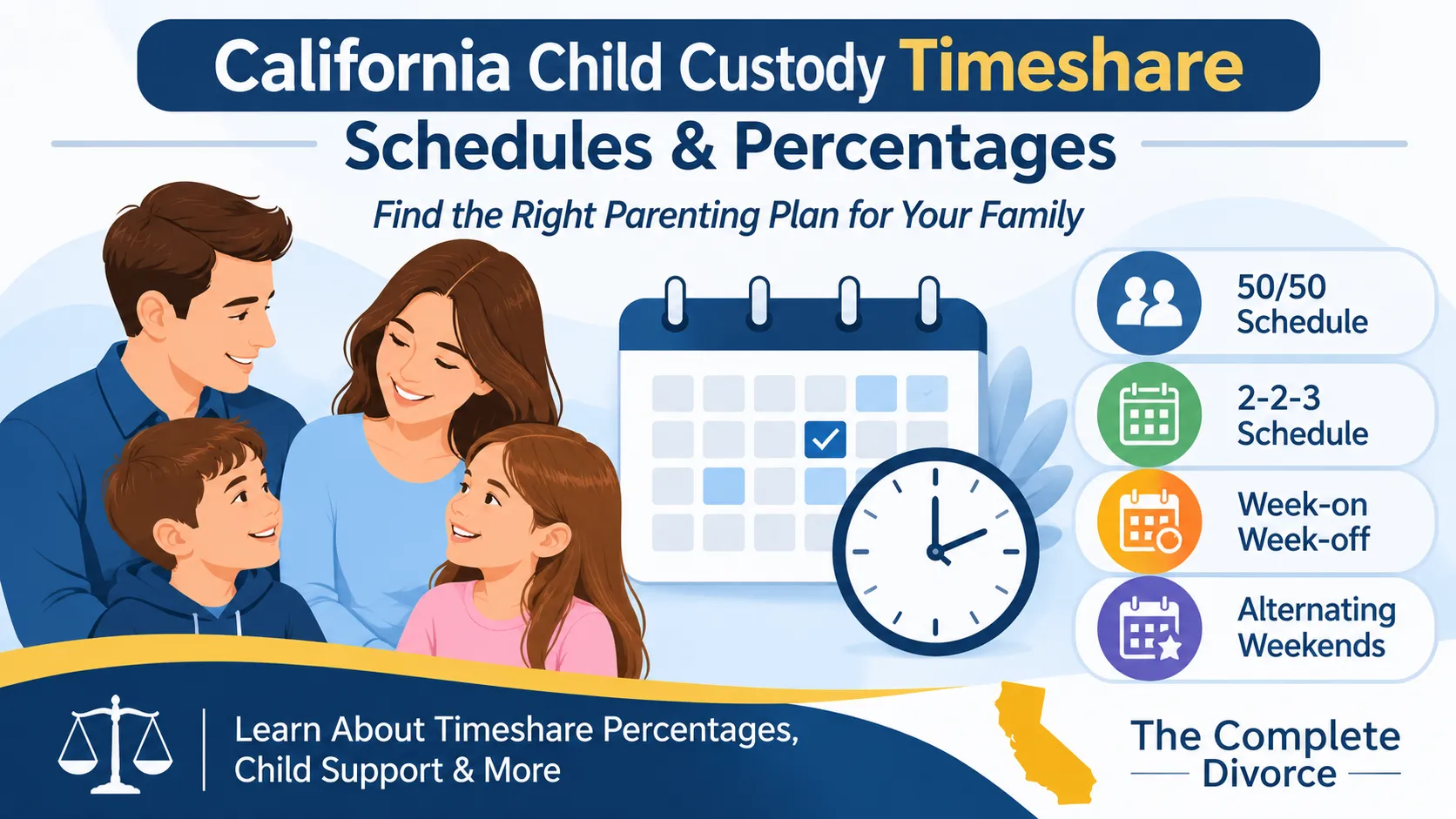
A California court uses a “custody timeshare” to determine what percentage of time each parent will spend with the children. The court considers legal and physical custody, the children’s best interests, the parents’ ability to protect them from harm, and each parent’s parenting time.
The custody timeshare percentage is calculated based on how many days or nights per year you have the children.
First, add up all of the days or nights you are entitled to during the year. Then divide that number by 365 and multiply by 100 to get the Percentage. If you use nights instead of days, this calculation is very easy. However, if you spend many hours a day caring for your children, this method may not be accurate enough.
Example: In a typical 2-2-3 schedule and a week-in /week-out schedule, both parents would have a 50/50 split of the available time. For example, if you alternate weeks with your ex-spouse and have the children every other weekend from Friday through Sunday, plus an extra mid-week evening (Wednesday), you would probably have about 20% of the time (depending on your yearly calendar).
Additionally, your time-share will affect your child support in California. To calculate your child support, use the California DCSS guideline calculator or a recognised tool like Xspouse.
When deciding how much support to pay or receive in California, the state’s child support formula (Family Code Section 4055) uses your income, the number of kids you have, and how much time each parent spends with the children.
The formula also considers the higher-earning parent’s percentage of total parenting time. As a result, the parent with more parenting time typically pays less.
Your financial situation is important when making these decisions. Do not choose a schedule solely to reduce payments, as it could negatively affect your child. Custody decisions are based on what is in your child’s best interest.
If you change from 20% to 30% parenting time, it may cost more, depending on the other parent’s income. However, the difference can range from $200 to $500, depending on the other parent’s income and expenses.
The “best” co-parenting plan depends on what is in the “best interest of the child“, your work commitments, how much time you can spend with your child at a given time, and how far apart your residences are. In determining a co-parenting plan (or timeshare), the Court will evaluate both the “practical needs of the child” as well as the overall “circumstances of the families.
Children’s age and developmental needs can influence which co-parenting arrangements best meet your family’s needs. While some arrangements are generalised, children grow at different rates; therefore, no single timeshare schedule suits every family.
A child 14 years old or older generally has the right to address the court about custody preferences under California Family Code § 3042. However, the judge will only allow this if the court determines it is appropriate.
California Courts consider each factor when deciding what is best for the child.
Although no single factor will determine your timeshare with the children, the court will consider all of these aspects when deciding what is in your children’s best interest.
Your co-parenting plan must be functional. When creating a daily routine, consider where you both live, your work hours, and how far your residence(s) are from your children’s school. Long distances may prevent you and your child from having regular contact on weekends and weekdays. Rotating shifts or overnight work may also create additional challenges for consistent parenting time.
Be sure to include transportation responsibilities (including after-school pickups), school events, sports games/activities, and medical appointments. Also be aware that if one party plans to move out of state, the state’s move-away law, along with the court’s determination of what is in the child’s “best interest”, may significantly affect your parenting arrangement.
California parents have several options for creating a detailed parenting plan in California. What works for you and your child depends on your child’s age and where you work and live relative to each other.
You & your co-parent can create another schedule, subject to court approval and in your children’s best interests. Some schedules provide equal parenting time with both parents; others give one parent more time than the other.
Shared parenting time is split down the middle, so both parents get around 50 per cent of the total time.
Most of these schedules give each party equal time over a set number of weeks. Before choosing a schedule, consider your child’s age, school routine, and ability to adjust to changes.
With this plan, your child can spend two weekends per month (typically Saturday-Sunday), plus an extra night at home midweek. Your percentage may also be closer to 25-30 per cent of the total time, rather than approximately 20 per cent for less frequent visitation.
This schedule likely meets the needs of families who live far apart, have different schedules, or want to keep their child’s routine Monday through Friday. However, California courts are unlikely to issue this schedule when co-parents disagree.
A vacation-based schedule may work better for parents who live farther apart than a weekly exchange.
None of these plans provides a particular percentage of physical custody. Record all exchange dates, travel information, and details in your Parenting Plan. Form FL-341(D) includes the provision for “Additional Provisions Regarding Physical Custody”, and form FL-341(C) provides “Holiday Schedule.
If a parenting time concern is based on an issue related to safety, then in addition to supervised visitation (in which someone else monitors or supervises each and every contact), the Court may also order that exchanges occur under supervision. The California form FL-341(A) outlines both supervised visitation and exchanges.
Step-up plans are agreements in which the amount of time spent with your children increases gradually as the factors causing this arrangement continue to improve, with specific steps identified at set times when the parties’ situation is reviewed.
Right of First Refusal provisions allow one party to spend time with your children before you arrange care with an alternate caregiver when you are unavailable. Be sure to outline the time frame in which this applies, how much advance notification there needs to be, and whether or not there are any exceptions. This can help avoid future conflict.
The goal of a reasonable visitation arrangement is to allow both parents (and/or other adults) to decide when they want to spend time with their child without a set schedule. Although a reasonable arrangement provides flexibility, it relies on cooperation from all parties involved. If one parent continues to refuse to follow through on scheduled visitations, the parties may need to return to court to establish a specific visitation schedule.
California law does not define reasonable visitation. Courts most often address reasonable visitation when your order requires you both to agree on visitation. Therefore, the details of visitation (the day(s) and time(s)) are left to be negotiated by you and your co-parent.
But this approach has limits. If you and your co-parent have difficulty agreeing on visitation, uncertainty about your visitation schedule may lead to multiple disputes. An open-ended reasonable-visitation order gives the courts less guidance to enforce than a detailed order with specific dates, times, and exchange procedures.
This type of order works best for co-parents who can communicate regularly and respect each other’s time.
A written schedule establishes your rights and obligations in advance. Written schedules generally work better than verbal agreements because they reduce disputes over visitation, minimise requests to change the agreed-upon schedule, and help you plan other parts of life (e.g., work and family).

Divorce Attorney — Mediator & Founder of The Complete Divorce
“Hi. I’m Dina Haddad, a divorce attorney-mediator here in California. I’m so tired of couples not having a process that’s easy to complete their divorce. They are getting lost, wasting time and money, and beyond frustrated with their results.
That’s why I created The Complete Divorce, California’s premier online divorce program. I took my successful mediation practice and condensed it into an affordable and winning program.”
In many cases, you & your co-parent will not have to go through a court hearing to decide how much parenting time to share. As such, California offers multiple options that let you and your co-parent agree on parenting time, with the court’s approval and in the best interest of your child.
Below, we review five ways to divorce in California without going to court.
Mediation is when you and your Co-Parent meet with a Neutral Professional, typically a Family Law Attorney, who assists both parties to resolve disputes and create a Parenting Plan.
Once you both agree on the terms of the Parenting Plan, you may document those Terms into a Stipulation and Order (FL-355) using a Child Custody and Visitation Order Attachment (FL-341), as necessary. Both Parties sign the documents and file them with the Court for approval.
The Judge reviews the Agreement prior to making it an Order. Mediation costs vary by provider, complexity of issues, etc.; therefore, please contact the mediator before using their services to confirm all associated fees. Some components of this service may be completed online.
If you and your other parent cannot agree on child custody in California, the law requires a court-appointed mediator to mediate custody disputes before the judge decides. These mediators are provided through Family Court Services, which are free or low-cost.
If the parties can’t reach an agreement, the mediator may recommend a resolution to the judge, based on that county’s rules of procedure. Some counties provide confidential mediation with no recommendations made to the court. Check for the specific requirements for your area prior to your scheduled mediation.
Even if you’ve reached a decision on how you’ll share parenting time, you can likely file for collaborative divorce or complete the process using an online service like The Complete Divorce.
Regardless of whether you choose this method or another, you still need the correct legal documents (which may include FL-105, FL-341, etc.) based on your specific circumstances. Your custody arrangement will require court approval. This option best fits couples who agree on what they want but need help preparing their documentation properly.
Even a small mistake in a parental custody agreement can lead to conflict after conflict. Avoid the most common errors:
The main benefit of having such a practical plan is reducing conflict and maintaining stability in the child’s life.
The Complete Divorce offers a flat-fee, fully online service for an uncontested California divorce. Its guided parenting time plan builder helps you and your co-parent compare custody schedules and prepare the FL-341 Attachment. Your paperwork package (reviewed before filing) will include the FL-105 UCCJEA, the FL-355 Stipulation and the Judgment Documents.
You can also contact Dina Haddad, a certified California Family Law Attorney and Mediator, who helps guide difficult custody decisions. The platform is geared toward parents who can agree on their custody arrangements, as well as parents who need help negotiating an agreement.
Complete your California Custody Timesharing Schedule the right way. Begin your online divorce today at The Complete Divorce.
The best child custody time-sharing (schedule) in California is the one that best meets your child’s needs as they grow, allows both of you to meet your job obligations, considers how far apart you live, and reflects an acceptable level of cooperation/co-parenting.
If you and the other parent have reached an agreement, you can create your own parenting plan without going through a contested hearing. To do so, however, you should use the proper paperwork to document your agreement and then file those papers with the court. We assist you through this entire process online at a fixed price.
Create your own custody schedule, complete the required paperwork, and we will help you get your parenting plan approved by the California court.
Start now with The Complete Divorce today!
Alternating weekends with one midweek overnight can be an acceptable solution. However, the custody schedule depends on many factors, including your children’s needs, your situation, and what the court deems acceptable.
Toddlers need short visitation schedules that provide a consistent routine. When choosing parenting time, consider your child’s attachment, sleep cycle, and ability to handle transitions from home to other locations.
No. California courts make custody decisions based on the best interests of the children. However, equal shared parenting is one possible solution to a parenting dispute, but there is no automatic legal right to 50% of the parenting time.
Divide the number of parenting hours or overnight visits assigned to each party during the year by the total number of parenting hours/overnight visits. Then multiply that result by 100%. This gives you a percentage used to determine how much child support each party owes.
Yes. You can mediate privately or negotiate directly with your co-parent about a custody arrangement. Once you both agree on a plan, submit it to the court as a written agreement so the court can approve it as an enforceable order.
California premier divorce program.
Making California divorce simple and lawyer-free.
 ⭐⭐⭐⭐⭐
more than 2,000 California couples helped
Divorce is unchartered territory. It’s a complicated and unfamiliar legal