

In mediation, you and your spouse work with a mediator
Online Divorce
Divorce smartly without a lawyer. Save yourself $10,000+.
You and your co-parent may agree on “every other weekend” without discussing pick-up times, transportation, and school holidays. Months later, those gaps can lead to disputes and court hearings.
A parenting plan needs more than a basic schedule; it outlines the terms you want the court to accept and enforce. This is why, in this guide, you will learn what California law requires in your parenting plan, how to tailor your plan to your co-parent situation, and examples of three practical plans.
Start your divorce and get a detailed parenting plan with The Complete Divorce for $49.99/mo.

Divorce Attorney — Mediator & Founder of The Complete Divorce
“Hi. I’m Dina Haddad, a divorce attorney-mediator here in California. I’m so tired of couples not having a process that’s easy to complete their divorce. They are getting lost, wasting time and money, and beyond frustrated with their results.
That’s why I created The Complete Divorce, California’s premier online divorce program. I took my successful mediation practice and condensed it into an affordable and winning program.”
A Parenting Plan in California sets out custody arrangements and Parenting Time. The Court will enter the parenting plan into an enforceable order (FL-180 Judgment Form) upon approval. Typically, you will complete FL-341 and other forms to provide documentation of your custody arrangements.
Under California Family Code Section 3011, the Court determines custody based on the minor children’s “best interest”. Additionally, pursuant to California Family Code Section 3020, the Court should order frequent, ongoing contact between both parents unless the minor children’s safety requires otherwise. The Parenting Plan must therefore reflect this standard.
A Parenting Plan is not a verbal agreement, which does not offer the same enforcement as a court order. A parenting plan differs from a marital settlement agreement (MSA), which may include child custody provisions. Child Support, however, will follow State Guidelines.
Your parenting plan must distinguish between three concepts; each is a different part of your child’s care.
Learn More: California Child Custody Laws and Parenting Time.
The Court will consider your proposed parenting plan for approval based on what is in the Best Interest of Your Child as set out in California Family Code §3011. Some of the factors to be considered by the court are:
When developing your plan, you may want to ensure it supports continued contact between the children and both parents (when reasonable or safe). However, if valid safety concerns exist, you may need to limit contact.
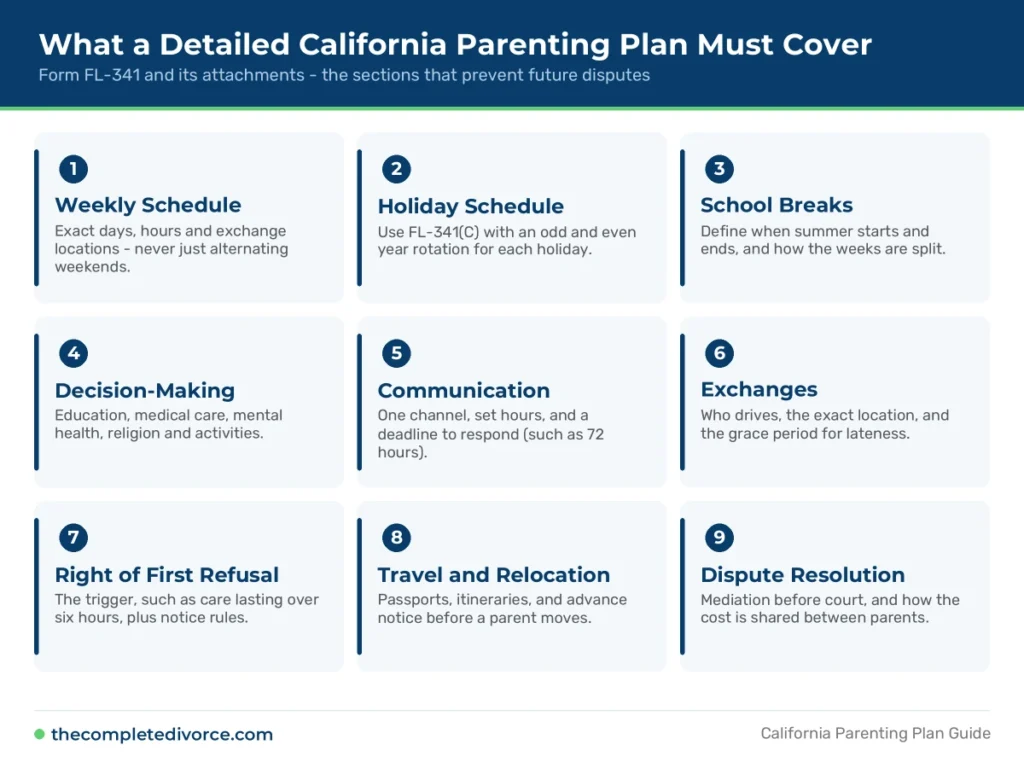
A detailed parenting plan covers roughly 12 areas, using FL-341 and supporting attachments where needed. Clear terms help you understand your responsibilities and reduce avoidable disputes. Use this checklist to identify what your plan needs.
Develop a calendar of how much time your children spend with each parent. State the exact days and hours, and where the children are exchanged, instead of saying “alternating weekends.” For example, you can state that parenting time is from Fridays (6 pm) to Sundays (6 pm).
Also, specify who picks up and drops off your children. Also, describe the process if an early dismissal occurs while your child is in school due to an emergency. Describe how the parents will provide care during their designated time if a child misses a full day of school (due to illness), has a doctor’s appointment, etc.
Holiday schedules may disrupt your regular routine. Write a list of who has your child and on what day. You can use the CA FL-341(C) Children’s Holiday Schedule or create a similar listing that works for you.
Include days off from school (Thanksgiving, winter break, spring break), as well as birthdays, mother’s/father’s day, any major religious holidays, and three-day weekends. If you are splitting winter break in half, clearly outline the changeover date.
A holiday rotation based on whether the year is odd or even will help ensure each parent gets specific holidays every other year. For example, one parent keeps Thanksgiving in odd-numbered years while the other keeps it in even-numbered years.
Clear guidelines for summer and school vacations matter because the normal routine can be irregular. Clearly define when the “summer” period begins (i.e., the first day after school closes) and ends (i.e., the last day before school reopens). Identify if your child will be alternating weeks, spending 2-week periods with one parent, or splitting the time during the break.
Establish an advance notice date (for example, by April 1st) to inform the other party of changes in travel plans and indicate what information needs to be included in that notification. Provide direction on resolving conflicting schedules. Do not use “we’ll figure it out.” Unclear agreements frequently result in disagreements. In writing, provide specific details regarding the time frame of exchanges.
Joint legal custody only addresses disputes. Your plan should outline how you will make decisions about education, health care, mental health treatment, religious beliefs, or participation in extracurricular activities.
Clearly describe how many decisions need consultation with both parties prior to being implemented. Specify how many decisions require a written agreement from both parents, and provide a dispute resolution procedure, including, but not limited to, mediation before seeking a court decision. Do not interpret silence as consent, unless that interpretation has been previously discussed and agreed upon.
You can include issues such as whether to enrol the child in school, who the child’s paediatrician will be, and whether to allow the child to receive therapy. Clearly define time frames for responses to issues. For example, requiring both parents to respond within 72 hours of notification on certain issues may reduce delays in implementing decisions.
Bonus Tip: Each provision included in your plan must be consistent with your custody arrangement and meet the needs of your children.
Establish guidelines for communication, exchanges, and the right of first refusal. Identify which method you will use (email or co-parenting app), and at what times you can communicate with your child while the other is in charge.
Identify where the exchanges occur, who brings the children, if there are grace periods involved, and the amount of time that one parent has to wait. Also, establish specifics about the right of first refusal if included; i.e., when does the right apply? For example, for care lasting over six hours. In addition, outline deadlines for notice and response by both parties.
Create your own policies for the way your children travel. Distinguish domestic (in-state), interstate, and international trips. State whether both of you need to be informed about the itinerary and lodging plans, as well as have access to the child’s emergency contact information.
Identify who will keep the child’s passport. Establish a process for when either parent wants to apply for a new passport or renew an existing one. If relocating, identify what advance notice each party must give prior to moving.
Relocation depends on far more than mileage. Your current California laws and prior agreements also govern your ability to relocate. We strongly recommend consulting an attorney before you decide.
You may agree on what is permitted regarding the introduction of new partners, as well as on the use of firearms and alcohol (or other substances) when your child is present. If you wish to set a specified waiting period before meeting new people in front of your children, specify this and note which people would be exempt from such a waiting period.
In addition, you can require that all firearms be locked up and kept out of your children’s reach at all times. You may also wish to include language stating that both parents will refrain from caring for their children while under the influence of alcohol or other drugs.
An alternative dispute resolution (ADR) provision sets out your process for resolving disputes before resorting to court action. The parties could agree to discuss an issue in writing within seven days of it being raised, followed by mediation with a specific mediator or through Family Court Services.
If the parties cannot resolve their issues through mediation, either party can request court intervention. Specify how costs for mediation shall be divided. In many cases, mediation is not the best way to address concerns regarding safety or domestic violence.
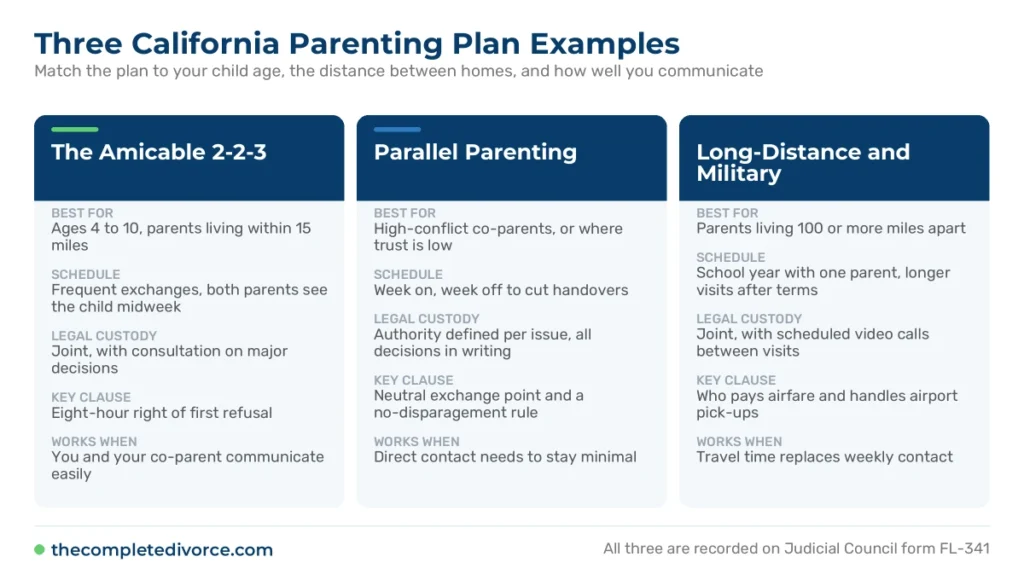
Your parenting plan should reflect your child’s age, how far apart you live from the other parent, and how cooperative you both are. The three examples below offer possible ways to structure a co-parenting arrangement based on your child’s age and the geographic distance between parents. As always, the arrangement will depend on your child’s needs and any court orders already in place.
In this example, there are two weeks with three days when one parent does not see the child. Each parent spends at least two days per week with their child.
During Weeks 1 & 2, Parent A sees the children Monday and Tuesday; Parent B sees the children Wednesday and Thursday; and Parent A again sees the children Friday through Sunday. For Weeks 3 & 4, Parent B sees the children Monday and Tuesday; Parent A sees the children Wednesday and Thursday; and Parent A again sees the children Friday through Sunday.
There are many ways to handle holidays, such as alternating holidays each year or using FL-341(C) in odd and even years, sharing legal custody, consulting each other on significant issues, or having an eight-hour right of first refusal. This type of scheduling works best if you and the other parent communicate effectively and exchange your children frequently.
The first step in managing disagreements over parenting time is to develop a comprehensive Parenting Plan to reduce conflict. A “week on / week off” schedule can dramatically cut back on how often you have to communicate about the children.
Consider using a single method of communication (such as OurFamilyWizard or TalkingParents) and designating a location for exchanging the children (i.e., school, a designated supervised visitation centre, etc.) as part of your parenting plan.
Define who has the authority to make decisions regarding the children, and require that all joint decision-making be in writing. Silence does not constitute agreement. Include provisions requiring parents to refrain from disparaging each other and prohibiting third parties from communicating messages on either parent’s behalf.
If there has been abuse or violence, it may be necessary to hire a professional to evaluate your situation, i.e., Custody Evaluation, Minor’s Counsel. Family Code §3044 and Family Code §3150 apply specifically to Domestic Violence Counselling Appointments.
Parents living long distances from each other may need to adjust their routine because of frequent trips back and forth. There is an opportunity for your child to live in the primary residence of one parent through the majority of the school year and then have longer visits with the other parent at the end of the semester.
You could alternate weekends, or use a pattern such as every three weekends when the trip is too far or time-consuming; however, you can also schedule video calls on days the children are not visiting either parent.
There will be an opportunity to split the summer into two blocks (6-8 weeks) where your child spends time in the care of one parent. Determine which parent will pay for airfare, etc. and determine who will facilitate drop-off and pick-up at airports. Also set up guidelines for communicating if travel plans change. Establish consistent virtual communication times using specific platforms and for how long.
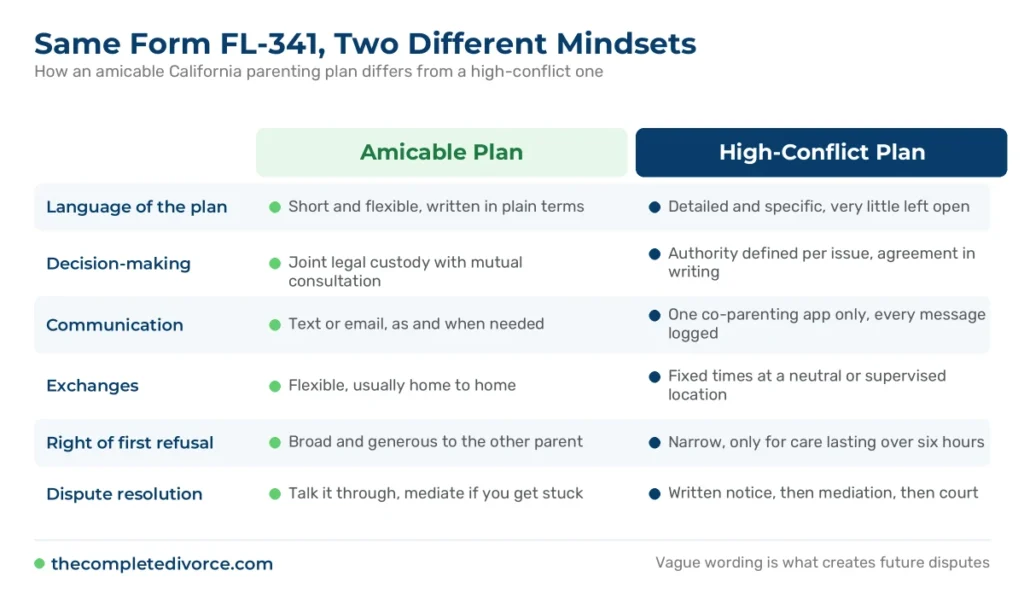
Both types of parenting plans use FL-341; however, the drafting process depends on how well you and your co-parent communicate. Amicable plans are typically short and concise; they use joint legal custody, require mutual consultation, and include flexible provisions you can write into the agreement.
However, a high-conflict situation requires a much greater degree of structure. Identify what time(s) of day or week that exchanges most likely happen, identify who makes decisions regarding children, establish the means by which each party will communicate, and establish procedures for resolving disputes.
Also consider narrowing the “right of first refusal” (i.e., whether a parent can unilaterally take possession of a child from the other parent) and add provisions against disparaging the other parent. Each provision in the agreement should reflect your individualised circumstances and comply with California Law.
In making this distinction, note that vague language leaves too many areas open to interpretation. In cooperative plans, if either parent chooses not to cooperate, repetitive disputes and/or the need for enforcement proceedings may arise.
Additionally, using the “grey rock” method (keeping communications minimal and neutral) or “parallel parenting” (limiting direct contact) may provide a basis for implementing structured agreements, even when parents cannot agree.
If a violation continues after enforcement mechanisms fail, consult an attorney to determine available enforcement alternatives. Depending on the facts, these alternatives may include filing a contempt proceeding under CCP §1218.
The Complete Divorce (TCD) lets California parents create a comprehensive parenting plan using its tools, avoiding the cost of hiring a litigator to represent them. TCD’s guided process helps you create a record of your children’s schedules, holidays, decision-making, communication, child exchanges, travel, and relocation plans.
In addition to developing a complete parenting plan, if you can agree on all aspects of your case, TCD can streamline your online divorce in California by simplifying paperwork and other tasks to make the overall process less tedious.
Start your divorce with The Complete Divorce and prepare your California parenting plan online for $49.99 per month.
A parenting plan in California becomes much more valuable when every detail of each arrangement is spelt out. Regardless of whether you have selected a collaborative 2-2-3 scheduling method or a formal parallel parenting method, both methods will be documented using the FL-341 form. These forms should only serve as a template for your own unique situation.
Download the Complete Divorce Parenting Plan Checklist, or let TCD help you prepare your plan and all related divorce documents online today.
Identify both the physical and legal aspects of the parenting arrangement, the schedule for each parent, holidays, school breaks, etc. Also consider decision-making responsibility for important issues, exchange locations, communication, travel restrictions, and dispute-resolution processes.
No. In many cases, the parties cannot agree. When they can’t, the court determines the custodial arrangement in the child’s “best interest”.
Legal custodial rights refer to which party has the authority to make important decisions about a minor child’s welfare. Physical custodial rights determine where the minor child will live.
Yes. You are able to create your own plan. However, it must comply with all applicable court rules. FL-341 is a standard attachment courts use to record custody and visitation agreements.
California premier divorce program.
Making California divorce simple and lawyer-free.
 ⭐⭐⭐⭐⭐
more than 2,000 California couples helped
In mediation, you and your spouse work with a mediator

In California, ending a marriage doesn’t have to mean conflict,

Community and Separate Property in a California divorce can pose