Online Divorce
Divorce smartly without a lawyer. Save yourself $10,000+.
- 100% Legit Divorce Program
I Can’t Afford a Divorce Lawyer: What Are My Options in California?
Getting divorced in California without enough money to pay an attorney is stressful. It becomes even more stressful when your spouse has already hired one. There are ways to make it more affordable.
This article covers your affordable options, including Fee Waivers, court-ordered attorney fees, mediation, and guided DIY services.
You can file your California divorce with The Complete Divorce for $49.99 per month without hiring an attorney.
Can You Really Get a Divorce Without a Lawyer in California?
Yes, California law allows individuals to represent themselves in a divorce case. Many have done this effectively, especially when both parties agree on all the details. When someone represents themselves in their divorce case, they must file their own documents, meet court deadlines, and make legal decisions.
Additionally, California is one of the states that uses no-fault divorce, which can make the process easier. However, as in most states, residency requirements apply before you can file for divorce, and a mandatory waiting period applies before your divorce can become final.
What a Lawyer Actually Costs in California
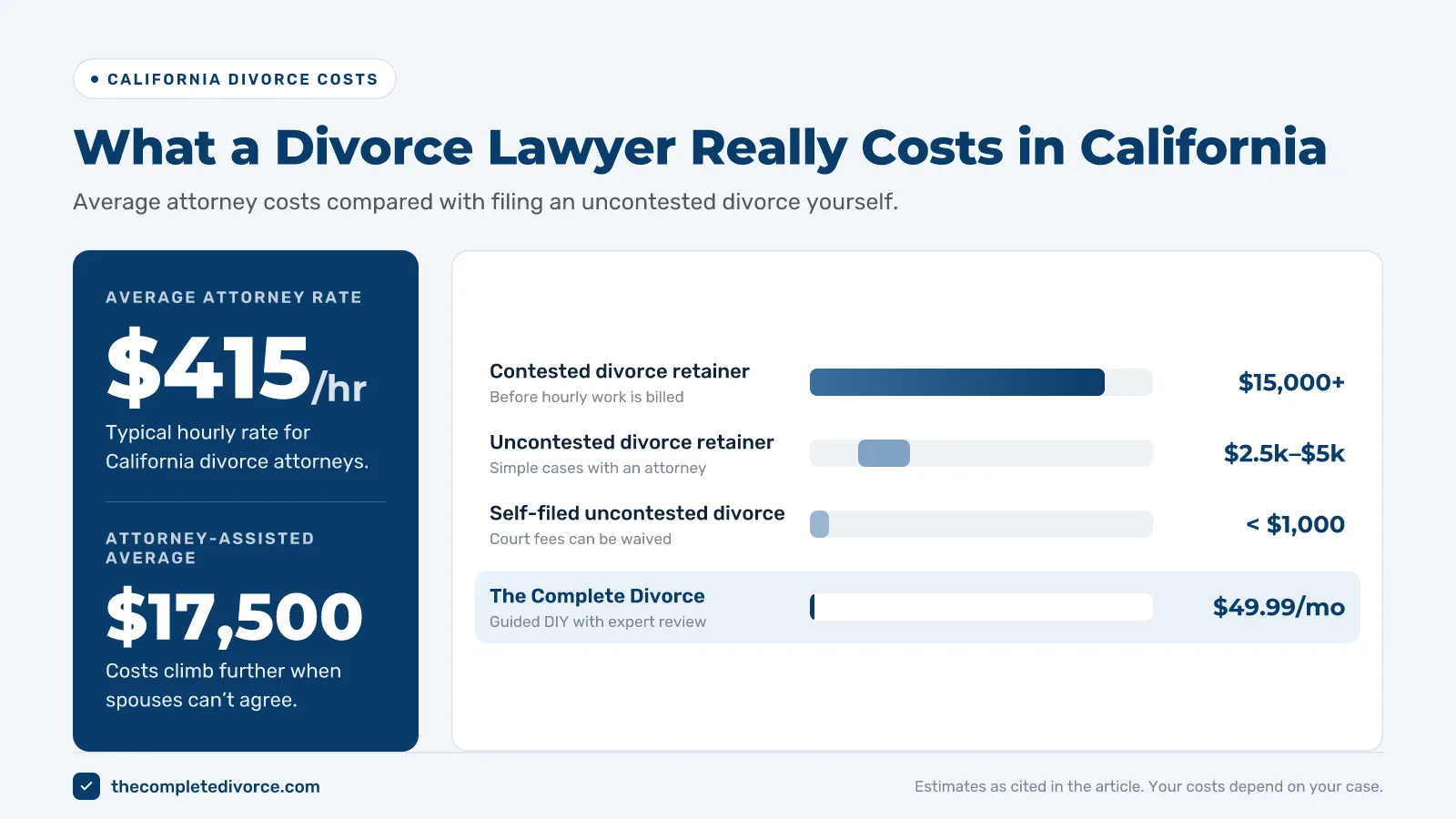
When you hire California divorce attorneys, expect high divorce costs in California, with an average rate of about $415 per hour. In addition, retainers for simple (uncontested) divorce cases often range from $2,500 to $5,000. For contested divorce cases, retainers can exceed $15,000.
It has been estimated that attorney-assisted divorces will cost an average of about $17,500. However, a relatively simple, self-filed, uncontested divorce case can be completed for less than $1,000. A fee waiver may also eliminate your court costs. If you cannot agree on issues, your legal expenses will increase.
When You Truly Need a Lawyer vs. When You Can Safely Go Without
It’s fair to ask: do you really need a divorce lawyer? In reality, you can do it yourself if your marriage was brief, you have no minor kids to share, your finances are simple and easy to understand, and you’ve agreed to the divorce terms in writing.
Often, you should hire an attorney for your divorce when you disagree about who has control over the children, you own a business or property that needs to be divided, you have retirement account(s) that require a QDRO (qualified domestic relations order), you believe one spouse will hide some of their money, or you’re experiencing domestic violence, or have a very unbalanced relationship.
The Affordable-Divorce Ladder: Your Options From $0 Upward
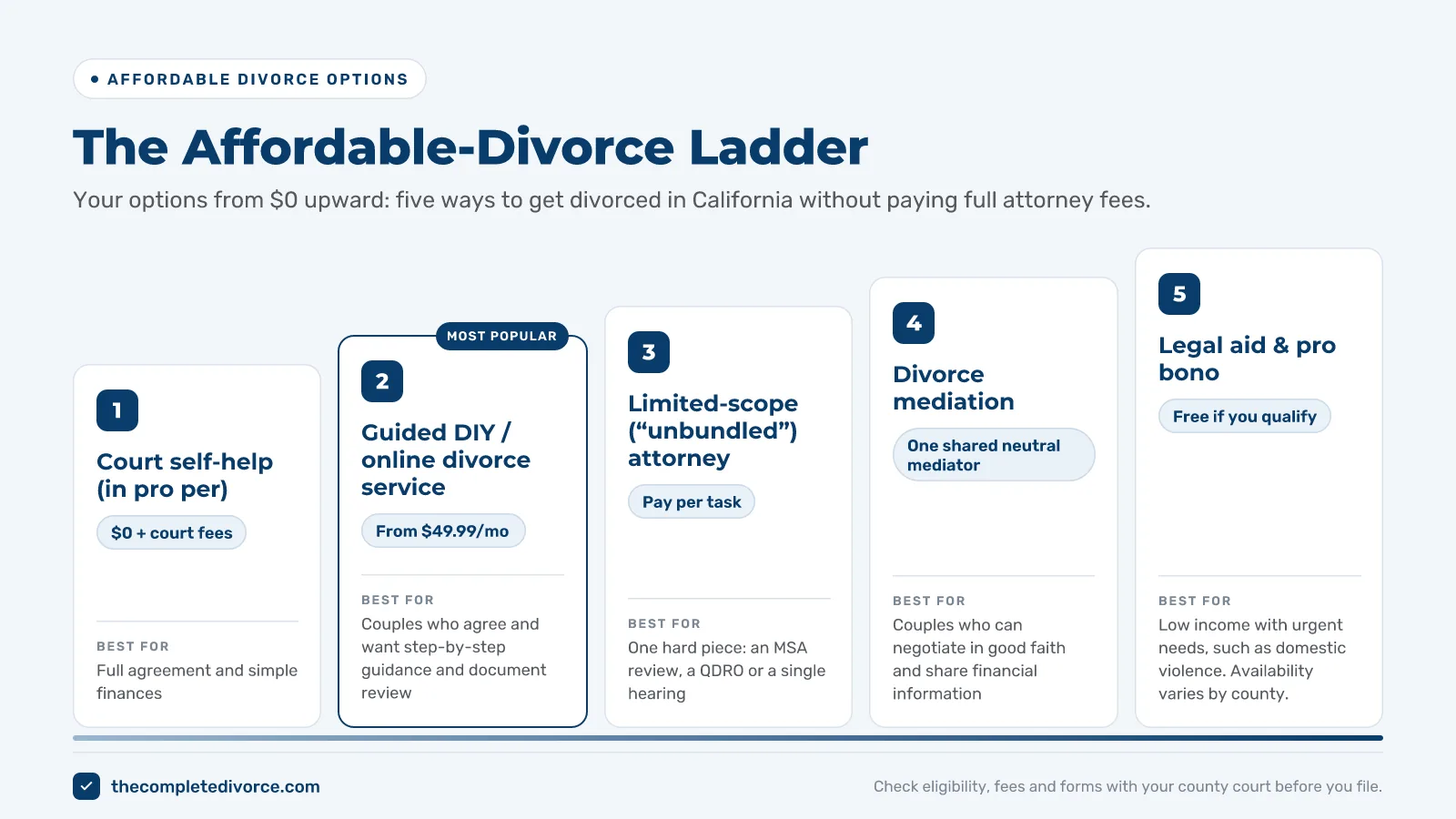
Option 1: File It Yourself with Free Court Self-Help (In Pro Per)
You can file for divorce yourself when you both agree on all the case details, and this is your least expensive option. The State of California offers an Online Self-Help Center that provides guidance at no cost. You can also download the Judicial Council forms (FL-100, FL-110, FL-140, FL-142, and FL-150) from their website.
Many Family Law Facilitators and Court Self-Help Centers statewide also offer help with the process. However, while you can download the forms for free, they don’t guarantee you filed the documents correctly. For example, failing to disclose properly, filing paperwork incorrectly, or having ambiguous agreements can lead to extra costs. That is why a Do-It-Yourself Divorce in California with The Complete Divorce is the best option, because it guides you through the process.
Option 2: Guided DIY / Online Divorce Services
Guided do-it-yourself divorce options are somewhere between doing it all by yourself and hiring a divorce attorney. They provide access to online guided forms, questionnaires, and document-generation software to help you create your own divorce documents.
Some providers may also offer county-specific information and let an attorney or other legal professional review the documents you create. The structure these services provide can reduce the chance of errors when filing an online divorce in California.
Option 3: Limited-Scope (“Unbundled”) Legal Help
You don’t have to hire an attorney to handle your entire divorce. With limited-scope representation, you hire an attorney for specific tasks, such as reviewing a marital settlement agreement, preparing a qualified domestic relations order (QDRO), or assisting with one specific court hearing.
California Rules of Court Rule 5.425 outlines how attorneys can enter into limited-scope agreements and the required notices. Limited scope is ideal for individuals who can prepare their own paperwork and make many decisions; however, they may need help with the most complicated decisions or documents.
Option 4: Divorce Mediation Instead of Two Lawyers
Divorce Mediation in California is an affordable option for couples who can settle most issues. The couple works with a neutral third-party mediator to reach a compromise agreement, avoiding the costs of extended litigation and hiring two attorneys separately. However, neither party has a representative (i.e., attorney) in the mediation process nor do they receive personal legal counsel from the mediator.
Therefore, mediation generally succeeds when the couple negotiates voluntarily, discloses financial information to one another, and can discuss terms without fear of retaliation. When mediation works, your case can move from a contested to an uncontested divorce.
Option 5: Legal Aid & Pro Bono (Who Actually Qualifies)
Free legal assistance in California does exist; however, eligibility and availability vary widely. Most legal aid organizations will preferentially help people with low income who have urgent needs (domestic violence, financial problems, etc.), but some of these groups may offer limited divorce assistance; others do not handle family law cases at all.
You can also contact your county bar association about pro bono programs, volunteer attorneys, reduced-fee referrals, etc. Law school clinics and court self-help centers sometimes provide advice, document assistance, and/or referrals; full representation is less common.
Before applying for free legal services, check each organization’s income limits, service area, and family law service rules. You might not qualify for free legal services, so consider guided-DIY services/limited scope legal assistance as practical alternatives.
Can’t Afford Even the Filing Fee?
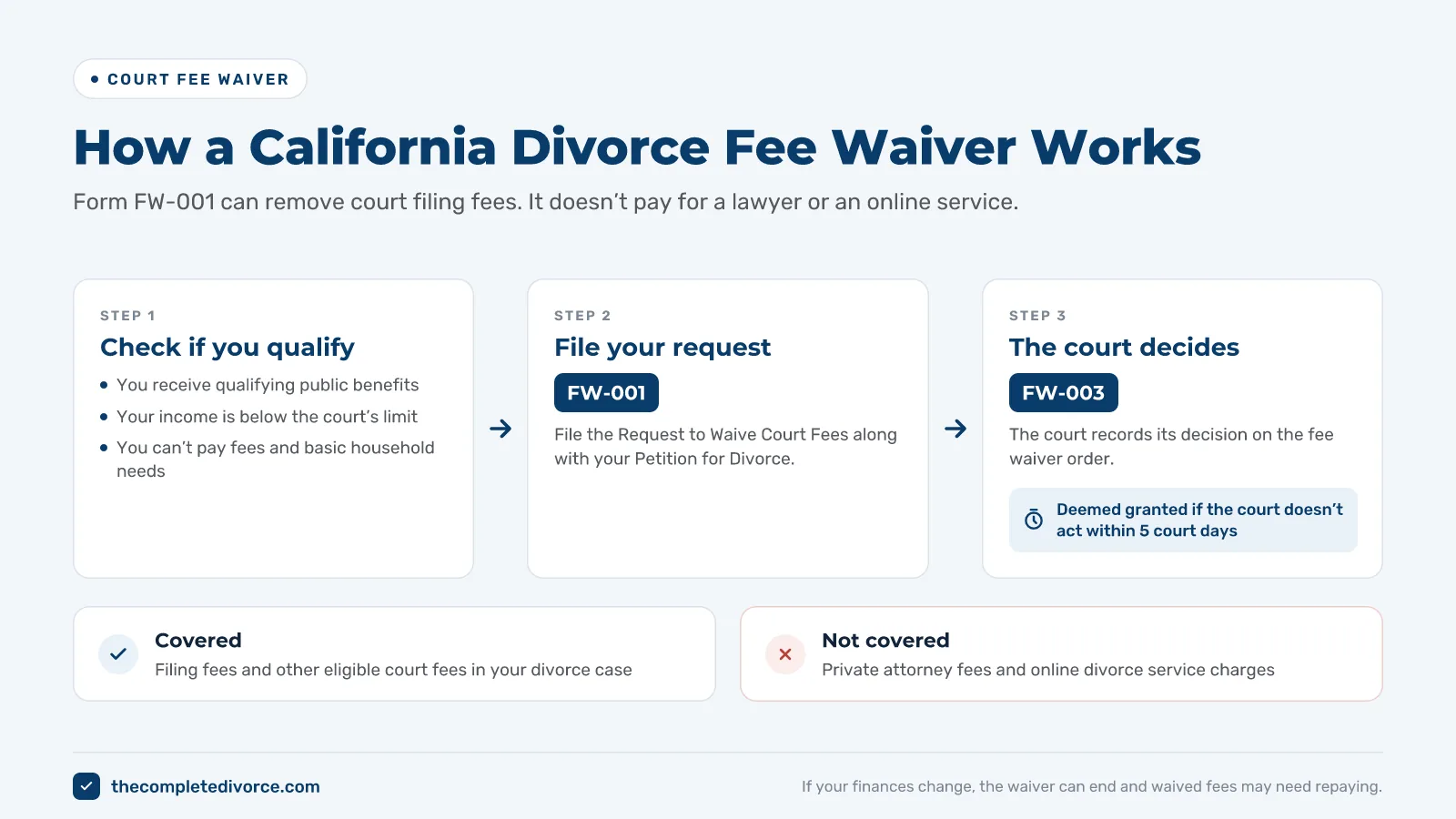
If you can’t pay California’s divorce filing fee, you may qualify for a court fee waiver. A court fee waiver allows qualified individuals to file their divorce without paying fees upfront. A court fee waiver won’t cover the cost of hiring a private lawyer or paying for an online divorce service.
Do You Qualify for a Fee Waiver?
You may be eligible for a fee waiver in California under Sections 68630–68640 if you are receiving appropriate government benefits, earning less than the required income limit, or unable to pay the costs of filing in addition to the costs of meeting your minimum household requirements.
To request a fee waiver, file Form FW-001 along with your Petition for Divorce. The Court will use Form FW-003 to document its Fee Waiver decision. In some cases, applicants who have significant assets may need to submit additional financial documentation.
What the Waiver Covers and How Fast It Moves
A Fee Waiver application covers eligible court fees (including filing fees) associated with a divorce. The application will not include payment of private attorney fees or an online service charge.
If you apply for a fee waiver under California Rule of Court 3.53, the court will typically approve it unless it rules on your case within five court days. If your financial situation changes at any time after applying for a fee waiver, then the fee waiver may be terminated, and you may need to repay the original amount waived.
Your Spouse Has a Lawyer, and You Don’t? Make Them Pay Your Fees
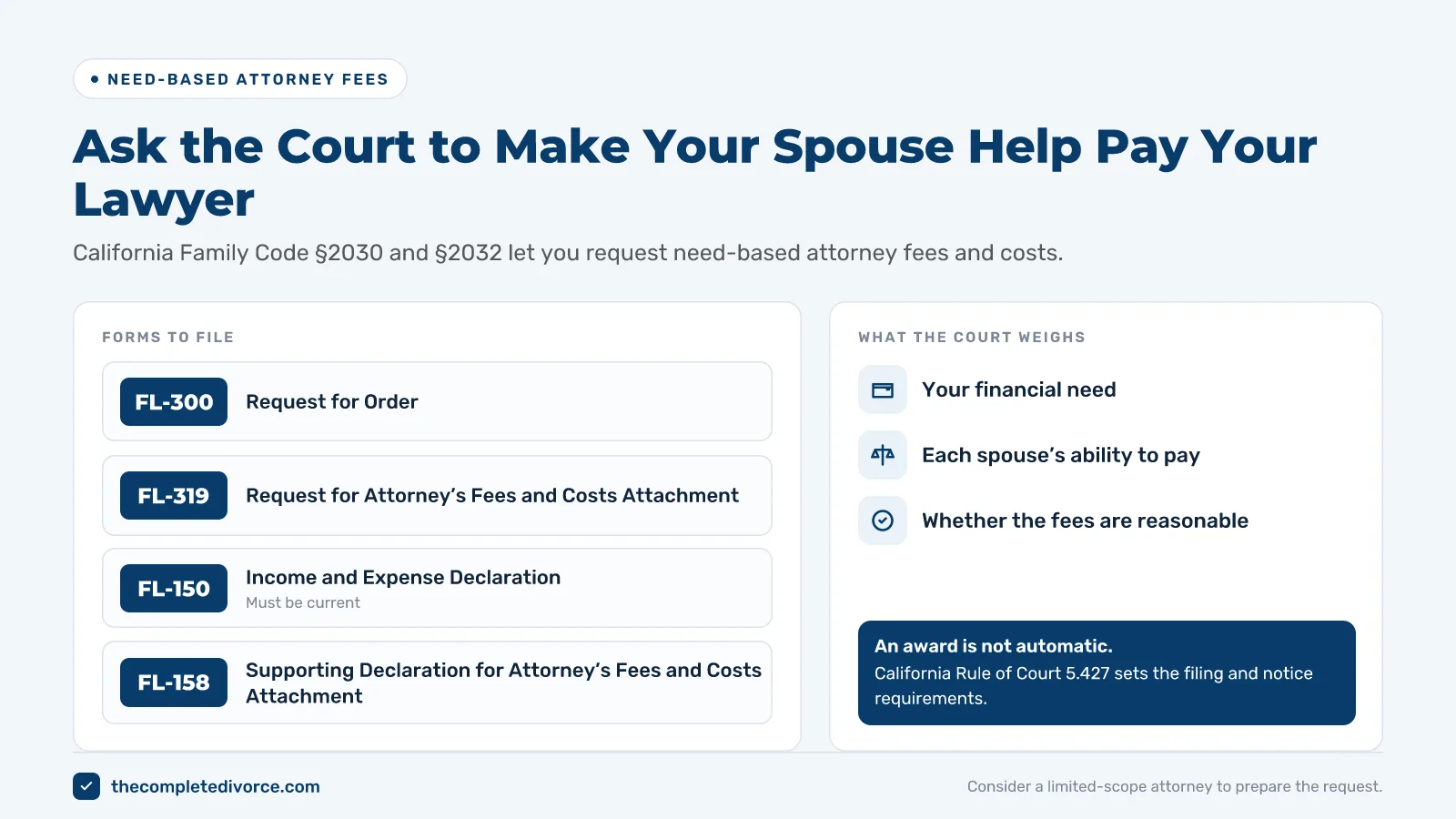
If your spouse hires an attorney and you can’t afford one in California, Family Code sections 2030 & 2032 let you seek court-ordered financial assistance. These statutes allow each party to obtain equal legal representation, regardless of financial situation.
How Need-Based Attorney Fees Work in California
When deciding whether spouses should contribute to their attorneys’ fees, California courts consider both parties’ financial positions. Under California Family Code Sections 2030 and 2032, the court can consider factors such as financial need, each party’s ability to pay, and whether the fee amount is reasonable.
An income difference between the two spouses would help your case; however, you are not entitled to an award. If you receive this type of award, it could fund a full-service private attorney or limited-scope representation, giving you access to legal counsel without bearing all the costs.
How to File the Request (FL-300 + FL-319 + FL-150 + FL-158)
To request that your ex pay for part or all of your legal fees, you will need to submit:
- A Request for Order (Form FL-300)
- Request for Attorney’s Fees and Costs Attachment (Form FL-319)
- An updated Income and Expense Declaration (current Form FL-150)
- Supporting Declaration for Attorney’s Fees and Costs Attachment (Form FL-158)
California Rules of Court Rule 5.427 contains specific requirements for the above forms. You will be required to give the other party notice of the submission of those items in compliance with applicable law. Consider hiring a limited-scope attorney to prepare the request.
Cheaper Legal Paths Built Into California Law
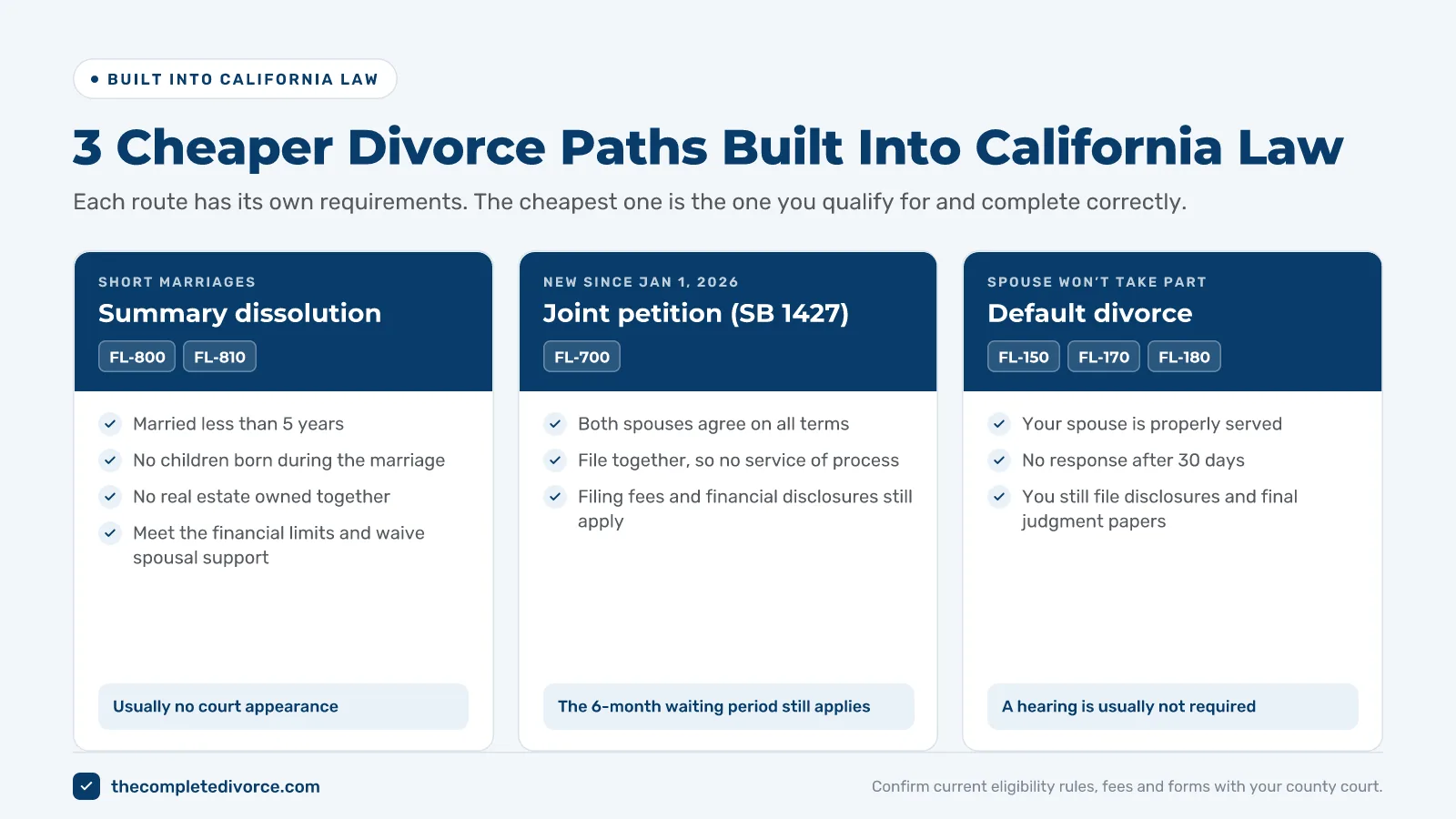
California offers more than affordable ways to get legal help. California also provides procedures that are designed to reduce paperwork, conflict, and expense for eligible couples.
These affordability options include:
- Summary dissolution for qualifying short marriages
- Joint petitions for couples who agree on divorce terms
- Default divorce when a properly served spouse doesn’t respond.
Each route has different requirements, so choose the right one. Before you file, confirm current eligibility rules, fees, and forms with your county court. The cheapest way is the way you qualify for and complete correctly.
Summary Dissolution: The Simplest, Cheapest Route
Summary Dissolution in CA Divorce is a simple divorce process for couples in California who have been married for less than 5 years, have no children born during the marriage, and have no real estate owned together. They must also meet the financial guidelines of Family Code Section 2400–2406 and agree to waive all claims for permanent spousal support. The couple would file Forms FL-800 and FL-810, are normally not required to appear before a judge, but must follow the requirements outlined by statute.
The New Joint Petition (SB 1427): File Together, Skip Service of Process
Since January 1, 2026, California couples can file a cheap uncontested divorce jointly by submitting Form FL-700. Unlike summary dissolution, the joint petition has no marriage-length, children or property limits; however, both spouses must agree to all terms of the divorce. By proceeding jointly, a spouse no longer needs to be served with a separate divorce petition; however, filing fees and the requirement for financial disclosure remain. The 6-month wait time also remains.
Default Divorce When Your Spouse Won’t Participate
If your partner does not cooperate, you may not need an extremely costly legal fight. After you serve your spouse (and after 30 days have passed), if they do not respond to your petition, you can ask for a Default Judgment. You are still responsible for filing all necessary divorce papers, including disclosure documents (e.g., Form FL-150) and the final paperwork (e.g., Forms FL-170 & FL-180). It is generally not necessary for either party to attend a hearing unless it is required by statute or case law.
The Real Cost of Getting It Wrong (Why “Free” Isn’t Always Cheapest)
A free divorce does not always mean a cheap one. Errors in preparing your divorce documents can also cause costly delays. Errors on incorrect county forms or an ineligible summary dissolution filing may require you to resubmit your paperwork.
If you fail to disclose all of your finances before submitting your divorce papers, it will delay your case; however, even after disclosing this information, issues related to your judgment could still arise.
Similarly, vague or unsigned Settlement Agreements do not clearly define what each party must do. Write down every agreement you make with your spouse and include the Agreement as part of your Judgment before you sign any irrevocable Spousal Support Waiver.
How The Complete Divorce Makes an Affordable Divorce Actually Work
The Complete Divorce combines the cost savings of filing your own papers and having legal guidance. For $49.99/month, you will have access to your specific case’s forms, step-by-step instructions for filling out those forms, expert review of your documents (by trained attorneys), and lifetime editing.
Drawing on Attorney-Mediator Dina Haddad’s years of experience as both an attorney and mediator, The Complete Divorce offers an optional strategy session, or mediation session, that covers 10+ common divorce topics. This approach helps you avoid mistakes when preparing your divorce paperwork without paying the high costs of hiring a lawyer.
Don’t skip the lawyer, just the money. Make your uncontested divorce in California fast and affordable today.
Conclusion
Hiring an attorney isn’t the same as being unable to afford a divorce. It simply means that you will need to find a legal process that fits your financial situation.
To start, look into filing for a court fee waiver. Also see if you qualify to have the other party pay for attorney’s fees under Family Code §2030. You can also consider guided DIY options (like ours) or mediation instead of hiring attorneys for both sides.
Take one small action now to regain control of your divorce and finances for just $49.99 per month with The Complete Divorce.

Written By:
Dina Haddad
Divorce Attorney — Mediator & Founder of The Complete Divorce
“Hi. I’m Dina Haddad, a divorce attorney-mediator here in California. I’m so tired of couples not having a process that’s easy to complete their divorce. They are getting lost, wasting time and money, and beyond frustrated with their results.
That’s why I created The Complete Divorce, California’s premier online divorce program. I took my successful mediation practice and condensed it into an affordable and winning program.”
FAQs: Can’t Afford a Divorce Lawyer in California
Q. What if I can’t afford a divorce lawyer in California?
You have several options, including a court fee waiver, legal aid, limited-scope representation, mediation, or guided Do-It-Yourself divorce services. In some cases, your spouse may be required to pay toward your attorney’s costs.
Q. Can I get a divorce in California without a lawyer?
Yes. In California, you may represent yourself in your divorce case. However, as a pro se litigant, you are required to prepare all of the necessary documentation, serve documents when required by statute or rule, provide full financial disclosure (as required), and ultimately obtain a Final Judgment.
Q. Can I make my higher-earning spouse pay my attorney’s fees?
Yes. Under California Family Code Sections 2030 & 2032, you may file a motion for need-based attorney’s fees. When considering this motion, the court will review both parties’ financial circumstances to determine whether to award attorney’s fees.
Q. How do I get the divorce filing fee waived in California?
You will file Form FW-001, Request to Waive Court Fees. Depending upon your eligibility (public benefits, income levels, etc.), or as demonstrated by you as a result of financial hardship, the Court may waive your filing fee.
Q. Does the court give me a free lawyer for a divorce in California?
No. Since divorce is a civil proceeding, Judges are typically reluctant to appoint counsel at no charge. However, many legal aid organizations, pro bono programs, and law school clinics provide free legal services.
California premier divorce program.
Making California divorce simple and lawyer-free.
- Filing & Review Support
- 1-on-1 Divorce Meeting
- Child support calculations
- MSA Filing Support
 ⭐⭐⭐⭐⭐
more than 2,000 California couples helped