In mediation, you and your spouse work with a mediator
Get California Online Divorce Forms for $49.99/month– Limited Time Offer!
Online Divorce
Divorce smartly without a lawyer. Save yourself $10,000+.
You and your spouse are filing FL-700 for an amicable divorce in California. Then you hit an obstacle: which summons goes with it? The answer is the FL-710 joint petition summons.
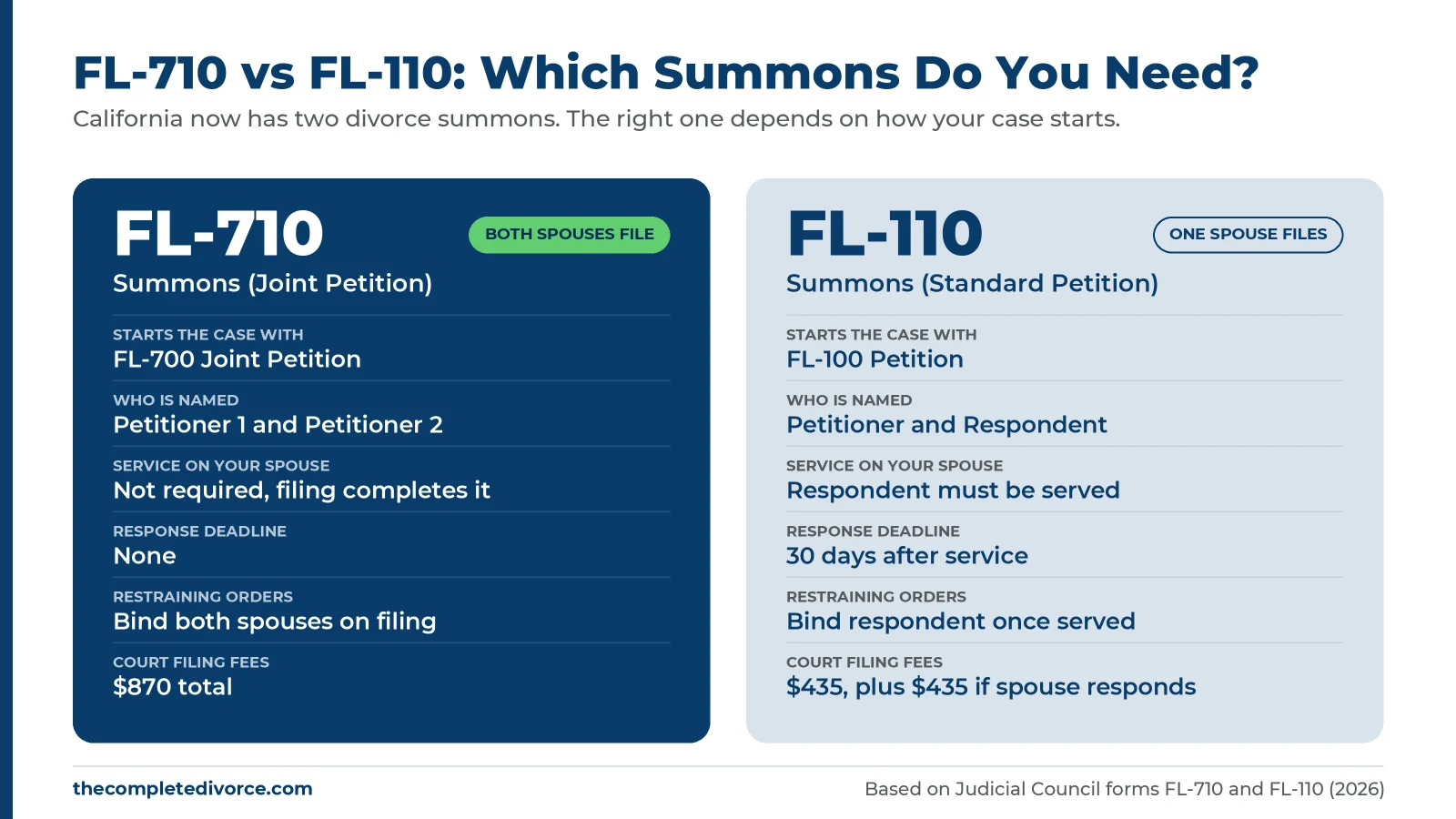
Under the new law, California offers FL-110 for a traditional divorce filing and FL-710 for joint filing under SB 1427. FL-710 differs from FL-110 in two major ways: it names no respondent, so no one has to be served, and its standard restraining orders bind both spouses the moment you file.
This guide explains who qualifies to use FL-710, what goes in each field, how to file it, and the common errors that delay joint petitions.
For $49.99/month, The Complete Divorce can guide your joint filing process and ensure your documents are court-ready with legal supervision. Complete your joint petition and move forward confidently.
Start your FL-700 Joint Petition. Our software is easy to use, led by California divorce attorney Dina Haddad.
These two answers rebuild the rest of the interview. Whole sections appear or disappear — you'll never be asked something that doesn't apply to you.
Every answer saves the moment you type it. Close the tab, come back next week, land on the same question.
These two answers tick the case type and the residency box on page 1 of FL-100. Next come your dates.
The date of separation must be after the date of marriage.
These five answers fill page 1 of FL-100 — the case type, the residency box, both dates and the children box. Print the form from the panel on the right and they are already on it.
Building your FL-100…
To file for divorce in California, at least one spouse must have lived in the state for six months and in the county where filing for at least three months to file for divorce. This doesn't apply to legal separation. Consider changing your response.
Form FL-710 is the two-page summons for use with FL-700 in a California divorce or legal separation action where spouses or registered domestic partners are filing together.
This form is part of the joint filing system created by SB 1427, which changed Family Code Sections 2330 and 2331 regarding joint filings.
It includes the court, case number, and both petitioning spouses. The form also provides notice of the Standard Family Law Restraining Orders, a Covered California Health Coverage Notice, and a warning that a community property presumption applies.
Unlike FL-110, the FL-710 does not list an identified respondent, indicate that someone is being sued, or require service of process or a response from either party within thirty days. Each spouse will be participating as a joint petitioner.
California introduced FL-710 to match the joint-petition process established by SB 1427, effective January 1st, 2026.
Traditional FL-110 starts with “you have been sued”, but it does not reflect a filing that was initiated by both parties. Instead of “you have been sued,” FL-710 uses “Notice to Joint Petitioners.”
Under Family Code § 2331(b), service on all parties occurs when you file the joint petition and summons, and both parties appear. The separate form for joint proceedings distinguishes them from traditional divorce court proceedings. Learn more about the benefits of joint petition.
FL-110 accompanies FL-100, the traditional divorce petition, and generally requires service to the respondent, who has 30 days to respond.
FL-710 accompanies FL-700 and identifies petitioner 1 and petitioner 2. Filing the joint petition and summons provides service and appearance without service as required in the traditional divorce proceedings.
While both forms provide notice of Standard Family Law Restraining Orders, their procedure differs.
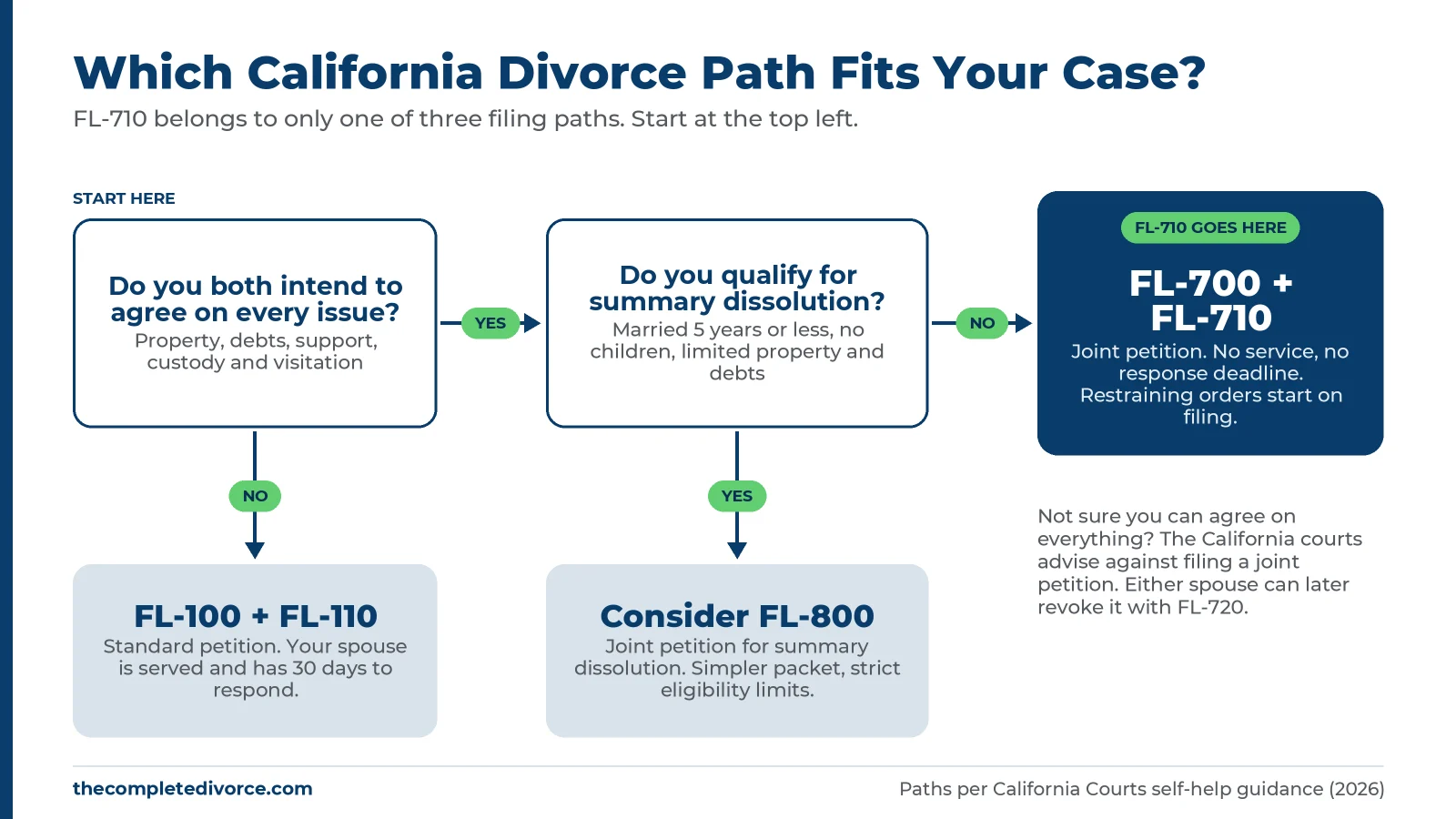
If filing FL-700, Joint Petition (California Dissolution/ Legal Separation) jointly with your spouse/partner, then use FL-710 as part of that filing.
A joint filing is meant for spouses or partners who intend to agree on all terms of the dissolution/separation, including property distribution, debt resolution, support payments, child custody agreements, and child support determinations.
A joint petition differs from a standard divorce and a summary dissolution; however, the filing method and requirements will determine the correct process.
To use FL-700 and FL-710, you and your spouse must intend to resolve every issue by agreement, including dividing property and debts, spousal or domestic partner support, child custody, and child support. On FL-700 you list the issues you plan to settle. You don’t need a signed final agreement on the day you file, but you will need one before the court can enter your judgment.
If you don’t think you can agree on everything, the California Courts advise against filing a joint petition. Use the traditional FL-100 petition and FL-110 summons instead.
Unlike summary dissolution, the joint petition doesn’t restrict couples based on length of marriage, and it doesn’t limit the amount of assets, debts, or the number of children involved.
To file for divorce, at least one spouse must have lived in California for the last 6 months and in the county where you file for the last 3 months.
Registered domestic partners who registered in California may be able to end their partnership here even if neither partner meets these residency rules.
Check the requirements for your situation before you fill out the forms.
FL-710 can’t be filed when a summary dissolution petition (FL-800) is submitted. The Joint Petition for Summary Dissolution is an option with less complicated paperwork; however, it has additional restrictions based on how long the parties were married, property and/or debt, and whether there are minor children from the relationship.
If the parties meet these requirements, the next phase is understanding how to file for summary dissolution in California. Additionally, FL-710 cannot be filed in conjunction with FL-100, Petition for Dissolution of Marriage.
This action requires FL-110 and follows the normal service-of-process guidelines. Therefore, choose the correct summons form(s) for your filing method instead of filing both forms together.
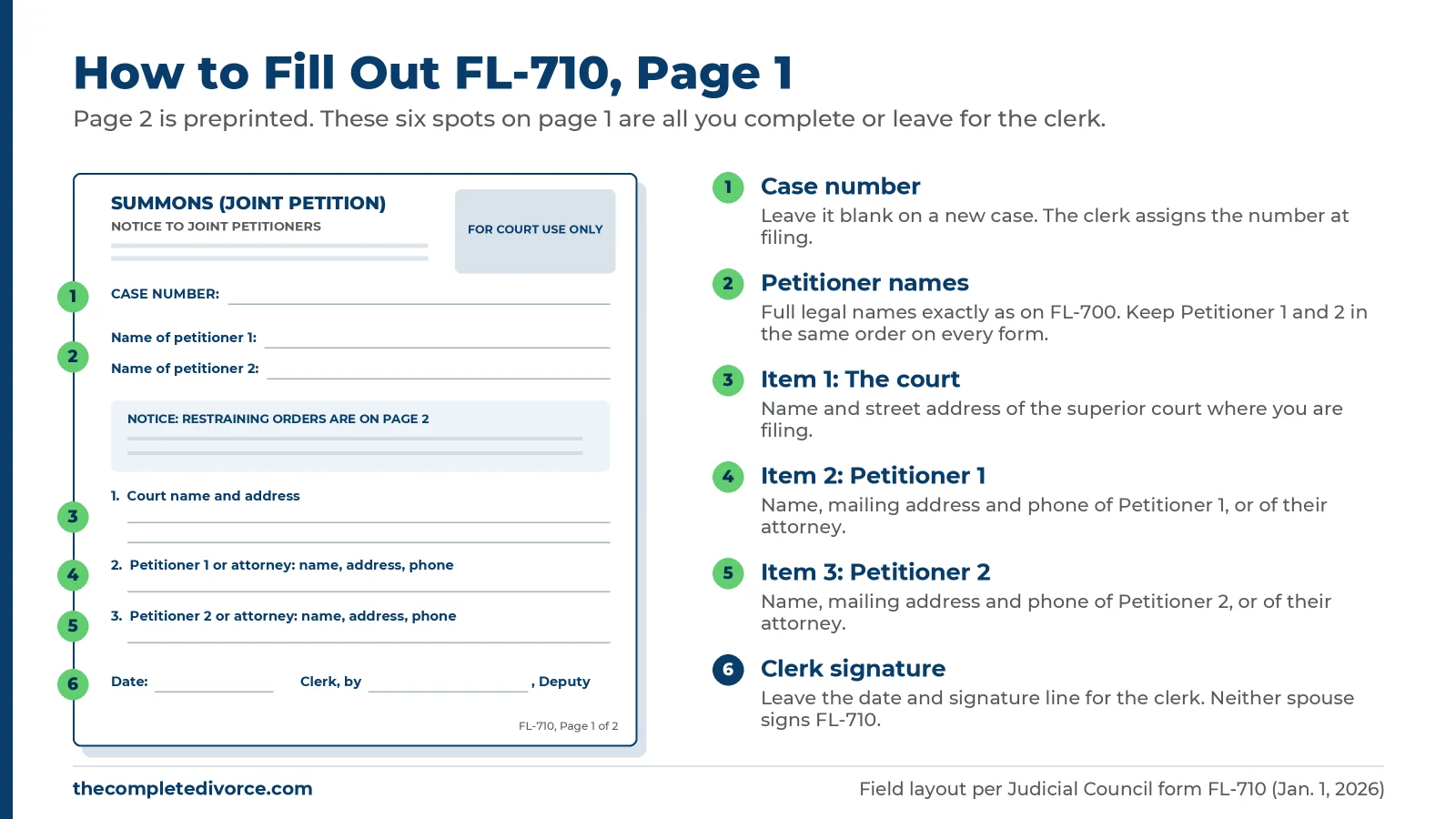
Form FL-710 has two pages of summons; however, petitioners are to complete only Page 1. Page 2 includes pre-printed restraining orders and legal notifications that each party must read.
Complete this form with either black or blue ink, or print out the official fillable PDF version. Please use U.S. letter paper. DO NOT SIGN the Clerk’s Section.
Once you have printed your completed PDF, select “Clear” so all previously entered information will be removed from the document.
Page 1 has the case caption and three numbered fields. Please enter each party’s legal name (full) as listed on your FL-700 and keep Petitioner 1 & Petitioner 2 the same across all forms.
If self-represented parties want to protect their identity, we recommend obtaining a private mailing address. Don’t sign or date the bottom of page 1. The only signature line on FL-710 belongs to the court clerk, who completes it when the summons is issued. You and your spouse sign the joint petition (FL-700), not the summons.
Page 2 is preprinted; therefore, there are no areas to enter information or signature lines. Both petitioners should be aware that all four ATROs are effective immediately upon filing as follows:
Both parties will also need to provide at least five business days’ advance notice to each other before making any extraordinary expenses and then provide proof of such expense.
File FL-710 along with FL-700 with the Superior Court of your appropriate California county. Also file FL-105 if you have minor children.
Retain copies for each petitioner and adhere to your county’s rules regarding filing electronically and/or on paper. If you want to file electronically, make sure you understand the California E-File Divorce Guide before submitting.
The statewide filing fee for a jointly filed petition for dissolution or legal separation is $870. Summary dissolution has its own fees.
If unable to pay the filing fee, either petitioner may apply for a fee waiver by filling out FW-001. Confirm the filing procedure in your area by contacting your local court clerk prior to mailing your packet.
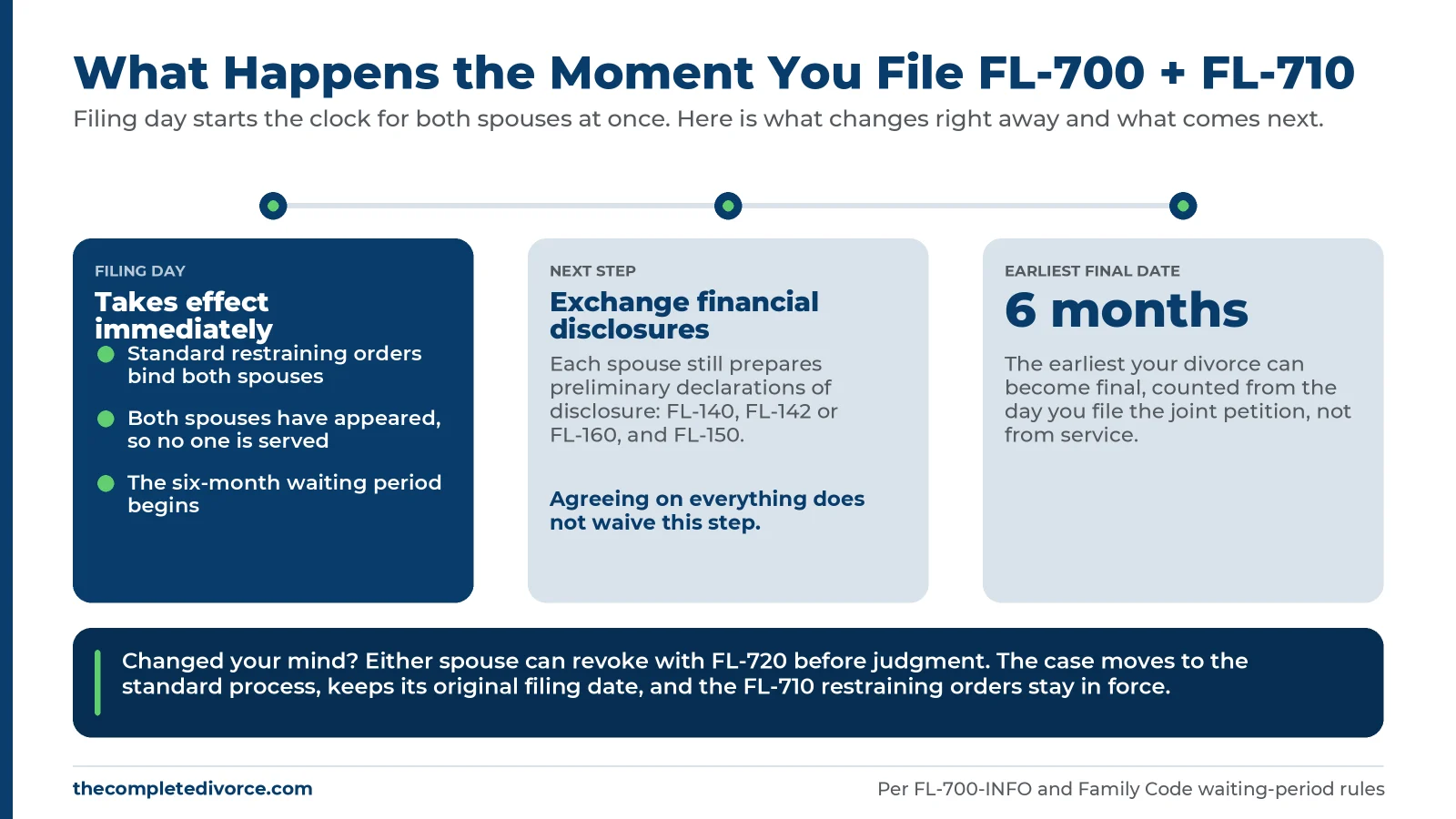
Filing FL-700 and FL-710 triggers three main effects:
Unlike the traditional FL-110 procedure, there is no respondent to serve in a joint petition case.
Both parties will need to file all the necessary financial disclosures. Either spouse can revoke the joint petition at any time before judgment by filing FL-720 (Notice of Revocation) along with an amended petition (FL-100) or amended response (FL-120). The case then moves to the standard process, but it keeps its original filing date, so the six-month waiting period still runs from the day you first filed.
You have filed Fl-720 and changed your case into traditional litigation. However, the restrictions from the Fl-710 remain in place.
You must comply with those restrictions until the case is dismissed, the court enters a judgment, or the Court removes the restrictions.
Any insurance changes, property transfers, or passport applications for minors will be subject to the applicable restrictions.
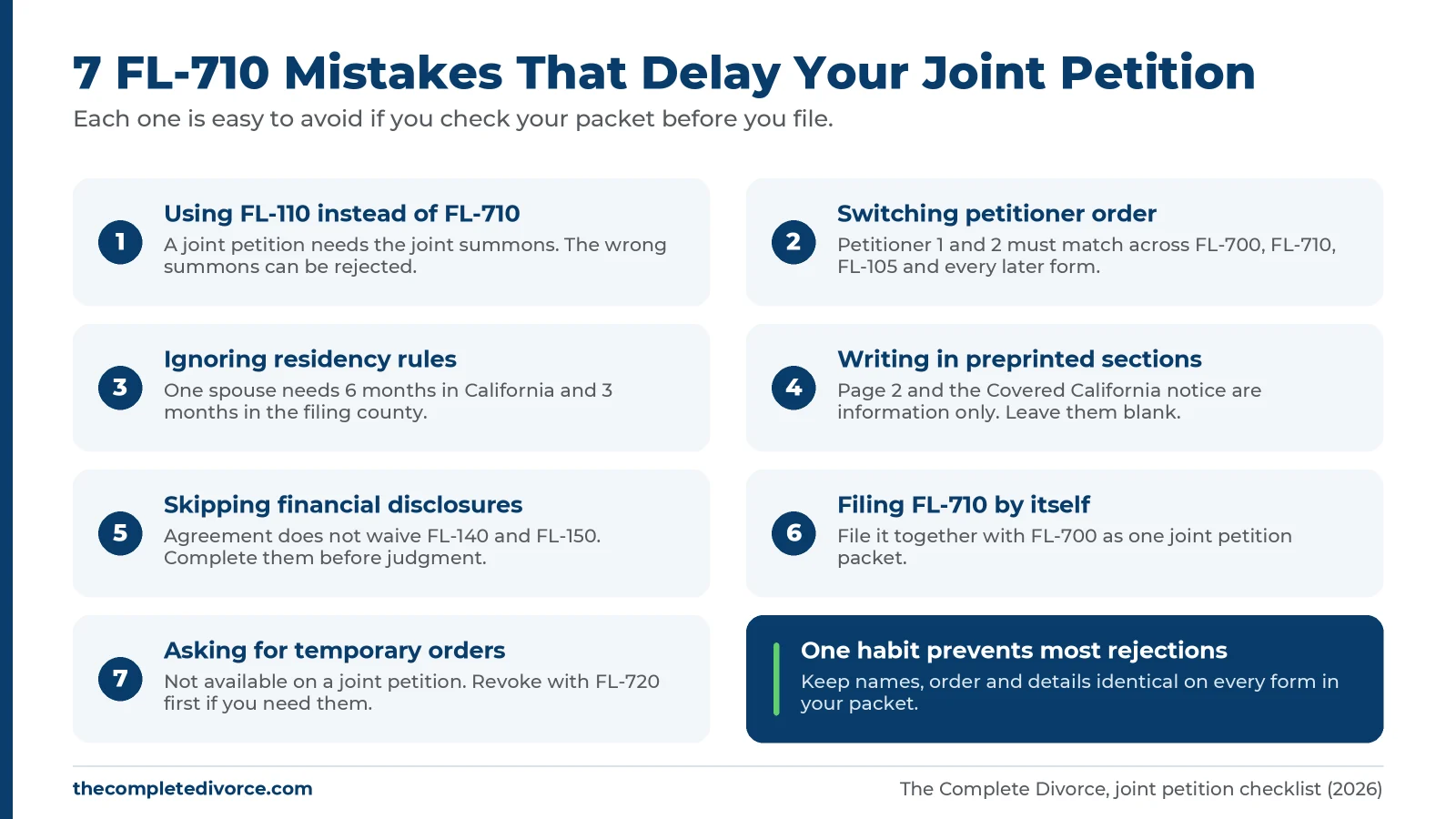
Avoid these seven mistakes when preparing your joint petition packet:
The Complete Divorce is an online tool that lets you create your own joint divorce papers in California, with or without a lawyer.
The complete divorce package includes county-specific versions of the FL-700, FL-710, and FL-105 (if you have minor children).
It also includes preparing the applicable financial disclosure documents. Dina Haddad, Esq., a California divorce attorney and mediator, created and still oversees the platform’s document review process.
Using Complete Divorce can help you avoid many common mistakes when filing for divorce. For example, some people may use the wrong document, such as the FL-110 instead of the FL-710. Others may sign in the wrong place (i.e., the section reserved for the clerk of the court).
For $49.99 per month, The Complete Divorce can monitor your marriage dissolution and ensure the final documents are court-ready and legally compliant, especially if you’re seeking a low-cost uncontested divorce in California. Start your joint divorce with The Complete Divorce. Start your divorce today!
FL-710 has two pages: three numbered fields on page 1 and four standard restraining orders on page 2. Keep every detail identical across your forms.
Correct filing starts a six-month wait period and saves you money on service costs. Incorrect Summons may be rejected or cause additional delay. For $49.99 per month, let The Complete Divorce prepare your county-specific FL-700 & FL-710 packet, reviewed by Dina Haddad’s team. Start today!

Divorce Attorney — Mediator & Founder of The Complete Divorce
“Hi. I’m Dina Haddad, a divorce attorney-mediator here in California. I’m so tired of couples not having a process that’s easy to complete their divorce. They are getting lost, wasting time and money, and beyond frustrated with their results.
That’s why I created The Complete Divorce, California’s premier online divorce program. I took my successful mediation practice and condensed it into an affordable and winning program.”
FL-710 is the two-page summons that is attached to FL-700 when spouses or registered domestic partners jointly file for a dissolution of marriage in California (or legal separation).
No. Use FL-710 with Joint Petitions; FL-110 is used with traditional divorce petitions and typically must be served on the Respondent.
No. The FL-100 is paired with FL-110 in a typical divorce process. A joint filing uses FL-700 and FL-710.
FL-710 is for couples going through a joint dissolution, not for one person suing the other. Therefore, filing FL-710 does not mean the other is being sued.
No. The only signature line on FL-710 is for the court clerk, who completes it when the summons is issued. Both spouses sign the joint petition (FL-700) instead.
Yes, as long as you both intend to reach a full agreement. You list the issues you plan to settle on FL-700. If you later can’t agree, either spouse can revoke the joint petition with FL-720 and the case moves to the standard process.
California premier divorce program.
Making California divorce simple and lawyer-free.
 ⭐⭐⭐⭐⭐
2000+ divorced without a lawyer.