
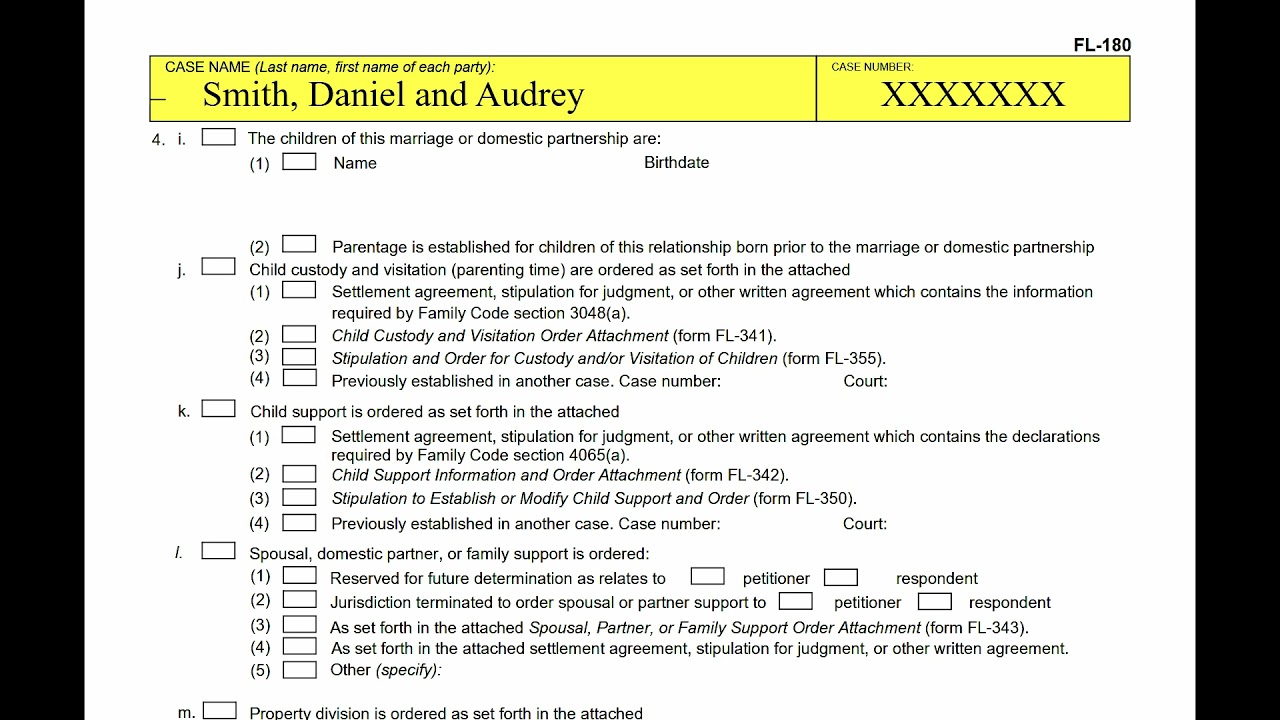
A judgment of divorce is the court order that legally ends your marriage. In California it is recorded on form FL-180, and in most cases your Marital Settlement Agreement is attached to it. Until a judge signs the judgment and the clerk enters it, you are still married, no matter how long ago you separated or how completely you agree.
This page explains what the judgment actually does, how the MSA fits inside it, the exact date you become legally single, and what you must do once it is entered. For the line-by-line form instructions, see our FL-180 guide.
A judgment of divorce, also called a judgment of dissolution of marriage, is the final court order in a California divorce case. It does three things at once:
California does not issue a separate document called a divorce decree or a divorce certificate. The entered FL-180 is your decree. Together with the FL-190 Notice of Entry of Judgment, it is the proof you show a lender, an employer, an immigration officer or a future spouse.
A judgment can be reached three ways: by agreement (both sign an MSA), by default (your spouse never responded within 30 days of service), or by trial (a judge decides contested terms). The overwhelming majority of California divorces end by agreement or default, which is why most people never see the inside of a courtroom.


 Trustindex verifies that the original source of the review is Google.
 Trustindex verifies that the original source of the review is Google.
 Trustindex verifies that the original source of the review is Google.
 Trustindex verifies that the original source of the review is Google.
 Trustindex verifies that the original source of the review is Google.
 Trustindex verifies that the original source of the review is Google.
 Trustindex verifies that the original source of the review is Google.
 Trustindex verifies that the original source of the review is Google.
 Trustindex verifies that the original source of the review is Google.
An MSA is a Marital Settlement Agreement: the written contract in which you and your spouse set out every term of your divorce. It covers how community property and debt are divided, whether spousal support is paid and for how long, child custody and a parenting schedule, and child support figures.
The relationship between the two documents is the part people find confusing, so here it is plainly:
This matters practically. If your spouse stops paying support under a signed MSA that was never incorporated into a judgment, your remedy is a breach of contract lawsuit. If the same MSA is part of an entered judgment, you can go back to the family court and use wage garnishment, liens and contempt. Same words, very different enforcement power.
One rule causes more rejections than any other: the FL-180 and the MSA must agree exactly. If the judgment form says support ends in 2029 and the agreement says 2030, the judge sends the packet back. Our marital settlement agreement guide covers drafting it clause by clause.
Courts do not accept the FL-180 on its own. You file a packet, and which forms it contains depends on your case:
Every box you tick on the FL-180 triggers a required attachment. Ticking a box without attaching its form is the most common reason packets come back, and each round trip costs weeks on top of the mandatory six-month wait.
Your marriage ends on the termination of marital status date written into the judgment. That date is never earlier than six months and one day after your spouse was served with the petition and summons.
Three things people commonly get wrong:
Court processing adds to it. Most California courts take four to twelve weeks to review and enter a judgment, depending on county backlog, so a realistic uncontested timeline is six to nine months. Call the clerk about four weeks after filing to confirm your packet was accepted, and read our guide to how long a California divorce takes.
Once entered, you receive the FL-190. Keep it: it is the document that proves you are free to remarry.
A judgment orders things to happen. It does not make them happen. These are yours to action:
Enforcement. If your ex ignores the judgment, the court has real tools: wage garnishment for support, liens on property, levies on bank accounts, interception of tax refunds, suspension of a driver or professional licence, and contempt proceedings. Unpaid California support accrues interest at ten percent a year and does not expire.
Modification. What can change later depends on the category:
That asymmetry is the strongest argument for getting the property terms right the first time, and for completing your financial disclosures honestly.
None of these are legal judgment calls. They are procedural, which means they are entirely preventable with a checked packet.
It is the final court order that legally ends a marriage, recorded on form FL-180. It restores both spouses to single status, turns the terms of your settlement into enforceable court orders, and closes the case. California does not issue a separate divorce decree, the entered FL-180 is the decree.
MSA stands for Marital Settlement Agreement, the written contract where spouses set out how property and debt are divided and how custody and support will work. It is attached to the FL-180 and incorporated into the judgment, which is what makes it enforceable by the court rather than only as a private contract.
No. The MSA is the agreement you and your spouse sign. The judgment is the order the judge signs. The MSA is attached to and incorporated into the judgment. An MSA that is never incorporated can only be enforced by suing for breach of contract, not through the family court.
On the termination of marital status date written in the judgment, which can never be earlier than six months and one day after your spouse was served. The clock runs from service, not filing, and the waiting period cannot be waived. Most uncontested cases finalise in six to nine months.
California does not issue a separate divorce certificate. Your proof is the entered FL-180 judgment plus the FL-190 Notice of Entry of Judgment. You can request certified copies from the clerk of the court where your case was filed.
Child custody and child support can always be modified when circumstances change materially. Spousal support is usually modifiable unless the MSA made it expressly non-modifiable. Property division is final once entered and can generally only be reopened for concealed assets, fraud or serious mistake.
You can enforce it through the family court using wage garnishment, property liens, bank levies, tax refund interception, licence suspension and contempt proceedings. Unpaid California support accrues interest at ten percent a year and does not expire.
Most California courts take four to twelve weeks to review and enter a judgment packet, depending on the county and its backlog. Contact the clerk around four weeks after filing to confirm it was accepted. A rejected packet restarts the review queue but not the six-month waiting period.
The judgment is the one filing where a small error costs the most, because a rejection lands after you have already waited six months. Our guided program builds the FL-180, the settlement agreement and every required attachment for your county, and a California divorce expert reviews the packet before it reaches the clerk.
\$49.99 per month. No contract, cancel anytime.