Learn the difference between uncontested and contested divorce in California,
Get California Online Divorce Forms for $49.99/month– Limited Time Offer!
Online Divorce
Divorce smartly without a lawyer. Save yourself $10,000+.
The California Courts have transitioned much of their court E-filing process online. Therefore, filing your divorce paperwork electronically will be easier and faster than it was prior to this change.
E-filing the divorce or domestic partnership has its requirement, especially in terms of residency and not every county court accepts E-filing. The E-filing is just a delivery method allowing you to handle paperwork electronically rather than manually and it does not make the legal aspects of filing less complicated
Such as couples can find paperwork troubling, they can make errors in forms and some in filing. But the chances of errors equals zero when you let a professional service like The Complete Divorce handle your matters through their ‘fully-guided divorce’ and offer complete support and guidance from e-filing to divorce judgment.
With The Complete Divorce E-filing you can be done sooner than you think. Subscribe and make E-filing easier than ever.
This blog explains E-filing for California divorce, its requirements, and the complete process to make it error-free.
Start your FL-100 Petition. Our software is easy to use – led by California divorce attorney, Dina Haddad.
These two answers rebuild the rest of the interview. Whole sections appear or disappear — you'll never be asked something that doesn't apply to you.
Every answer saves the moment you type it. Close the tab, come back next week, land on the same question.
These two answers tick the case type and the residency box on page 1 of FL-100. Next come your dates.
The date of separation must be after the date of marriage.
These five answers fill page 1 of FL-100 — the case type, the residency box, both dates and the children box. Print the form from the panel on the right and they are already on it.
Building your FL-100…
To file for divorce in California, at least one spouse must have lived in the state for six months and in the county where filing for at least three months to file for divorce. This doesn't apply to legal separation. Consider changing your response.
An e-file divorce is a California divorce where you use the court’s electronic filing system (e-filing) to submit your divorce paperwork instead of physically filing it with the clerk at the courthouse.
This has replaced traditional filing, where you would hand-deliver the paperwork. But regardless of this improvement, the way that divorces are processed by courts hasn’t changed.
Read More: Types of Divorce in California?
Online filing does not work differently, at least not where eligibility is concerned. Submitting your forms through the court’s website instead of carrying them to the clerk is just a delivery method.
E-filing depends upon residency, and that rule is the same online as it is on paper. For eligibility, one spouse must have lived in California for six months and in the filing county for three months before filing.
Only one spouse has to meet this, so if you arrived in California a few weeks ago and your husband or wife has lived in Sacramento for years, you’re covered by their residency. So if you’ve been a California resident for the period of time mentioned above and your husband lives in Florida or somewhere else, you can end the marriage with e-filing.
Clearing residency just lets you file. It has nothing to do with how long the divorce takes. There’s a separate six-month waiting period — aka the cooling-off period — that doesn’t begin until your spouse is served, and there’s no way around it.
Not every county lets you file online, so always check before you file. The following are some of the counties, among many others listed on Odyssey e-FileCA, that accept e-filing.
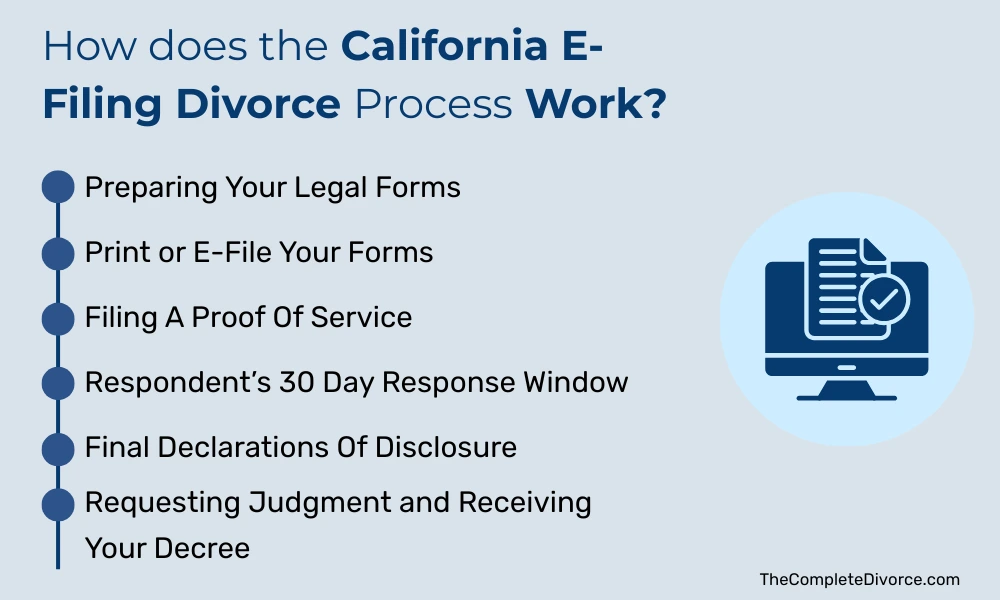
California’s e-file divorce process allows for electronic submissions; however, the rules governing the divorce process have remained very rigid. Following the steps below will assist in avoiding the likelihood that your submission will be rejected by the courts.
Confirm California residency eligibility before you start preparing the forms. Accurately complete the Judicial Council forms for your divorce, which include the FL-100(Petition) and FL-141 (Disclosure).
Alongside your petition, you’ll also file a Summons (Form FL-110). It will notify your spouse that a case has begun and will also trigger automatic temporary restraining orders (ATROs) that prohibit either spouse from moving minor children out of state, selling or hiding community property, etc.
If you have minor children, you’ll also need a Declaration Under the UCCJEA (Form FL-105) so the court can confirm it has authority to make custody decisions.
Once the paperwork is prepared, you can file it with the court. Filing can be done with printed paperwork delivered or mailed to the courthouse, or by submitting the documents electronically via a certified Electronic Filing Service Provider (EFSP).
Submit the court filing fee — $435 in most California counties. The fee can vary slightly by county. You can also waive it by filing a fee waiver using Form FW-001 if your income qualifies.
Once submitted, the court will assign a case number to your California divorce case. Keep this number handy; you’ll reference it on every form you file from this point forward.
In California, the petitioner will need to serve the Respondent with the divorce petition and then file a Proof of Service using Form FL-115. By law, you cannot serve the papers yourself. Instead, service must be completed by an adult who is not a party to the case, a registered process server, or the county sheriff, generally within 60 days of filing.
However, the California joint petition — introduced on January 1, 2026, under Senate Bill 1427 — offers enormous benefits, as it allows couples to file jointly using Form FL-700 and avoid formal service entirely, regardless of how long they’ve been married, whether they have children, or how complex their assets are.
Because the joint filing itself counts as service on both spouses, no one has to be formally served. However, if the agreement later breaks down, either spouse can revoke the joint petition, and the case converts to the traditional petition-and-response track without losing its original filing date.
Once you serve the Respondent, they have 30 days to file a Response using Form FL-120, which has a filing fee of $435. But there are two scenarios:
Number 1 — If the Respondent files a Response:
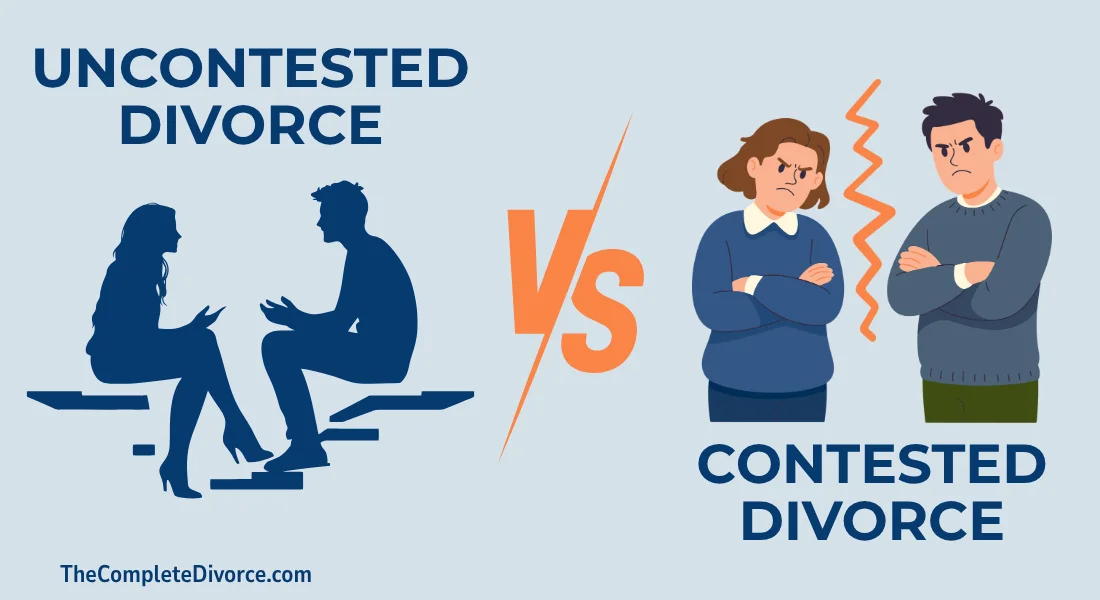
If they file a response, both parties are now formally participating. In procedural terms, this is a “contested” case, but you can still settle every issue outside court using mediation or The Complete Divorce program and finish as an uncontested matter. Learn more about contested vs uncontested divorce.
Number 2 — If the Respondent does not respond within the deadline:
If they don’t respond, you can proceed with a default divorce, in which you move forward without their further participation. California has a mandatory six-month waiting period, and it begins on the date the Respondent is served or first appears in the case.
California law requires both spouses to fully and honestly exchange their financial information before a judge will end the marriage. This happens in two rounds: a preliminary declaration of disclosure early in the case, and a final declaration of disclosure closer to judgment. This can include the following forms:
Here’s a tricky thing for E-Filers to be careful about. FL-140 and FL-142 are not filed with the court, but you will serve them on your spouse. The FL-150 is also served, and it is additionally filed with the court whenever child support, spousal support, or attorney fees are at issue.
You just file FL-141 and let the court know that the exchange took place. The preliminary disclosure cannot be waived under any circumstances, but the final disclosure can be.
After the financial disclosures and waiting period have been completed, you can ask the court to enter the judgment. Which forms you use will depend on how your spouse responded.
For example, if your spouse never filed a response, request a default judgment using FL-165 along with FL-170 and FL-180.
However, if your spouse responded and you’ve reached a written settlement, you’ll typically file the Appearance, Stipulations, and Waivers (FL-130), the FL-170, and the FL-180 with your signed Marital Settlement Agreement attached.
In both cases, a judge reviews your packet to confirm nothing is missing. If everything is in order, the judge signs your Judgment (FL-180). The court then returns the Notice of Entry of Judgment (FL-190), which confirms your divorce is final and states the exact date your marriage legally ends.
Many people use an online divorce in California to avoid litigation. Litigation typically requires attorneys’ time, and that can cost anywhere from $20,000 to $50,000 or even more. Platforms such as The Complete Divorce can provide lower costs per month compared to attorney fees.
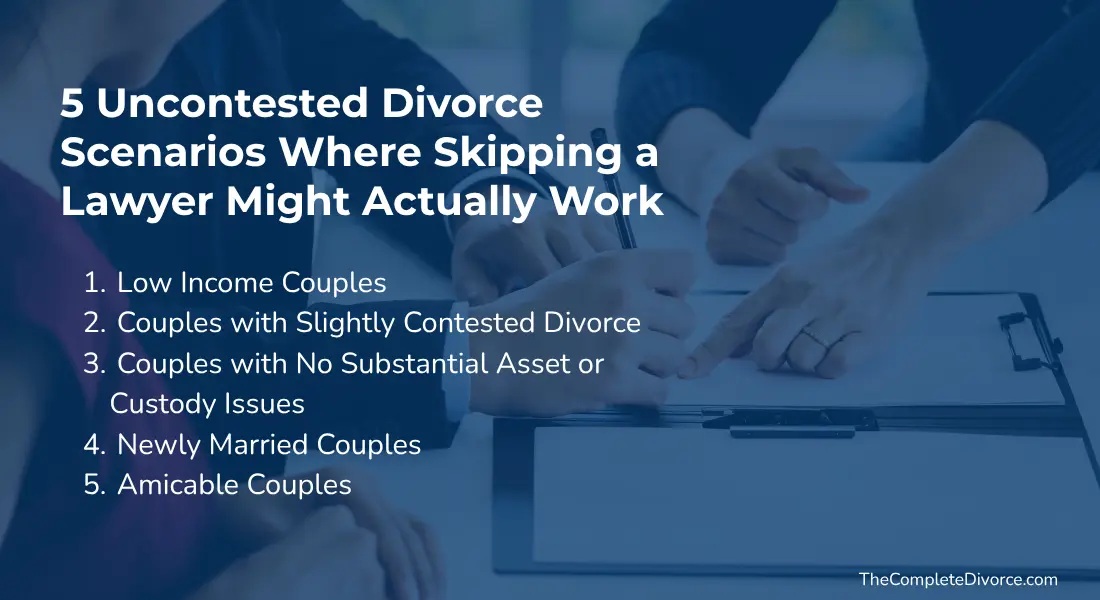
An online divorce may be most suitable for couples with less than 5 years of marriage, no children, and very few assets that will need to be divided. When completing accurate paperwork and when both spouses agree on all aspects of their divorce, fully-assisted DIY divorce is often the way to go. Learn more about “getting a divorce but can’t afford an attorney.”
Filing an online divorce will not lower the legal standards. The courts will still follow all the same rules; the only difference is that you are filing electronically rather than by mail.
The most common reasons that people’s electronic filings are rejected are due to submitting old (outdated) Judicial Council forms, failing to submit required FL-141 disclosures, and having inconsistencies in their FL-150 financial information.
If this happens, you will need to make the corrections and then have to wait longer to receive your final divorce decree. To make sure you do everything correctly and follow all the required procedures, get organized assistance and full support through The Complete Divorce.
Online divorce in California generally succeeds if both parties agree on all key areas, such as property, debts, and other basic issues. It is also ideal for low-conflict divorces where there is no history of abuse or complicated assets.
When you have an uncontested divorce, it can be financially reasonable to get divorced by yourself rather than hiring a lawyer.
Compared to Collaborative Divorce, which can involve several different attorneys, online divorce (structured platforms) like The Complete Divorce provide a way for people to do their own uncontested divorce at a lower cost.
The Complete Divorce offers a practical option for those who can’t afford expensive litigation and are wary of attempting E-filing. And you know that E-filing only works if you’ve done the paperwork correctly, so that your forms are county-specific and your financial disclosure is in order as well. With The Complete Divorce, you get a lot of things:
We File for You — Paperwork Option
The program generates case-specific, correct Judicial Council forms, from the FL-100 petition to the FL-180 judgment. The forms are tailored to your county — ensuring you never submit wrong or expired forms or miss paperwork.
The Fully Guided Divorce So That You Stay on Track
From step-by-step video tutorials, checklists, and flowcharts to expert webinars, we make sure you stay on track. We walk you through each form. We offer a built-in MSA builder and parenting plans. We help couples and parents with property and debt division, support, custody schedules, and retirement transfers.
Extraordinary Support, Even If You Miss Something
The program offers a bi-weekly webinar with divorce expert Dina. You can use the webinar to ask real questions about filing procedures, financial disclosures, taxes, and custody. For more personalized support related to E-filing, we offer a 1-on-1 strategy meeting, including petition and response packet filing, judgment and MSA filing, child and spousal support calculations, and a review of your Judicial Council forms before anything goes to the court.
An electronic (e-file) divorce in California offers an efficient way to file the divorce papers. But preparing properly is essential, as errors may cause a delay in receiving your divorce decree or result in having your documents rejected by the courts.
Structured support, such as The Complete Divorce, will help you prepare your divorce papers correctly, ensuring they comply with all required regulations; this will reduce delays and costs. We’ve successfully helped over 2000+ divorcing couples. We believe divorce needs to come harder on families and children. Start your easier, E-divorce with The Complete Divorce and move forward with peace of mind.

Divorce Attorney — Mediator & Founder of The Complete Divorce
“Hi. I’m Dina Haddad, a divorce attorney-mediator here in California. I’m so tired of couples not having a process that’s easy to complete their divorce. They are getting lost, wasting time and money, and beyond frustrated with their results.
That’s why I created The Complete Divorce, California’s premier online divorce program. I took my successful mediation practice and condensed it into an affordable and winning program.”
Yes. E-file divorce in California is allowed, and courts accept filings from approved electronic filing systems. While the process is entirely digital, divorce laws, divorce paperwork, and divorce time frames remain as they were before.
Many times, yes. Some courts may approve electronic signature use, however this will depend upon which type of form you are submitting and what your local court’s rules are
Forms that typically are needed include:
Yes. The Court will still issue its Final Decree of Divorce Certificate. The process of filing online only provides an alternative way of filing your paperwork.
Not necessarily. Most simple, uncontested divorces may be prepared and completed through online platforms such as The Complete Divorce, if the proper documentation has been properly filled out.
California premier e-divorce program.
Get E-Divorce through our DIY Program
 ⭐⭐⭐⭐⭐
⭐⭐⭐⭐⭐
2000+ divorced without a lawyer.
Learn the difference between uncontested and contested divorce in California,
California’s uncontested divorce is most affordable, fast and friendly. It’s