
Solo vs. Single Parenting Defined – Solo parents raise children
Get California Online Divorce Forms for $49.99/month– Limited Time Offer!
Online Divorce
Divorce smartly without a lawyer. Save yourself $10,000+.
Not every divorce or legal separation in California means court appearances, piles of paperwork and big bills for lawyers. Some couples can work together and they can end marriage peacefully and amicably, i.e., leading to successful divorce.
Summary Dissolution is a such a simplified divorce pathway that can be used by couples who have only been married briefly, do not have any minor children, and own little to nothing together.
If you qualify for shorter marriages or summary dissolution, you can consider The Complete Divorce to complete your entire divorce confidently. The program is expert-led — meaning that you will not need a lawyer to handle paperwork.
We’ll assist you and guide you from paperwork to reviewing and filing. We’ll empower you to not only take control of your divorce but also get it done without a court. Subscribe for $49.99/mo and complete your dissolution.
This guide will help explain summary dissolution in California, its eligibility, filing requirements and options other than it when it might not be the right fit for your case.
Modernizing California Divorce
Complete your divorce without a lawyer.
Move forward with peace of mind and avoid court rejections through our fully-assisted DIY divorce program. This program is founded and led by California divorce expert, Dina.
Summary Dissolution is an easier way to get a divorce in California. It is intended for people who have been married less than five years, do not have many assets, do not have children (from this or prior marriages) and both agree about how everything will be divided.
There is no court hearing required, no trial and you rarely see a judge. In a summary dissolution both parties file a Joint Petition. The goal of a summary dissolution is to have your dissolution become final six months after you filed.
California has another option that uses the same procedure as a summary dissolution but for registered domestic partners that qualify. While The Complete Divorce helps separating couples simplify the divorce process, this service is not available to those in a domestic partnership.
In California, putting a price on the end of a marriage may seem impersonal, but it comes down to a standard $435 filing fee, no matter where you are in the state.
Whether you’re in bustling Los Angeles or serene Santa Barbara, the cost remains the same. However, when it’s a joint decision, and both partners are on board from the beginning, the total filing fee is still $435.
But, if one spouse is responding to the petition, they’ll also need to pay the same $435 fee to file their response. So, while it may seem like a financial transaction, it’s a reminder that divorce, even in its official paperwork, has a human and emotional side to it.
A summary dissolution does not last forever. Once you file the proper documentation with the court, your divorce is usually finalized within 6 months.
That implies you can resume your life relatively fast. It’s like hastening the end of your marriage, but keep in mind that not everyone qualifies for this choice. You must meet certain standards, and both you and your partner must agree to end the marriage.
So, if you’re qualified and can work together, a summary dissolution may be a more uncomplicated way to divorce in California.
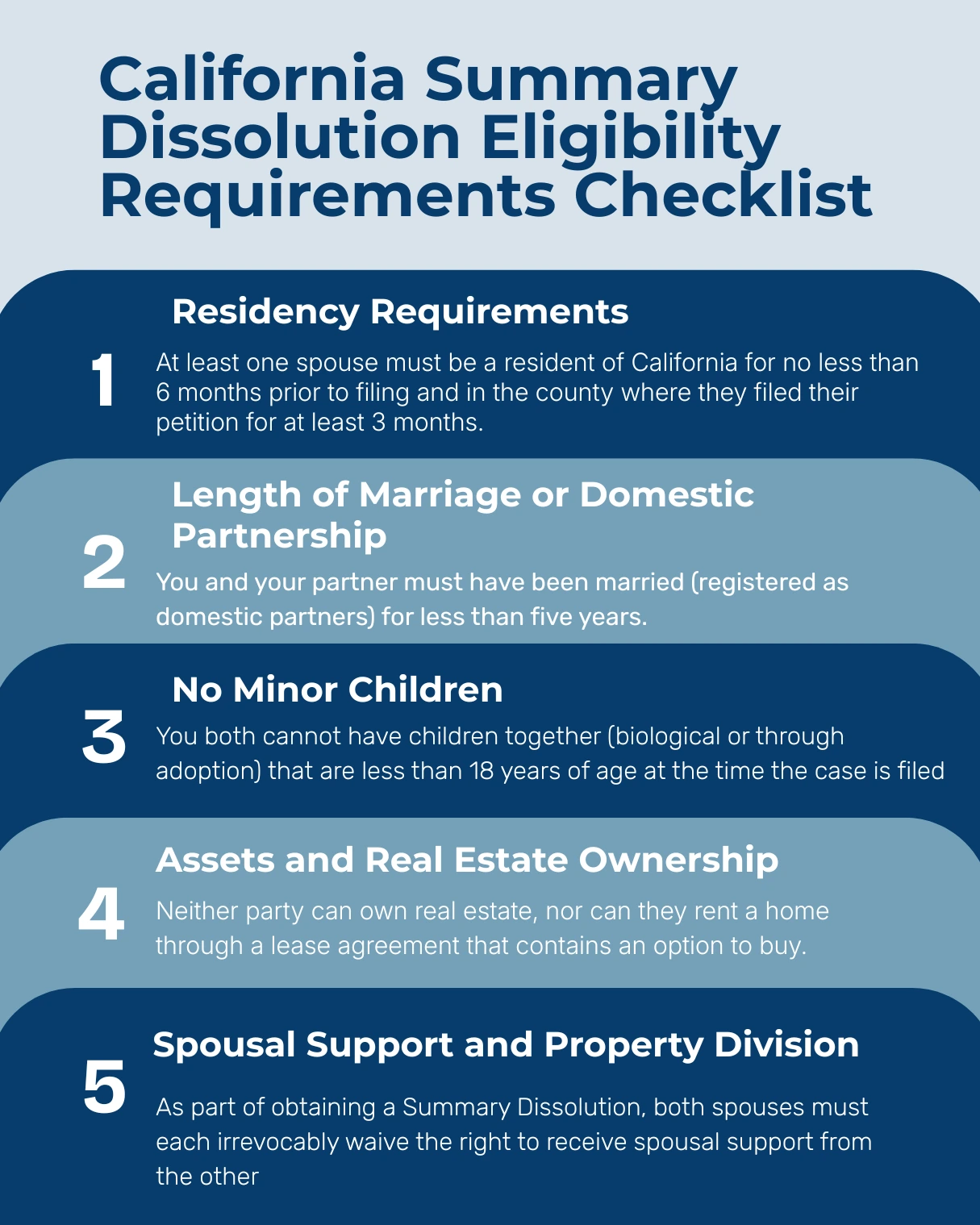
Qualification of Summary Dissolution is generally straightforward; however, all criteria for eligibility must be met. Failure to satisfy even one of the criteria results in the summary dissolution being unusable and an alternative divorce option, such as California’s new Joint Petition for Dissolution, will be necessary.
A strict eligibility list exists for both married couples and registered domestic partners. It is essential to review this checklist prior to spending time on the summary dissolution paperwork.
For spouses who were legally married, at least one spouse must be a resident of California for no less than 6 months prior to filing and in the county where they filed their petition for at least 3 months.
Registered domestic partners do not have to comply with California’s Residency Requirements. As for same-sex couples and domestic partners, most of these rules also apply.
You and your partner must have been married (registered as domestic partners) for less than five years. The time frame begins on the day you were married (or registered), ends on the day you separated, and doesn’t include the length of time that has passed since you filed for Summary Dissolution.
The distinction in timeline matters. For example, if you had been together four years and eleven months before separating and then waited three years before filing for divorce, you would still meet the requirements under the five-year rule based upon the time frame of your separation rather than the time elapsed until you filed.
You both cannot have children together (biological or through adoption) that are less than 18 years of age at the time the case is filed, and neither party can be pregnant when the petition for dissolution is filed.
If you do have children together, you can opt for an uncontested divorce instead, which you can learn more about in our Fully Guided Uncontested Divorce Process guide.
Neither party can own real estate, nor can they rent a home through a lease agreement that contains an option to buy. It is possible to enter into a standard one-year rental agreement without an option to buy, provided the lease expires by the end of the term.
Any community property that was purchased during the marriage period may be subject to the current statutory limits ($57,000), excluding any vehicle(s).
Typically, bank accounts, investment accounts, and retirement plans accumulated during the marriage are included in determining whether the parties have exceeded these statutory limits. In general, community debt obligations may not exceed $7,000, excluding automobile loan payments.
As part of obtaining a Summary Dissolution, both spouses must each irrevocably waive the right to receive spousal support from the other and each must agree as to how all property and debts will be divided.
While many mediators fail to consider the spousal support waiver, it is generally irreversible. As such, once waived, it may not be revised or rescinded even if the financial situation of either party changes.
If either spouse disagrees as to how property, debt or support should be distributed, then a Summary Dissolution cannot be obtained.
| Factor | Summary Dissolution | Regular Divorce |
|---|---|---|
| Eligibility | Strict requirements regarding marriage length, children, assets, debts, and property ownership | Available to most married couples |
| Who Files | Both spouses file a Joint Petition together | One spouse files as petitioner and the other becomes respondent |
| Court Appearance | Typically none required | May be required depending on the case |
| Cost | Usually lower due to fewer forms and less procedure | Often higher because of additional filings, disclosures, and possible hearings |
| Timeline | Minimum six-month waiting period | Minimum six-month waiting period, but contested issues can extend the case significantly |
| Spousal Support | Permanently waived by both spouses | Can be requested, negotiated, reserved, or ordered by the court |
| Complexity | Simplified paperwork and streamlined process | More extensive procedures, disclosures, and case management requirements |
Summary Dissolution and Standard Divorce both terminate a marriage. The main difference is in how each terminates a marriage.
Only a few specific couples can use summary dissolution as it has very restrictive criteria, while almost all other couples can apply for a standard dissolution. Learn more about the other types of divorce available in California.
Summary dissolution offers the easiest, least stressful way to get divorced as a couple. There is less paperwork, fewer procedural steps, and no need to serve one spouse with divorce papers because both parties participate from the start.
On the other hand, regular divorce gives couples much more flexibility. Couples can deal with child custody, child support, large property estates, real estate properties, and spousal support. It is also the default option when couples disagree on any issue.
If you do not qualify for summary dissolution that does not mean you are in store for a long court battle. California has recently added another co-operative filing option called Joint Petition for Dissolution of Marriage, which was introduced in 2026.
Many couples will be able to use this process if they exceed the summary dissolution limits but still agree on everything.
California’s Senate Bill 142 added a new cooperative divorce alternative called the Joint Petition for Dissolution. Spouses are able to file using Form FL-700 (Joint Petition) even though their marriage does not meet all of the requirements to qualify as a Summary Dissolution.
One major difference between summary dissolution and a joint petition is that there is no time limit on when you got married. Regardless of how long your spouse has been your husband/wife, you can file jointly.
A second difference is that both parties are allowed to have children, and assets/debts exceeding what would normally be required for summary dissolution.
While the process may seem very different from summary dissolution at times, both parties will otherwise file jointly, provide each other with financial disclosures, draft a settlement agreement, and work together towards obtaining a final Judgment.
As with summary dissolution, after filing a joint petition, the couple will still be subject to a six-month waiting period before the divorce becomes final.
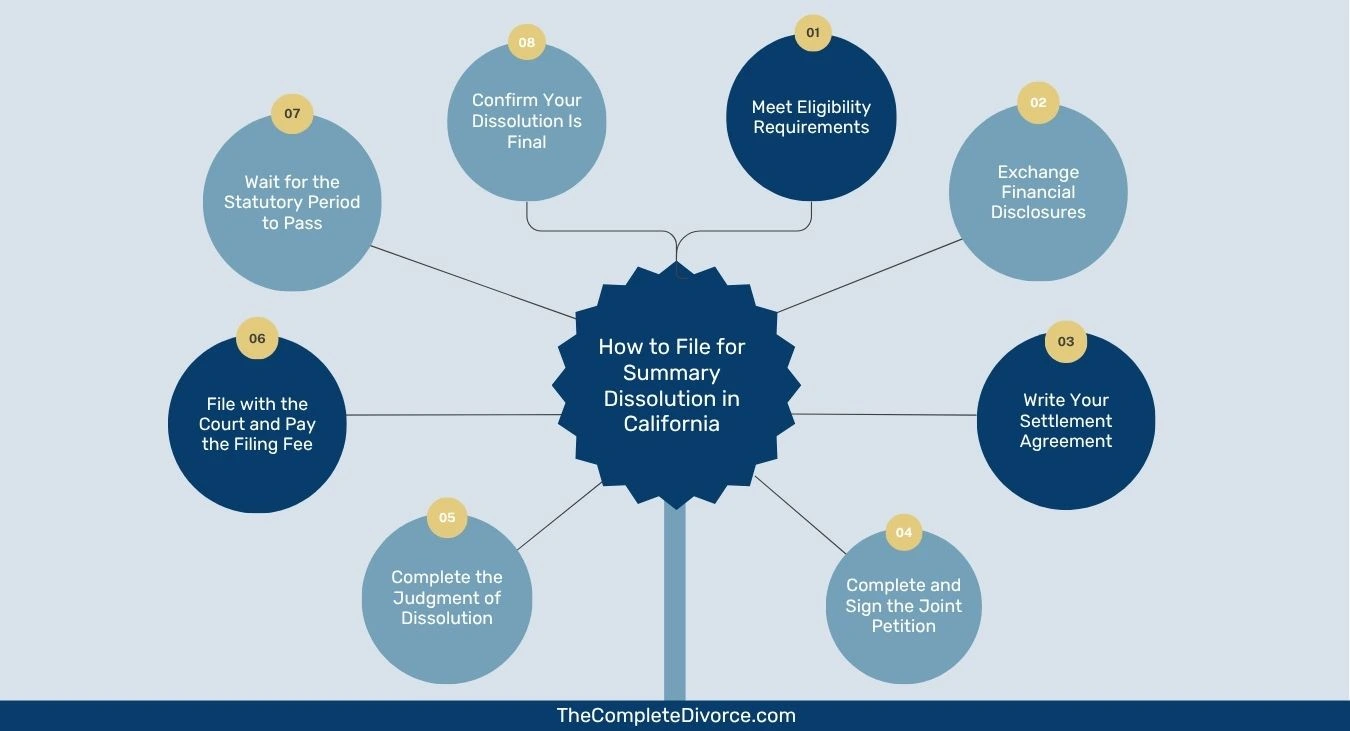
Before you submit any forms, make sure you meet all of the summary dissolution requirements listed above. Both parties must also read and certify that they have read the FL-810 summary dissolution information booklet.
This booklet provides a brief overview of the process and explains the legal rights & responsibilities of both parties. It also includes worksheets for identifying separate property, community property and Debts.
Prior to signing the petition, both parties must exchange complete financial disclosures. These documents will include your pay stubs, FL-140 Declaration of disclosure, FL-160 Schedule of Assets and debt, and your FL-150 income and expense statement.
Alternatively, you may use the property worksheets included in the FL-810 booklet. If either party has acquired any new investments or businesses since separation that generate income, they must be disclosed.
You must prepare a written settlement agreement which specifically describes how all community property and Debts will be divided between you. Even if there is no shared property or Debts, the settlement agreement must state that fact.
The sample agreement included in the FL-810 booklet may be used by you but you may also use your own document or template. Both parties must sign and date the finalized settlement agreement.
The fl-800 joint petition for summary dissolution is the court document that initiates the case. Both parties complete and sign the form together confirming under penalty of perjury that they satisfy all qualifications, have made full financial disclosures and have reached an agreement on how to divide all community property and debt.
Along with filing the petition, you must prepare the appropriate judgment document needed for the court to dissolve the marriage.
The documentation verifies your eligibility for a summary dissolution, incorporates your settlement agreement into your judgment, and provides the court with all of the required information to grant a judgment ending your marriage.
You will need to file the completed documents that were used to obtain your Summary Dissolution at the Superior Court in the County where you live.
In most cases, if you do not meet the income requirements for a fee waiver, you will need to pay the filing fee. Once you have filed the document(s) you will begin the waiting period.
During the statutory waiting period, it is common that there are no hearings, discovery disputes or other issues requiring appearance before the court.
If the proper paperwork has been filed by each party and neither party has revoked their Petition prior to expiration of the mandatory waiting period, the divorce will be finalized once the waiting period expires.
Once the statutory waiting period has expired, the Court processes the case and then your Summary Dissolution is finalized.
It is advisable to retain copies of your filed Judgment and supporting documentation. The marriage termination becomes effective upon completion of this process and each spouse is able to pursue independent interests.
Summary dissolution in California is a viable option for couples looking to end their marriage or domestic partnership quickly and cost-effectively.
By understanding the requirements, facts, costs, and procedures, you can embark on this journey with confidence, knowing that you are taking the steps necessary to move forward in your life.
Remember that consulting with legal professionals can provide valuable guidance throughout this emotional process, helping you navigate the path to freedom with clarity and peace of mind.
Understanding family laws in California is also essential, as they play a significant role in the dissolution process, especially when family dynamics are involved.
If you qualify for summary dissolution, The Complete Divorce can help you simplify the divorce while providing the complete assistance.
With us, you don’t need a lawyer. We will assist you with paperwork, review and filing. We’ll also provide divorce webinars that help parties clarify confusion and streamline dissolution. Start your dissolution today for $49.99/mo and move forward with confidence.

Divorce Attorney — Mediator & Founder of The Complete Divorce
“Hi. I’m Dina Haddad, a divorce attorney-mediator here in California. I’m so tired of couples not having a process that’s easy to complete their divorce. They are getting lost, wasting time and money, and beyond frustrated with their results.
That’s why I created The Complete Divorce, California’s premier online divorce program. I took my successful mediation practice and condensed it into an affordable and winning program.”
No. A summary dissolution requires both spouses’ cooperation. To be eligible for summary dissolution, both spouses must sign all documents associated with the divorce, provide each other with full financial disclosure, and work together throughout the duration of the proceeding.
No. Most summary dissolutions typically do not require you to attend court hearings or have a judge make either party present.
A minimum of six months. According to California law, there is a six-month waiting period after your dissolution is filed for it to become final.
No. As part of the process of completing summary dissolution, both spouses waive spousal support rights forever. These waivers generally cannot be reversed at a future date.
You still qualify. Your written settlement agreement will state that neither party has community property and that neither party owes community debt. Both parties should then sign the agreement.
California premier divorce program.
Making California divorce simple and lawyer-free.
 ⭐⭐⭐⭐⭐
⭐⭐⭐⭐⭐
2000+ divorced without a lawyer.