
Solo vs. Single Parenting Defined – Solo parents raise children
Get California Online Divorce Forms for $49.99/month– Limited Time Offer!
Online Divorce
Divorce smartly without a lawyer. Save yourself $10,000+.
In California, yes it is possible to end your marriage peacefully, smartly, and amicably. By amicably, we mean that parties can work together to complete their divorce as smoothly and peacefully as possible, reducing divorce cost, timeline, and conflict.
Amicable divorce is different from a no-fault divorce or an uncontested divorce. It refers to how two people choose to collaborate during the entire divorce process.
By understanding the differences among these and other types of divorce, you’ll be able to identify if an Amicable Divorce is best for you. Couples who meet eligibility requirements will find many options available that can make the divorce process much easier, including a guided DIY divorce, e-filing (self representation), divorce without a lawyer, and mediation.
Start your amicable divorce for $49.99 at The Complete Divorce as the program allows you to be more productive, smart, and get your divorce done without hiring expensive lawyers and visiting the courthouse.
Start your FL-100 Petition. Our software is easy to use – led by California divorce attorney, Dina Haddad.
These two answers rebuild the rest of the interview. Whole sections appear or disappear — you'll never be asked something that doesn't apply to you.
Every answer saves the moment you type it. Close the tab, come back next week, land on the same question.
These two answers tick the case type and the residency box on page 1 of FL-100. Next come your dates.
The date of separation must be after the date of marriage.
These five answers fill page 1 of FL-100 — the case type, the residency box, both dates and the children box. Print the form from the panel on the right and they are already on it.
Building your FL-100…
To file for divorce in California, at least one spouse must have lived in the state for six months and in the county where filing for at least three months to file for divorce. This doesn't apply to legal separation. Consider changing your response.
An amicable divorce refers to an agreement by two divorcing individuals to proceed through the divorce process cooperatively without prolonged disputes, lengthy and costly litigation, or excessive court appearances.
The parties resolve their marital relationship mutually and respectfully during an amicable divorce by agreeing upon the terms of the divorce, like property distribution, spousal and child support , distribution of debts, and co-parenting arrangements.
California does not recognize “Amicable Divorce” as a legitimate legal description. However, it has become common terminology among professionals, describing the manner in which spouses choose to pursue their divorce.
On the other hand, “no fault divorce” and “uncontested divorce” are legally recognized descriptions that determine whether a case can be filed and resolved in an expedited fashion.
Related: Uncontested vs Contested Divorce
A lot of people use the term “amicable divorce” with both “no-fault divorce” and “uncontested divorce.” These are separate parts of a divorcing couple’s experience.
In California, all amicable divorces are considered to be an uncontested divorce since the parties have reached an agreement regarding all material issues.
However, not every uncontested divorce will be an amicable divorce. This is because some couples only settle disputes after long negotiations, mediation, and conflict.
It is important to know the differences between amicable, no-fault, and uncontested divorce when looking into how they relate to the divorce process.
| Comparison | No-Fault Divorce | Amicable Divorce | Uncontested Divorce |
|---|---|---|---|
| What It Means | Legal grounds for divorce without proving fault | Cooperative approach to ending a marriage | Divorce where all issues are resolved by agreement |
| Main Goal | Dissolve the marriage | Achieve a peaceful and fair resolution | Finalize the divorce without a trial |
| Cost & Time | Varies widely depending on disputes | Usually the lowest-cost and most efficient option | Typically faster and less expensive than contested divorce |
| Court Role | Depends on the matter whether it is contested or uncontested since all divorces are no-fault in California | Limited court involvement but the judge is still required to sign the final divorce papers | May have temporary hearings (not a trial); Judge is still required to sign the final divorce paper |
| Divorce Grounds | Irreconcilable differences or permanent incapacity | Irreconcilable differences or permanent incapacity | Irreconcilable differences or permanent incapacity |
Amicable divorce: Needs spousal cooperation, open lines of communication, and a willingness to settle on a mutually beneficial resolution. Both spouses actively participate in developing a resolution.
No-fault divorce: No-fault does not need spousal cooperation. If one spouse wishes to terminate the marriage, they can do so, regardless of whether or not the other spouse agrees with terminating the marriage.
Uncontested divorce: An uncontested divorce needs spousal cooperation and agreement on certain terms. Your case can only be considered to be “uncontested” after both parties have resolved their disputes.
Amicable divorce: The only required time a judge is needed is at the end of the divorce process when the judge reviews and signs the final judgment packet.
Even if a judge is needed for incomplete paper work or clarification on the agreement, it is almost never in person but handled through notes.
No-fault divorce: The judge signs the final judgment packet. In California, every divorce is no-fault.
Uncontested divorce: Typically, the judge’s function is administrative and includes reviewing all of the papers that were submitted as part of the divorce and then signs the final judgment packet.
Amicable divorce: In many cases, couples choose to use mediation, represent themselves (“pro se”), or use a DIY option in California without hiring attorneys.
No-fault divorce: An attorney is not necessary under the law; however, some spouses elect to retain an attorney based on the complexity of their individual circumstances.
Uncontested divorce: Attorneys are optional. If both parties agree and can complete the appropriate paperwork correctly, attorneys are not needed.
Amicable Divorce: An amicable divorce is often the quickest and least expensive way to obtain a divorce. When spouses cooperate with one another, it reduces conflict and time, which then reduces the cost.
No-Fault Divorce: Designating a divorce as “no-fault” does not shorten timelines or reduce costs. No-fault has really no bearing on the speed or cost. Even though a party has designated the divorce as “no-fault,” contested no-fault divorces can be very expensive.
Uncontested Divorce: Generally, uncontested divorces cost less and move more quickly than contested divorces; however, the cost varies greatly based upon what filing fees are charged, along with which support service(s) you decide to use.
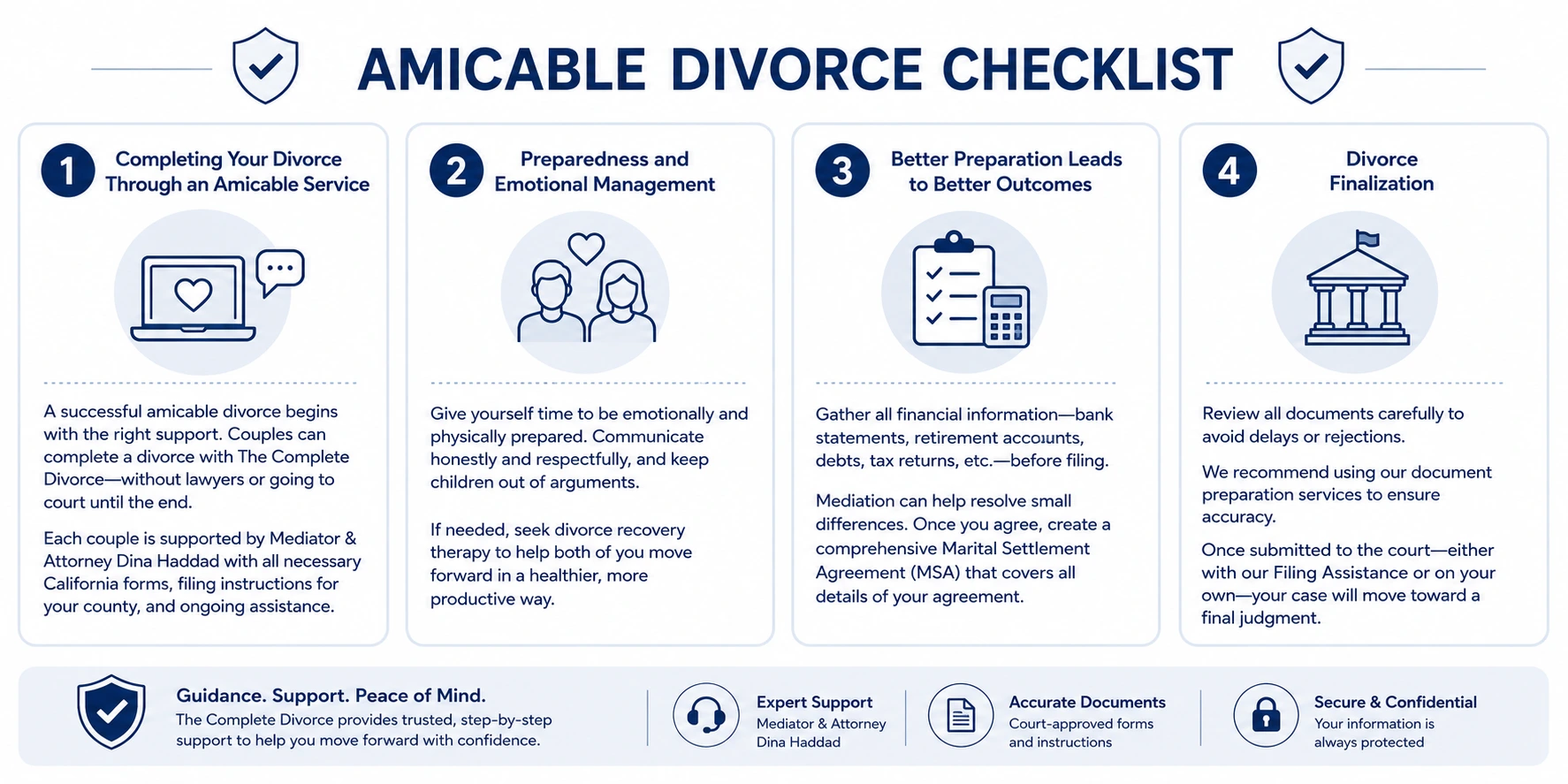
A successful amicable divorce begins with the right support. Couples can successfully complete a divorce with The Complete Divorce, and they don’t have to hire lawyers or appear before a judge until the end.
Each couple is supported by Mediator & Attorney Dina Haddad throughout the divorce process. They will be provided with all necessary California divorce documents (forms), filing instructions for their specific county, and continued assistance during this time.
Before filing, give yourself sufficient time to be emotionally and physically prepared. Prepare yourselves for a respectful divorce by learning how to communicate honestly with each other. Avoid having the children involved in arguments.
In the event that you find it difficult to manage your emotional state during the divorce process, consider seeking out divorce recovery therapy as a means of helping both parties move forward more productively.
Collect all relevant financial information, such as bank statements, retirement accounts, debt, tax returns, etc., prior to filing.
Mediation services may assist if small differences continue to prevent you from reaching an agreement. After reaching an agreement on your terms, develop a comprehensive Marital Settlement Agreement (MSA) outlining all of the details regarding your agreements.
Review all documents thoroughly to avoid any delays due to rejections after submitting them to the court. While many people have completed this portion of the divorce process without legal representation, we recommend using our document preparation services to ensure your documents are correct.
Once you have submitted your documents to the appropriate authorities either through The Complete Divorce’s Filing Assistance Service or individually, your case should proceed towards a final judgment.
An advantage of an amicable divorce is that it may significantly reduce the time required to obtain a divorce and lower the costs associated with the dissolution of a marriage.
All divorces in California require a mandatory six-month waiting period prior to the court finalizing the divorce. When you file and serve the divorce papers in California, the waiting period begins.
Even if there are no disputes and the spouses have agreed on all issues, the court cannot grant a divorce until the waiting period has expired.
Divorce cost is yet another area where amicable couples may find benefits. Most counties in California have a filing fee of about $435, which is often all you’ll pay in an uncontested/amicable divorce. But if you opt for litigation, attorney fees often exceed $35,000 per spouse.
Therefore, a couple getting a divorce but cannot afford an attorney may be able to do so by cooperating and preparing the required documents themselves. For document preparation, The Complete Divorce (TCD) can help manage their entire divorce process for less than $12/week.
With TCD, couples have a cheaper alternative to litigation and can ensure their court-required documentation is completed correctly, reducing the risk of costly delays or rejected documentation.
You can have an amicable divorce, even when you first feel like your ex-spouse won’t cooperate or isn’t willing to agree on things. Many couples start with some disagreements but are later able to come to terms through divorce mediation in California, as well as other forms of professional assistance.
However, if communication has broken down and is now non-existent, then exploring other types of divorce may be the next best course of action. It could give you both an idea about which way would make the most sense for each couple.
With one-on-one support from divorce attorney and mediator Dina Haddad, many contested cases were resolved and successfully converted into full online divorces in California, all without lengthy court battles.
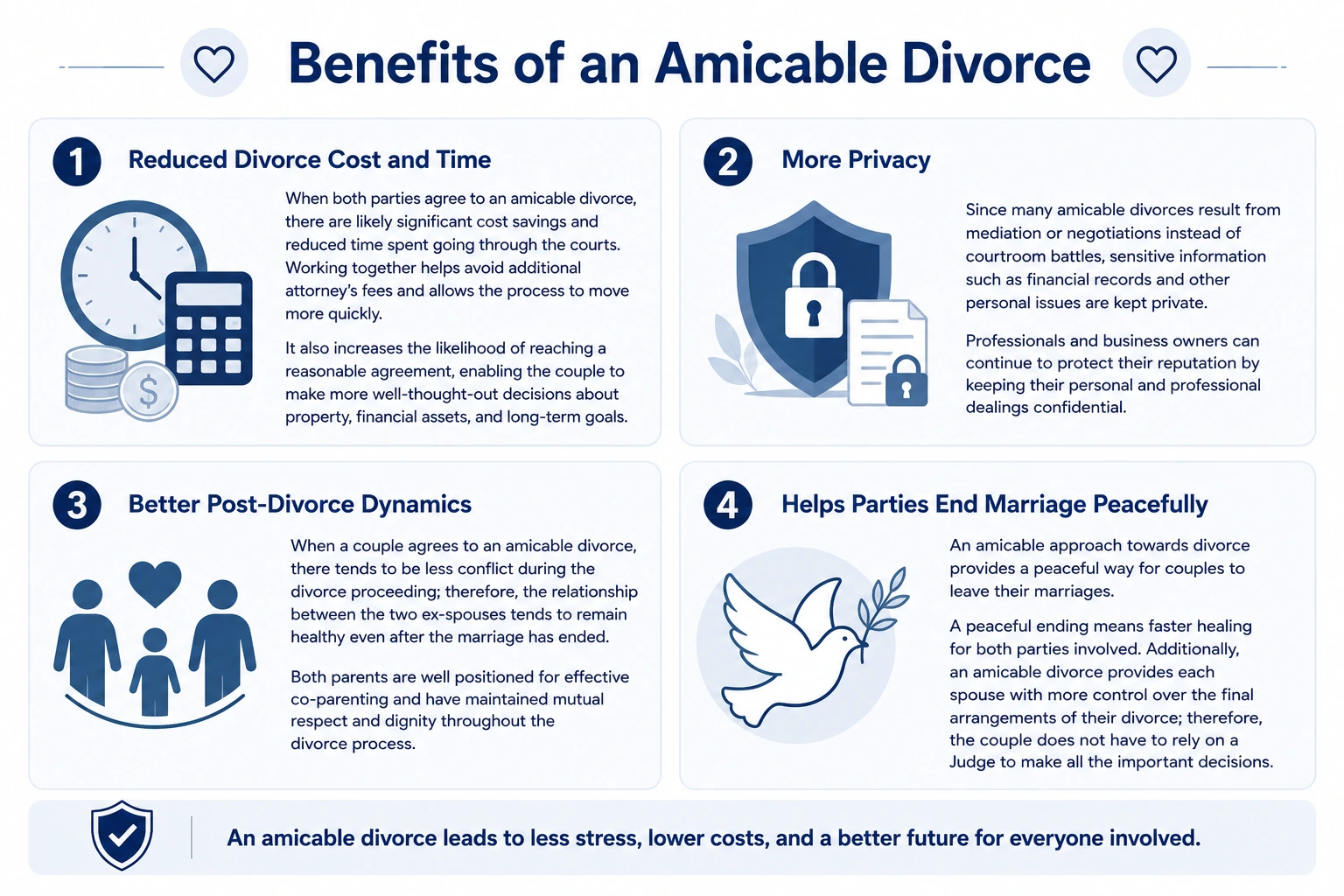
When both parties agree to an amicable divorce, there are likely significant cost savings and reduced time spent going through the courts. When working together, each party avoids paying additional attorney’s fees, which saves money and allows them to go through the process more quickly.
An additional advantage of working together is a much higher likelihood of reaching a reasonable agreement, enabling the couple to make more well-thought-out decisions about property, financial assets, and long-term goals.
Since many amicable divorces result from mediation or negotiations instead of courtroom battles, sensitive information such as financial records and other personal issues are kept private. Professionals and business owners can continue to protect their reputation by keeping their personal and professional dealings confidential.
When a couple agrees to an amicable divorce, there tends to be less conflict during the divorce proceeding; therefore, the relationship between the two ex-spouses tends to remain healthy even after the marriage has ended. Both parents are well positioned for effective co-parenting and have maintained mutual respect and dignity throughout the divorce process.
An amicable approach towards divorce provides a peaceful way for couples to leave their marriages. A peaceful ending means faster healing for both parties involved. Additionally, an amicable divorce provides each spouse with more control over the final arrangements of their divorce; therefore, the couple does not have to rely on a Judge to make all the important decisions.
An amicable divorce is simply more than a nice way of saying “we are getting divorced.” It’s one of the best financial decisions for the divorce process.
By avoiding malicious legal battles, couples can typically finalize their divorce status much quicker, avoid potentially large long-term debts created by attorneys’ fees, etc.
For $49.99/month, couples seeking amicable/uncontested divorces use The Complete Divorce‘s court-ready documents/forms, attend expert-led strategy sessions, and have access to ongoing support.
Choose The Complete Divorce for a more seamless divorce process throughout!

Divorce Attorney — Mediator & Founder of The Complete Divorce
“Hi. I’m Dina Haddad, a divorce attorney-mediator here in California. I’m so tired of couples not having a process that’s easy to complete their divorce. They are getting lost, wasting time and money, and beyond frustrated with their results.
That’s why I created The Complete Divorce, California’s premier online divorce program. I took my successful mediation practice and condensed it into an affordable and winning program.”
One of the most effective methods for qualified couples to begin an amicable divorce is through filing a joint petition (FL-700). A joint petition allows spouses to submit their divorce jointly instead of serving each other with divorce papers.
No, you do not have to. While California is a community property state, spouses are usually free to enter into a mutually agreed-upon settlement agreement pertaining to the distribution of assets and debts, so long as the terms of the agreement are reasonable and acceptable to the judge.
The amicable divorce starts when both spouses agree to collaborate and settle any major disputes out of court.
From there, you would need to submit all necessary paperwork, exchange financial disclosure statements, negotiate a settlement agreement, and submit all court documents.
If you complete this prior to 6 months from when you filed, your judgment for divorce may be entered before your marital status dissolves.
In most instances, spouses will be able to modify a settlement before a final judgment. If the divorce has become final, then modifications may be possible depending on the specific circumstances surrounding that issue (i.e. child custody and/or support).
If you and your spouse choose to reconcile before the divorce becomes final, you may be able to either suspend or terminate the case.
Which course of action is best suited will depend on where your case stands at that time and whether a final judgment has yet been entered.
California premier divorce program.
Making California divorce simple and lawyer-free.
 ⭐⭐⭐⭐⭐
⭐⭐⭐⭐⭐
2000+ divorced without a lawyer.